Norway Nutritional And Performance Drinks Market Top 5 Importing Countries and Market Competition (HHI) Analysis
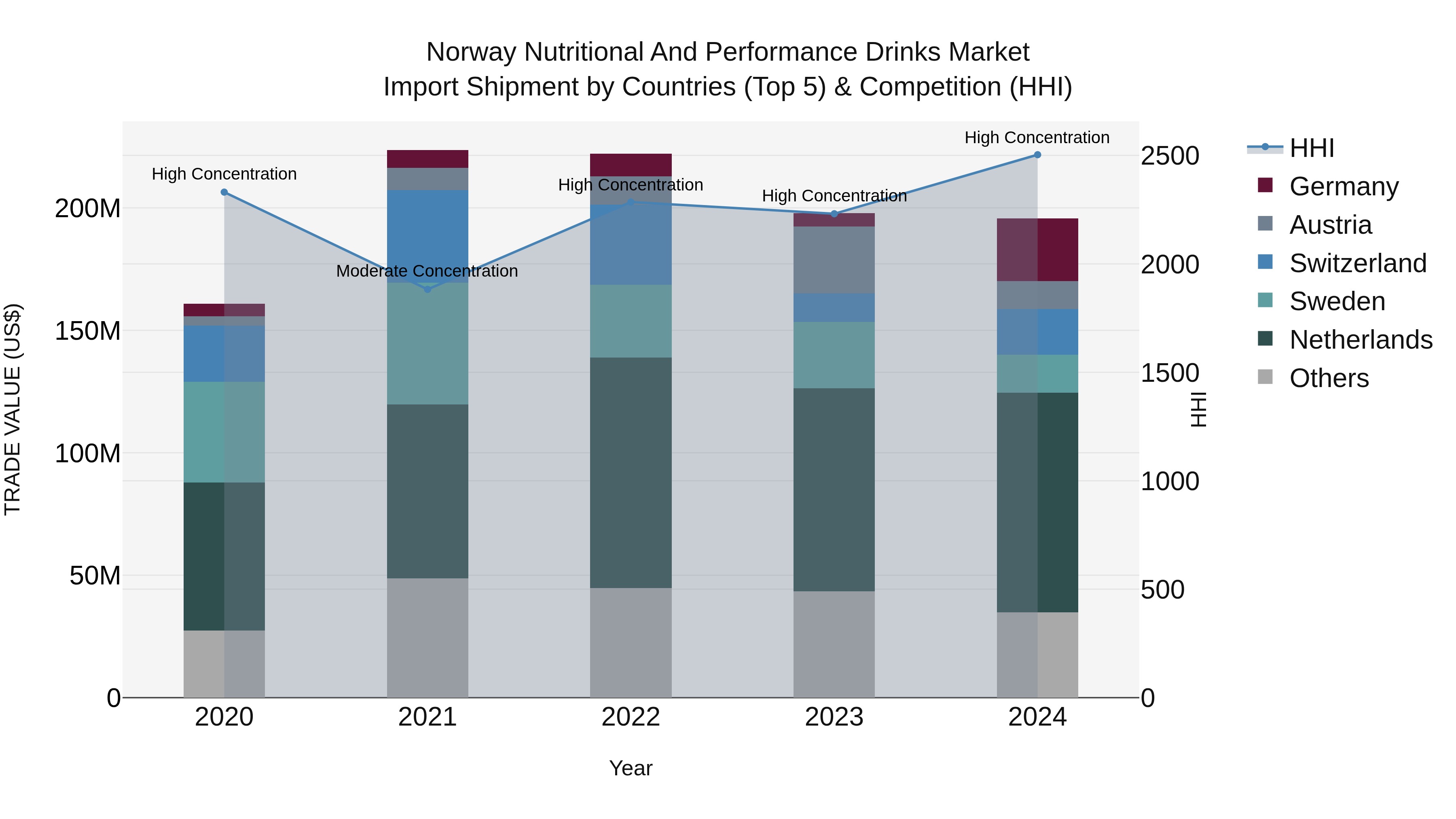
Norway continues to see a steady increase in the import of nutritional and performance drinks, with the top exporting countries being Netherlands, Germany, Switzerland, Sweden, and Austria in 2024. The market shows high concentration with a high Herfindahl-Hirschman Index (HHI), indicating a competitive landscape. The compound annual growth rate (CAGR) from 2020 to 2024 stands at a healthy 5.02%, although there was a slight decline in growth from 2023 to 2024 at -1.12%. This suggests a stable market with opportunities for continued growth and competition among key players.
Key Highlights of the Report:
- Norway Nutritional and Performance Drinks Market Outlook
- Market Size of Norway Nutritional and Performance Drinks Market, 2025
- Forecast of Norway Nutritional and Performance Drinks Market, 2032
- Historical Data and Forecast of Norway Nutritional and Performance Drinks Revenues & Volume for the Period 2022 - 2032F
- Norway Nutritional and Performance Drinks Market Trend Evolution
- Norway Nutritional and Performance Drinks Market Drivers and Challenges
- Norway Nutritional and Performance Drinks Price Trends
- Norway Nutritional and Performance Drinks Porter's Five Forces
- Norway Nutritional and Performance Drinks Industry Life Cycle
- Historical Data and Forecast of Norway Nutritional and Performance Drinks Market Revenues & Volume By Type for the Period 2022 - 2032F
- Historical Data and Forecast of Norway Nutritional and Performance Drinks Market Revenues & Volume By Energy Drinks for the Period 2022 - 2032F
- Historical Data and Forecast of Norway Nutritional and Performance Drinks Market Revenues & Volume By Protein Shakes for the Period 2022 - 2032F
- Historical Data and Forecast of Norway Nutritional and Performance Drinks Market Revenues & Volume By Functional Beverages for the Period 2022 - 2032F
- Historical Data and Forecast of Norway Nutritional and Performance Drinks Market Revenues & Volume By Vitamin Water for the Period 2022 - 2032F
- Historical Data and Forecast of Norway Nutritional and Performance Drinks Market Revenues & Volume By Application Area for the Period 2022 - 2032F
- Historical Data and Forecast of Norway Nutritional and Performance Drinks Market Revenues & Volume By Sports Nutrition for the Period 2022 - 2032F
- Historical Data and Forecast of Norway Nutritional and Performance Drinks Market Revenues & Volume By Meal Replacement for the Period 2022 - 2032F
- Historical Data and Forecast of Norway Nutritional and Performance Drinks Market Revenues & Volume By Immune Support for the Period 2022 - 2032F
- Historical Data and Forecast of Norway Nutritional and Performance Drinks Market Revenues & Volume By Hydration for the Period 2022 - 2032F
- Historical Data and Forecast of Norway Nutritional and Performance Drinks Market Revenues & Volume By End User for the Period 2022 - 2032F
- Historical Data and Forecast of Norway Nutritional and Performance Drinks Market Revenues & Volume By Athletes for the Period 2022 - 2032F
- Historical Data and Forecast of Norway Nutritional and Performance Drinks Market Revenues & Volume By Fitness Enthusiasts for the Period 2022 - 2032F
- Historical Data and Forecast of Norway Nutritional and Performance Drinks Market Revenues & Volume By General Consumers for the Period 2022 - 2032F
- Historical Data and Forecast of Norway Nutritional and Performance Drinks Market Revenues & Volume By Office Workers for the Period 2022 - 2032F
- Historical Data and Forecast of Norway Nutritional and Performance Drinks Market Revenues & Volume By Product Type for the Period 2022 - 2032F
- Historical Data and Forecast of Norway Nutritional and Performance Drinks Market Revenues & Volume By Electrolyte Drinks for the Period 2022 - 2032F
- Historical Data and Forecast of Norway Nutritional and Performance Drinks Market Revenues & Volume By Whey-Based Drinks for the Period 2022 - 2032F
- Historical Data and Forecast of Norway Nutritional and Performance Drinks Market Revenues & Volume By Herbal Infusions for the Period 2022 - 2032F
- Historical Data and Forecast of Norway Nutritional and Performance Drinks Market Revenues & Volume By Antioxidant Drinks for the Period 2022 - 2032F
- Norway Nutritional and Performance Drinks Import Export Trade Statistics
- Market Opportunity Assessment By Type
- Market Opportunity Assessment By Application Area
- Market Opportunity Assessment By End User
- Market Opportunity Assessment By Product Type
- Norway Nutritional and Performance Drinks Top Companies Market Share
- Norway Nutritional and Performance Drinks Competitive Benchmarking By Technical and Operational Parameters
- Norway Nutritional and Performance Drinks Company Profiles
- Norway Nutritional and Performance Drinks Key Strategic Recommendations






































