Norway Plastic Bottles Market Growth Rate Analysis (2021 - 2031)
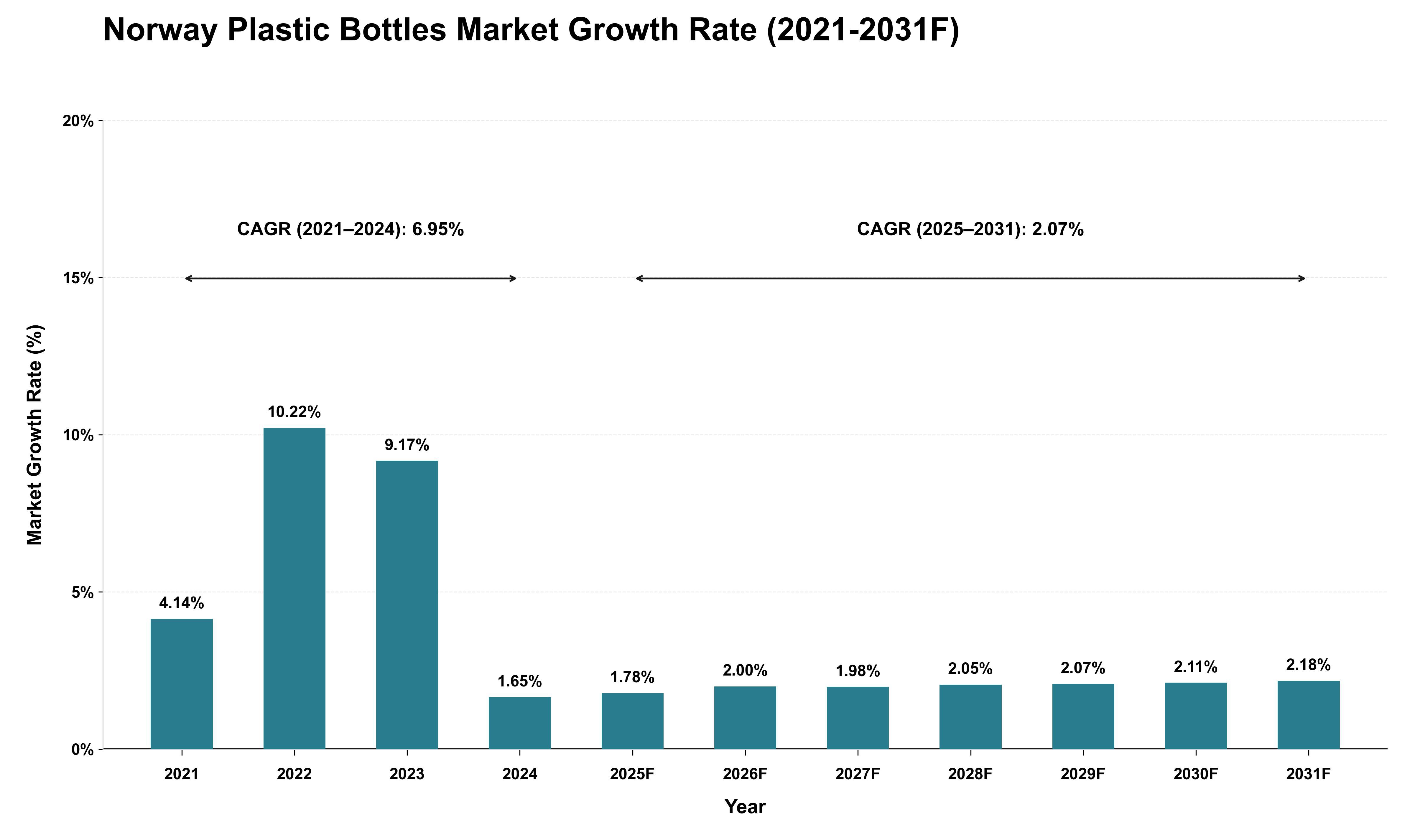
Between 2021 and 2024, the Norwegian plastic bottles market experienced a robust CAGR of 6.95%, driven by post-pandemic recovery in consumer demand and increased reliance on packaged goods, particularly in the beverage sector. The annual growth peaked in 2022 at 10.22%, reflecting heightened import activity as global supply chains began to stabilize following disruptions from the COVID-19 pandemic. However, by 2024, growth decelerated to just 1.65%, indicative of a shift towards more sustainable packaging solutions and regulatory pressures impacting plastic usage. Looking ahead to 2025-2031, the forecasted CAGR of 2.07% suggests a gradual stabilization as Norway continues to adapt its import strategies amidst evolving environmental policies and global commodity price fluctuations. This period will likely see incremental growth driven by innovation in recycling technologies and shifts towards alternative materials while maintaining a steady demand for plastic bottles within established markets.
Key Highlights of the Report:
- Norway Plastic Bottles Market Outlook
- Market Size of Norway Plastic Bottles Market, 2024
- Forecast of Norway Plastic Bottles Market, 2031
- Historical Data and Forecast of Norway Plastic Bottles Revenues & Volume for the Period 2021-2031
- Norway Plastic Bottles Market Trend Evolution
- Norway Plastic Bottles Market Drivers and Challenges
- Norway Plastic Bottles Price Trends
- Norway Plastic Bottles Porter`s Five Forces
- Norway Plastic Bottles Industry Life Cycle
- Historical Data and Forecast of Norway Plastic Bottles Market Revenues & Volume By Raw Material Type for the Period 2021-2031
- Historical Data and Forecast of Norway Plastic Bottles Market Revenues & Volume By Polyethylene Terephthalate (PET) for the Period 2021-2031
- Historical Data and Forecast of Norway Plastic Bottles Market Revenues & Volume By Poly Propylene (PP) for the Period 2021-2031
- Historical Data and Forecast of Norway Plastic Bottles Market Revenues & Volume By Low-density Polyethylene (LDPE) for the Period 2021-2031
- Historical Data and Forecast of Norway Plastic Bottles Market Revenues & Volume By High-density Polyethylene (HDPE) for the Period 2021-2031
- Historical Data and Forecast of Norway Plastic Bottles Market Revenues & Volume By Other Raw Materials for the Period 2021-2031
- Historical Data and Forecast of Norway Plastic Bottles Market Revenues & Volume By End-user for the Period 2021-2031
- Historical Data and Forecast of Norway Plastic Bottles Market Revenues & Volume By Beverage for the Period 2021-2031
- Historical Data and Forecast of Norway Plastic Bottles Market Revenues & Volume By Food for the Period 2021-2031
- Historical Data and Forecast of Norway Plastic Bottles Market Revenues & Volume By Cosmetics for the Period 2021-2031
- Historical Data and Forecast of Norway Plastic Bottles Market Revenues & Volume By Pharmaceutical for the Period 2021-2031
- Historical Data and Forecast of Norway Plastic Bottles Market Revenues & Volume By Household Care for the Period 2021-2031
- Historical Data and Forecast of Norway Plastic Bottles Market Revenues & Volume By Other for the Period 2021-2031
- Norway Plastic Bottles Import Export Trade Statistics
- Market Opportunity Assessment By Raw Material Type
- Market Opportunity Assessment By End-user
- Norway Plastic Bottles Top Companies Market Share
- Norway Plastic Bottles Competitive Benchmarking By Technical and Operational Parameters
- Norway Plastic Bottles Company Profiles
- Norway Plastic Bottles Key Strategic Recommendations






































