Norway Polyisobutylene Market Top 5 Importing Countries and Market Competition (HHI) Analysis
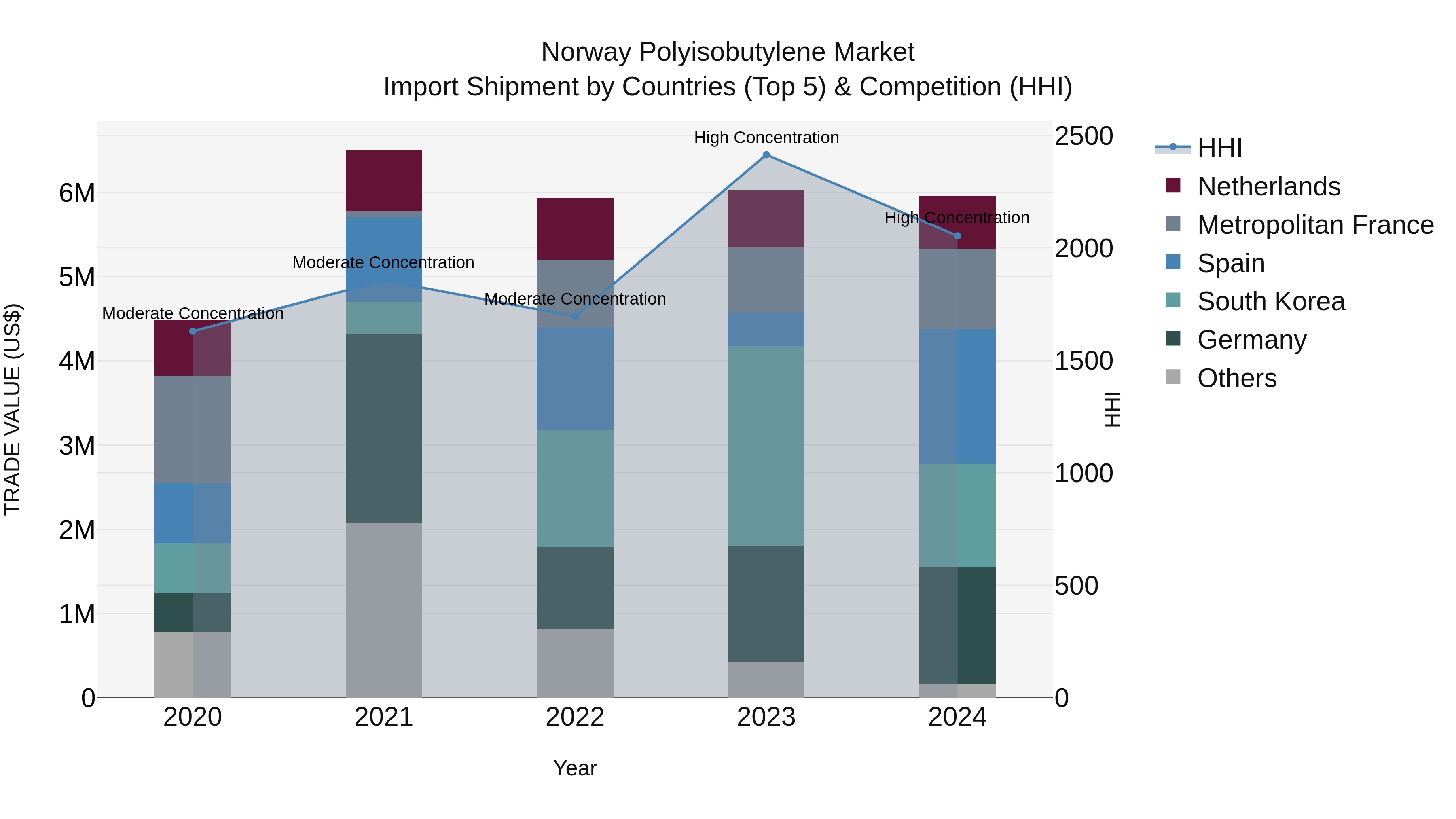
Norway`s polyisobutylene import market in 2024 continued to be dominated by key exporting countries such as Spain, Germany, South Korea, Metropolitan France, and the Netherlands. Despite a slight decrease in growth rate from 2023 to 2024, the compound annual growth rate (CAGR) over the period of 2020-2024 remained strong at 7.33%. The high Herfindahl-Hirschman Index (HHI) suggests a concentrated market landscape, with these top exporting countries maintaining significant market share. Overall, Norway`s polyisobutylene import sector is showing steady growth and continued reliance on key trading partners.
Polyisobutylene Market: Norway vs Top 5 Major Economies in 2027 (Europe)
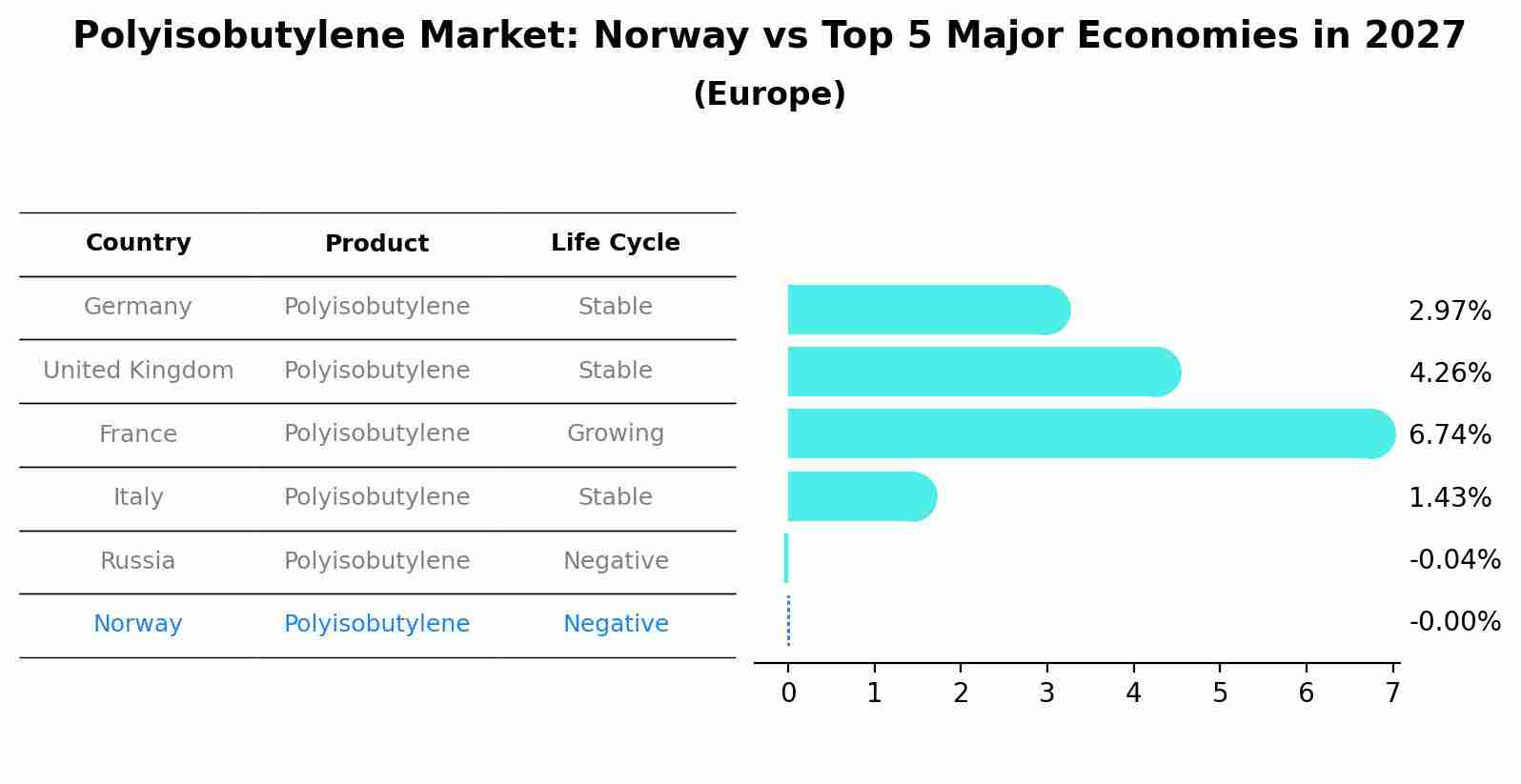
By 2027, the Polyisobutylene market in Norway is anticipated to reach a growth rate of -0.00%, as part of an increasingly competitive Europe region, where Germany remains at the forefront, supported by United Kingdom, France, Italy and Russia, driving innovations and market adoption across sectors.
Norway Polyisobutylene Market Overview
The Norway polyisobutylene market is characterized by its use in various industrial applications due to its excellent chemical resistance, low permeability to gases, and flexible properties. Polyisobutylene is widely utilized in the production of lubricants, adhesives, and sealants. The market is driven by demand in the automotive and construction industries, where polyisobutylene`s properties enhance the durability and performance of products. However, the market faces challenges related to fluctuations in raw material prices and environmental regulations affecting production processes.
Drivers of the market
The Norway Polyisobutylene market is primarily driven by the demand for high-performance materials in the automotive and construction industries. Polyisobutylene`s use in automotive sealing applications and as a fuel additive significantly contributes to its market growth. Additionally, the increasing focus on reducing vehicle emissions and enhancing fuel efficiency supports the demand for this polymer. The versatility of polyisobutylene, including its use in adhesives and coatings, further drives its market potential.
Challenges of the market
The Norway polyisobutylene market faces challenges related to fluctuating raw material prices. As polyisobutylene is derived from isobutylene, which is a byproduct of the oil and gas industry, any volatility in crude oil prices can directly impact production costs. Additionally, the market is constrained by the limited number of local producers, which can lead to supply shortages and increased prices. Regulatory pressures for environmental sustainability are also significant, as polyisobutylene production involves processes that need to comply with strict environmental standards. The high cost of implementing these standards can deter new entrants and strain existing producers.
Government Policy of the market
The Norwegian government has implemented several policies to support the polyisobutylene market, particularly focusing on environmental regulations and sustainable practices. Regulations are in place to ensure that polyisobutylene production and usage adhere to strict environmental standards. These policies aim to reduce the carbon footprint of production processes and promote the use of eco-friendly technologies. Additionally, there are incentives for companies adopting green practices, such as tax breaks and grants for research and development in sustainable polyisobutylene applications.
Key Highlights of the Report:
- Norway Polyisobutylene Market Outlook
- Market Size of Norway Polyisobutylene Market, 2024
- Forecast of Norway Polyisobutylene Market, 2031
- Historical Data and Forecast of Norway Polyisobutylene Revenues & Volume for the Period 2021-2031
- Norway Polyisobutylene Market Trend Evolution
- Norway Polyisobutylene Market Drivers and Challenges
- Norway Polyisobutylene Price Trends
- Norway Polyisobutylene Porter`s Five Forces
- Norway Polyisobutylene Industry Life Cycle
- Historical Data and Forecast of Norway Polyisobutylene Market Revenues & Volume By Molecular Weight for the Period 2021-2031
- Historical Data and Forecast of Norway Polyisobutylene Market Revenues & Volume By Low Molecular Weight Polyisobutylene for the Period 2021-2031
- Historical Data and Forecast of Norway Polyisobutylene Market Revenues & Volume By Medium Molecular Weight Polyisobutylene for the Period 2021-2031
- Historical Data and Forecast of Norway Polyisobutylene Market Revenues & Volume By High Molecular Weight Polyisobutylene for the Period 2021-2031
- Historical Data and Forecast of Norway Polyisobutylene Market Revenues & Volume By Product for the Period 2021-2031
- Historical Data and Forecast of Norway Polyisobutylene Market Revenues & Volume By C-PIB for the Period 2021-2031
- Historical Data and Forecast of Norway Polyisobutylene Market Revenues & Volume By HR-PIB for the Period 2021-2031
- Historical Data and Forecast of Norway Polyisobutylene Market Revenues & Volume By Application for the Period 2021-2031
- Historical Data and Forecast of Norway Polyisobutylene Market Revenues & Volume By Tires for the Period 2021-2031
- Historical Data and Forecast of Norway Polyisobutylene Market Revenues & Volume By Lube Additives for the Period 2021-2031
- Historical Data and Forecast of Norway Polyisobutylene Market Revenues & Volume By Fuel Additives for the Period 2021-2031
- Historical Data and Forecast of Norway Polyisobutylene Market Revenues & Volume By 2-stroke Engines for the Period 2021-2031
- Historical Data and Forecast of Norway Polyisobutylene Market Revenues & Volume By Industrial Lubes & Others for the Period 2021-2031
- Historical Data and Forecast of Norway Polyisobutylene Market Revenues & Volume By Adhesives & Sealants for the Period 2021-2031
- Historical Data and Forecast of Norway Polyisobutylene Market Revenues & Volume By End-use Industry for the Period 2021-2031
- Historical Data and Forecast of Norway Polyisobutylene Market Revenues & Volume By Transportation for the Period 2021-2031
- Historical Data and Forecast of Norway Polyisobutylene Market Revenues & Volume By Industrial for the Period 2021-2031
- Historical Data and Forecast of Norway Polyisobutylene Market Revenues & Volume By Food for the Period 2021-2031
- Historical Data and Forecast of Norway Polyisobutylene Market Revenues & Volume By Others for the Period 2021-2031
- Norway Polyisobutylene Import Export Trade Statistics
- Market Opportunity Assessment By Molecular Weight
- Market Opportunity Assessment By Product
- Market Opportunity Assessment By Application
- Market Opportunity Assessment By End-use Industry
- Norway Polyisobutylene Top Companies Market Share
- Norway Polyisobutylene Competitive Benchmarking By Technical and Operational Parameters
- Norway Polyisobutylene Company Profiles
- Norway Polyisobutylene Key Strategic Recommendations






































