Norway Wax Market Top 5 Importing Countries and Market Competition (HHI) Analysis
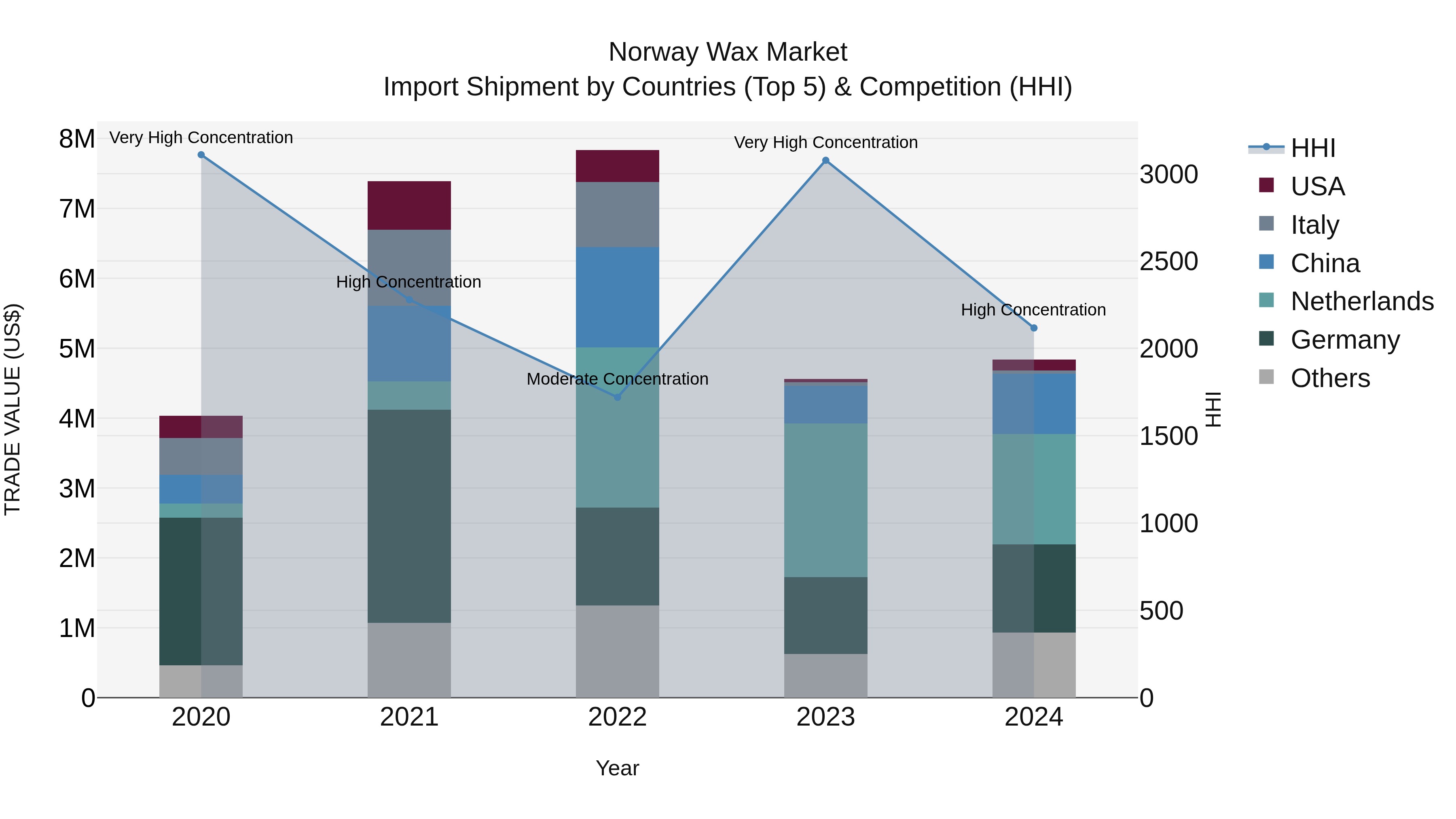
Norway`s wax import market continues to show steady growth, with a notable increase in concentration among top exporting countries in 2024. The Netherlands, Germany, China, Malaysia, and the USA are key players in supplying wax to Norway. The high Herfindahl-Hirschman Index (HHI) suggests a competitive market landscape, while the impressive Compound Annual Growth Rate (CAGR) of 4.65% from 2020 to 2024 indicates sustained expansion. Moreover, the growth rate of 6.07% from 2023 to 2024 highlights a promising outlook for the industry, signaling potential opportunities for market players and investors.
Norway Wax Market Overview
The wax market in Norway is diverse, catering to various industries such as cosmetics, pharmaceuticals, and packaging. Demand for natural and environmentally friendly wax products is on the rise, driven by consumer preferences for sustainable materials. Innovations in production processes and the introduction of bio-based waxes are shaping the market landscape, offering new opportunities for manufacturers and suppliers.
Drivers of the market
The Norway wax market is influenced by a rising demand for eco-friendly and sustainable wax products across various applications, including cosmetics, packaging, and food. As consumers become more environmentally conscious, manufacturers are increasingly focusing on bio-based and natural wax alternatives, driving innovation in product offerings. Furthermore, the expanding cosmetics and personal care industry in Norway supports the growth of the wax market, as these products often utilize wax for texture and stability.
Challenges of the market
In the Norwegian wax market, challenges stem from fluctuating raw material prices and competition from alternative materials. The volatility in the prices of natural waxes and synthetic alternatives can significantly affect profit margins. Additionally, consumer preferences are shifting towards sustainable and eco-friendly products, pressuring manufacturers to innovate while managing costs. Furthermore, the market faces regulatory challenges related to health and safety standards, which can lead to increased compliance costs.
Government Policy of the market
The Norwegian wax market is influenced by regulations aimed at sustainability and environmental protection. Policies encourage the use of bio-based and environmentally friendly wax products. The government supports initiatives that promote innovation in production methods and the development of new applications for waxes, aligning with broader goals of reducing carbon footprints and promoting circular economy practices.
Key Highlights of the Report:
- Norway Wax Market Outlook
- Market Size of Norway Wax Market, 2024
- Forecast of Norway Wax Market, 2031
- Historical Data and Forecast of Norway Wax Revenues & Volume for the Period 2021-2031
- Norway Wax Market Trend Evolution
- Norway Wax Market Drivers and Challenges
- Norway Wax Price Trends
- Norway Wax Porter`s Five Forces
- Norway Wax Industry Life Cycle
- Historical Data and Forecast of Norway Wax Market Revenues & Volume By Product for the Period 2021-2031
- Historical Data and Forecast of Norway Wax Market Revenues & Volume By Mineral for the Period 2021-2031
- Historical Data and Forecast of Norway Wax Market Revenues & Volume By Synthetic for the Period 2021-2031
- Historical Data and Forecast of Norway Wax Market Revenues & Volume By Natural for the Period 2021-2031
- Historical Data and Forecast of Norway Wax Market Revenues & Volume By Applications for the Period 2021-2031
- Historical Data and Forecast of Norway Wax Market Revenues & Volume By Candles for the Period 2021-2031
- Historical Data and Forecast of Norway Wax Market Revenues & Volume By Packaging for the Period 2021-2031
- Historical Data and Forecast of Norway Wax Market Revenues & Volume By Plastic & Rubber for the Period 2021-2031
- Historical Data and Forecast of Norway Wax Market Revenues & Volume By Cosmetics & Toiletries for the Period 2021-2031
- Historical Data and Forecast of Norway Wax Market Revenues & Volume By Fire Logs for the Period 2021-2031
- Historical Data and Forecast of Norway Wax Market Revenues & Volume By Adhesives for the Period 2021-2031
- Historical Data and Forecast of Norway Wax Market Revenues & Volume By Others for the Period 2021-2031
- Norway Wax Import Export Trade Statistics
- Market Opportunity Assessment By Product
- Market Opportunity Assessment By Applications
- Norway Wax Top Companies Market Share
- Norway Wax Competitive Benchmarking By Technical and Operational Parameters
- Norway Wax Company Profiles
- Norway Wax Key Strategic Recommendations






































