Oman Metal Fabrication Market Size, Share & Growth Rate
The Oman Metal Fabrication Market was estimated at USD 217 Million in 2025 and is projected to reach USD 299 Million by 2032, growing at a CAGR of 4.7% from 2026 to 2032. This growth trajectory is significantly fueled by the nations robust investments in construction and infrastructure projects. Additionally, the increasing urbanization across Oman, coupled with the demand from key sectors such as automotive and aerospace, is creating a favorable environment for metal fabrication services.
Oman Metal Fabrication Market Year-wise Growth Rate and Key Drivers
This graph highlights how the Oman Metal Fabrication Market has steadily grown over the years, supported by major growth factors.
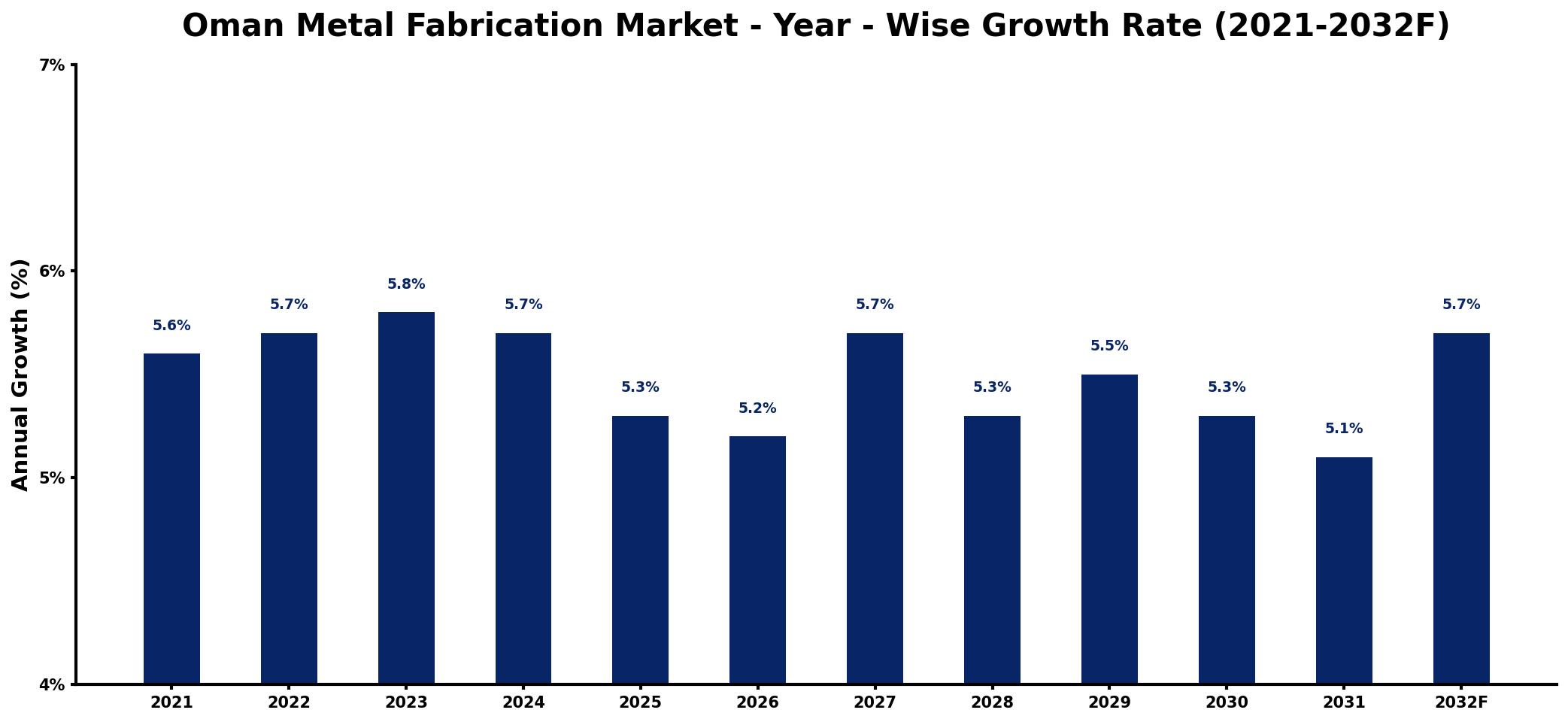
The table below presents the year‑wise growth rates along with the key drivers influencing the market
| Year | Growth Rate | Major Drivers |
| 2021 | 5.6% | Increased construction sector investments |
| 2022 | 5.7% | Growing demand from energy industry |
| 2023 | 5.8% | Expansion of industrial infrastructure projects |
| 2024 | 5.7% | Rising automotive manufacturing activities |
| 2025 | 5.3% | Higher investments in renewable energy |
| 2026 | 5.2% | Boost in residential development projects |
| 2027 | 5.7% | Surge in transportation sector demand |
| 2028 | 5.3% | Increased focus on export markets |
| 2029 | 5.5% | Growing need for customized solutions |
| 2030 | 5.3% | Rise in government infrastructure spending |
| 2031 | 5.1% | rising procurement volume requirements |
| 2032 | 5.7% | Increased automation in manufacturing processes |
Note: Market size estimations and growth projections presented in this report are based on 6Wresearch's proprietary forecasting methodology, utilizing the latest available industry data, government publications, and primary research inputs.
Oman Metal Fabrication Market Synopsis
Currently, Omans metal fabrication market is witnessing a transformative phase, characterized by rapid infrastructure development and an accelerating push for industrial diversification. This dynamic sector plays a critical role in enhancing the country's economic landscape by supporting various industries that rely on fabricated metal products.
Amidst strategic investments in both public and private sectors, the metal fabrication market has become increasingly vital. A growing focus on local manufacturing, in conjunction with initiatives to foster advanced technological adoption, marks a significant evolution in the industrys capabilities and output.
Oman Metal Fabrication Market Key Takeaways
- Strong growth projected due to infrastructure investment and urbanization.
- Increased demand for metal fabrication across multiple industries enhances market viability.
- Government policies aim to bolster local manufacturing and skill development.
- Challenges include raw material costs and competition from imports.
- Emerging opportunities are present in advanced technologies and export markets.
Evaluation of Restraints in Oman Metal Fabrication Market
The Oman metal fabrication market faces several constraints that hinder its full potential. One significant challenge is the high cost of raw materials, which can negatively impact pricing and profitability for local fabricators. Furthermore, there exists a pressing shortage of skilled labor, as the sector requires specialized expertise that is currently in limited supply. Additionally, the competition posed by low-cost imports can undermine local businesses, making it essential for Omani fabricators to differentiate their offerings. Finally, regulatory changes can introduce complexities that influence operational efficiencies and market dynamics.
Oman Metal Fabrication Market Trends
Key trends shaping the Oman metal fabrication market include a significant shift towards automation and the integration of advanced technologies in manufacturing processes. This transition is not only enhancing productivity but also improving precision in fabricated products. Furthermore, sustainability is gaining traction, with an increasing focus on environmentally friendly practices, as companies seek to minimize waste and energy consumption.
The rise of digitalization within the sector is also noteworthy, as companies leverage data analytics to optimize operations and better meet client demands. Additionally, collaboration between local and international firms is emerging as a strategy to boost technological transfer and capability development.
Oman Metal Fabrication Market Opportunities
There are numerous growth opportunities within the Oman metal fabrication market, particularly in the realm of advanced fabrication technologies. Investment in Research & Development (R&D) is critical to drive innovation and elevate the quality of fabricated products. Moreover, the ongoing urbanization and infrastructure initiatives provide a fertile ground for new projects, enabling fabricators to expand their client base and enhance product offerings. Export opportunities are also increasing as Omani fabricators look beyond regional markets to penetrate international territories.
Government Initiatives in the Oman Metal Fabrication Market
The government of Oman is actively promoting the metal fabrication market through various supportive policies aimed at enhancing local manufacturing capabilities. Initiatives by the Ministry of Commerce, Industry and Investment Promotion focus on providing incentives to businesses that invest in advanced fabrication technologies. Moreover, there is a strong emphasis on skills development, which aims to bridge the gap in the labor market and ensure a steady pipeline of qualified professionals in the sector. Public spending on infrastructure projects further bolsters the market's growth, reflecting a commitment to economic diversification.
Future Insights of the Oman Metal Fabrication Market
Looking ahead to 2026-2032, the Oman metal fabrication market is set to experience substantial growth driven by continued investments in infrastructure and urban development. The increasing integration of smart technologies and automation will likely enhance operational efficiencies, positioning Oman as a competitive player in the regional market. Furthermore, sustained government support for local manufacturing and a push for exports will open new avenues for growth, making the next several years critical for stakeholders in the metal fabrication industry.
Oman Metal Fabrication Market Latest Developments (2025 - 2026)
Recent developments in the Oman metal fabrication market indicate a strong trend towards modernization, with several companies adopting cutting-edge technologies to streamline operations. Investments in digital solutions are also on the rise as businesses seek to improve productivity and maintain competitive edges. Moreover, partnerships between local firms and international players are facilitating knowledge exchange and bolstering the technological capabilities of the sector. This collaborative approach is expected to further enhance the market landscape in the coming years.
Oman Metal Fabrication Market - Key Attractiveness of the Report
- 10 Years of Market Numbers
- Historical Data Starting from 2022 to 2025
- Base Year: 2025
- Forecast Data until 2032
- Key Performance Indicators Impacting the Market
- Major Upcoming Developments and Projects
Key Highlights of the Report:
- Oman Metal Fabrication Market Outlook
- Market Size of Oman Metal Fabrication Market, 2025
- Forecast of Oman Metal Fabrication Market, 2032
- Historical Data and Forecast of Oman Metal Fabrication Revenues & Volume for the Period 2022-2032F
- Oman Metal Fabrication Market Trend Evolution
- Oman Metal Fabrication Market Drivers and Challenges
- Oman Metal Fabrication Price Trends
- Oman Metal Fabrication Porter's Five Forces
- Oman Metal Fabrication Industry Life Cycle
- Historical Data and Forecast of Oman Metal Fabrication Market Revenues & Volume By End-user Industry for the Period 2022-2032F
- Historical Data and Forecast of Oman Metal Fabrication Market Revenues & Volume By Manufacturing for the Period 2022-2032F
- Historical Data and Forecast of Oman Metal Fabrication Market Revenues & Volume By Power and Utilities for the Period 2022-2032F
- Historical Data and Forecast of Oman Metal Fabrication Market Revenues & Volume By Construction for the Period 2022-2032F
- Historical Data and Forecast of Oman Metal Fabrication Market Revenues & Volume By Oil and Gas for the Period 2022-2032F
- Historical Data and Forecast of Oman Metal Fabrication Market Revenues & Volume By Other End-user Industries for the Period 2022-2032F
- Historical Data and Forecast of Oman Metal Fabrication Market Revenues & Volume By Metal Folding for the Period 2022-2032F
- Historical Data and Forecast of Oman Metal Fabrication Market Revenues & Volume By Product category for the Period 2022-2032F
- Historical Data and Forecast of Oman Metal Fabrication Market Revenues & Volume By Structural steel fabrication for the Period 2022-2032F
- Historical Data and Forecast of Oman Metal Fabrication Market Revenues & Volume By Process Equipment Fabrication for the Period 2022-2032F
- Oman Metal Fabrication Import Export Trade Statistics
- Market Opportunity Assessment By End-user Industry
- Market Opportunity Assessment By Product category
- Oman Metal Fabrication Top Companies Market Share
- Oman Metal Fabrication Competitive Benchmarking By Technical and Operational Parameters
- Oman Metal Fabrication Company Profiles
- Oman Metal Fabrication Key Strategic Recommendations






































