Oman Power Generation Market Size, Share & Growth Rate
The Oman Power Generation Market was estimated at USD 483 Million in 2025 and is projected to reach USD 654 Million by 2032, growing at a CAGR of 4.4% from 2026 to 2032. This positive trajectory is primarily fueled by a surge in electricity demand linked to rapid economic growth and population expansion. Additionally, government initiatives aimed at diversifying the energy mix, particularly through renewable resources, are reinforcing the market's expansion and sustainability goals.
Oman Power Generation Market Year-wise Growth Rate and Key Drivers
This graph highlights how the Oman Power Generation Market has steadily grown over the years, supported by major growth factors.
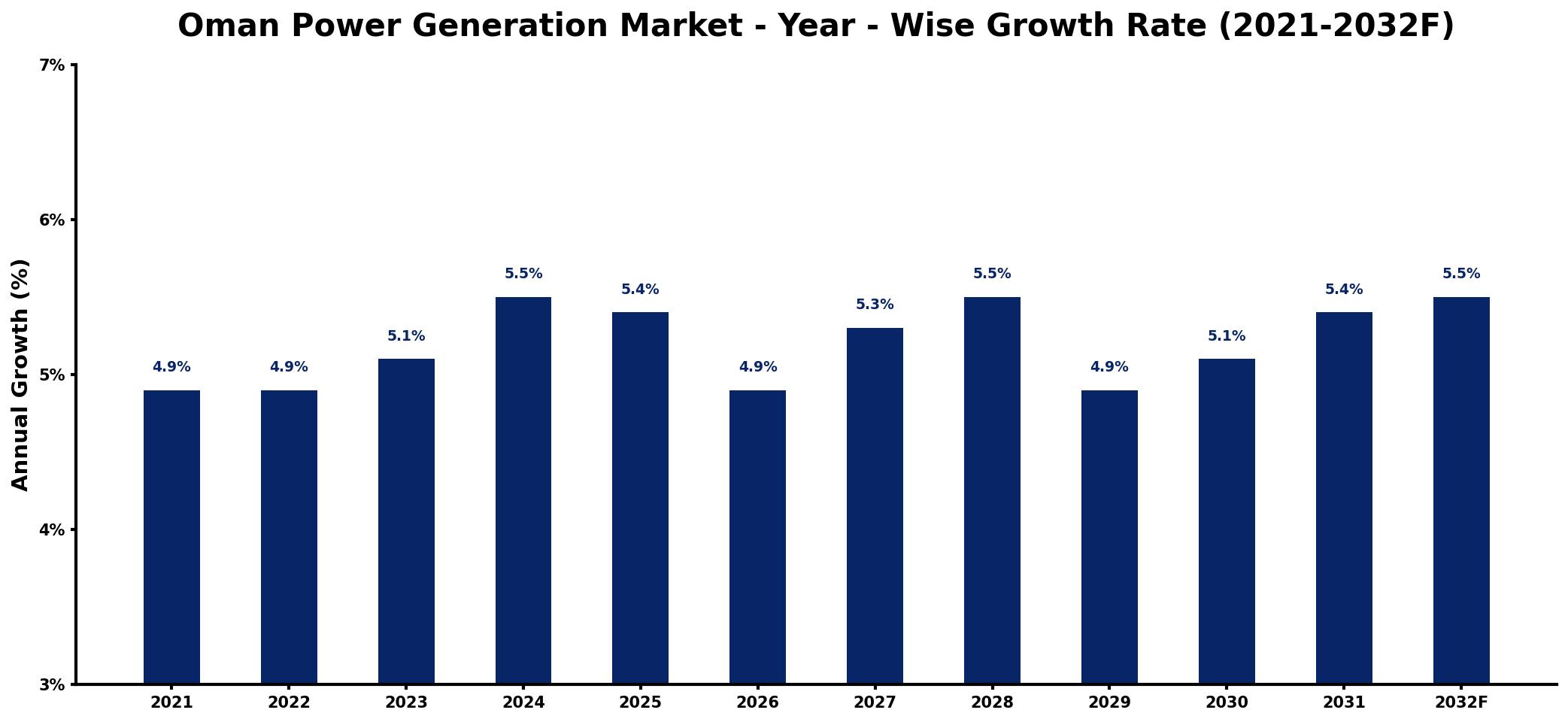
The table below presents the year‑wise growth rates along with the key drivers influencing the market
| Year | Growth Rate | Major Drivers |
| 2021 | 4.9% | Rising industrial energy demand |
| 2022 | 4.9% | Increased residential electricity consumption |
| 2023 | 5.1% | Growth in renewable energy investments |
| 2024 | 5.5% | Expansion of infrastructure projects |
| 2025 | 5.4% | Boost in commercial sector activities |
| 2026 | 4.9% | Surge in population energy needs |
| 2027 | 5.3% | Development of new energy policies |
| 2028 | 5.5% | Advancements in energy efficiency technologies |
| 2029 | 4.9% | Enhanced grid modernization efforts |
| 2030 | 5.1% | Demand for electric vehicle charging |
| 2031 | 5.4% | Increased foreign direct investments |
| 2032 | 5.5% | rising procurement volume requirements |
Note: Market size estimations and growth projections presented in this report are based on 6Wresearch's proprietary forecasting methodology, utilizing the latest available industry data, government publications, and primary research inputs.
Oman Power Generation Market Synopsis
Oman is undergoing significant energy transformation, with a notable shift toward renewable sources such as solar and wind power. The government has set an ambitious target of achieving 30% renewable energy in the national energy mix by 2030, marking a decisive move away from traditional fossil fuels.
In alignment with this transition, Oman's investments in smart grid technology are crucial for enhancing the efficiency and reliability of electricity distribution. As urbanization continues to escalate, meeting the increasing demand for electricity while ensuring sustainable practices will be pivotal for the nation's energy future.
Oman Power Generation Market Key Takeaways
- The market is experiencing robust growth driven by increasing electricity demands and strategic government policies.
- A notable shift toward renewable energy sources is reshaping the market landscape.
- Investment opportunities abound in energy storage solutions and smart grid technologies.
- Government initiatives are geared toward encouraging private sector participation in the energy market.
- Challenges persist in integrating renewables into the existing power grid while ensuring stability and reliability.
Evaluation of Restraints in Oman Power Generation Market
Despite the promising outlook, several constraints are hindering the growth of the Oman Power Generation Market. A primary concern is the necessity for substantial investment in infrastructure to support the increasing electricity demand. Additionally, the integration of renewable energy sources into the current power grid presents challenges, particularly in managing variability and ensuring a steady supply of electricity. Regulatory frameworks must also adapt to facilitate smoother transitions to renewable solutions while maintaining market stability.
Oman Power Generation Market Trends
The current trend in the Oman Power Generation Market centers around the accelerated deployment of renewable energy technologies, with solar and wind emerging as significant contributors. Enhanced interest in energy storage solutions is being witnessed, which will be vital for achieving grid reliability amidst the integration of intermittent renewable sources. Moreover, the development of smart grids is gaining traction, driven by advancements in digital technology aimed at optimizing efficiency and managing energy distribution effectively.
Oman Power Generation Market Opportunities
The transition towards renewable energy presents lucrative investment opportunities, particularly in solar and wind projects that aim to diversify Omans energy landscape. The government's proactive stance in promoting these initiatives through incentives and regulatory frameworks creates an attractive environment for investors. Furthermore, the modernization of existing power plants and the implementation of innovative technologies to enhance operational efficiency will likely yield substantial returns for stakeholders seeking to navigate this evolving market.
Government Initiatives in the Oman Power Generation Market
The Omani government plays a crucial role in shaping the power generation landscape through various initiatives and policies. The Authority for Electricity Regulation (AER) oversees the regulatory framework, promoting private sector engagement via Independent Power Projects (IPPs) and Public-Private Partnerships (PPPs). With established renewable energy targets, the government is focused on fostering a diverse energy mix, and policies are in place to offer incentives such as long-term power purchase agreements, ensuring a conducive investment climate.
Future Insights of the Oman Power Generation Market
Looking ahead to 2026-2032, the Oman Power Generation Market is set to experience steady growth propelled by the confluence of population growth, urbanization, and industrialization. A commitment to diversify energy sources and ramp up renewable capacity will significantly influence the market dynamics. The anticipated advancements in technology and digitalization will further enhance operational efficiencies and grid reliability, positioning Oman as a forward-thinking player in the regional energy sector.
Oman Power Generation Market Latest Developments (2025 - 2026)
In the recent months, the Oman Power Generation Market has witnessed a marked increase in renewable project announcements, highlighting the government's commitment to its 2030 renewable energy targets. Additionally, initiatives aimed at upgrading existing infrastructure have gained traction, with various stakeholders exploring innovative solutions to enhance energy efficiency. The integration of cutting-edge technologies within the power sector continues to be a focus area, shaping the future direction of Oman's energy landscape.
Oman Power Generation Market - Key Attractiveness of the Report
- 10 Years of Market Numbers
- Historical Data Starting from 2022 to 2025
- Base Year: 2025
- Forecast Data until 2032
- Key Performance Indicators Impacting the Market
- Major Upcoming Developments and Projects
Key Highlights of the Report:
- Oman Power Generation Market Outlook
- Market Size of Oman Power Generation Market, 2025
- Forecast of Oman Power Generation Market, 2032
- Historical Data and Forecast of Oman Power Generation Revenues & Volume for the Period 2022-2032F
- Oman Power Generation Market Trend Evolution
- Oman Power Generation Market Drivers and Challenges
- Oman Power Generation Price Trends
- Oman Power Generation Porter's Five Forces
- Oman Power Generation Industry Life Cycle
- Historical Data and Forecast of Oman Power Generation Market Revenues & Volume By Application for the Period 2022-2032F
- Historical Data and Forecast of Oman Power Generation Market Revenues & Volume By Commercial for the Period 2022-2032F
- Historical Data and Forecast of Oman Power Generation Market Revenues & Volume By Industrial for the Period 2022-2032F
- Historical Data and Forecast of Oman Power Generation Market Revenues & Volume By Residential for the Period 2022-2032F
- Historical Data and Forecast of Oman Power Generation Market Revenues & Volume By Source for the Period 2022-2032F
- Historical Data and Forecast of Oman Power Generation Market Revenues & Volume By Non-Renewable for the Period 2022-2032F
- Historical Data and Forecast of Oman Power Generation Market Revenues & Volume By Renewable for the Period 2022-2032F
- Oman Power Generation Import Export Trade Statistics
- Market Opportunity Assessment By Application
- Market Opportunity Assessment By Source
- Oman Power Generation Top Companies Market Share
- Oman Power Generation Competitive Benchmarking By Technical and Operational Parameters
- Oman Power Generation Company Profiles
- Oman Power Generation Key Strategic Recommendations






































