Pakistan Artificial Intelligence in Retail Market Size & Growth Rate (2026-2032)
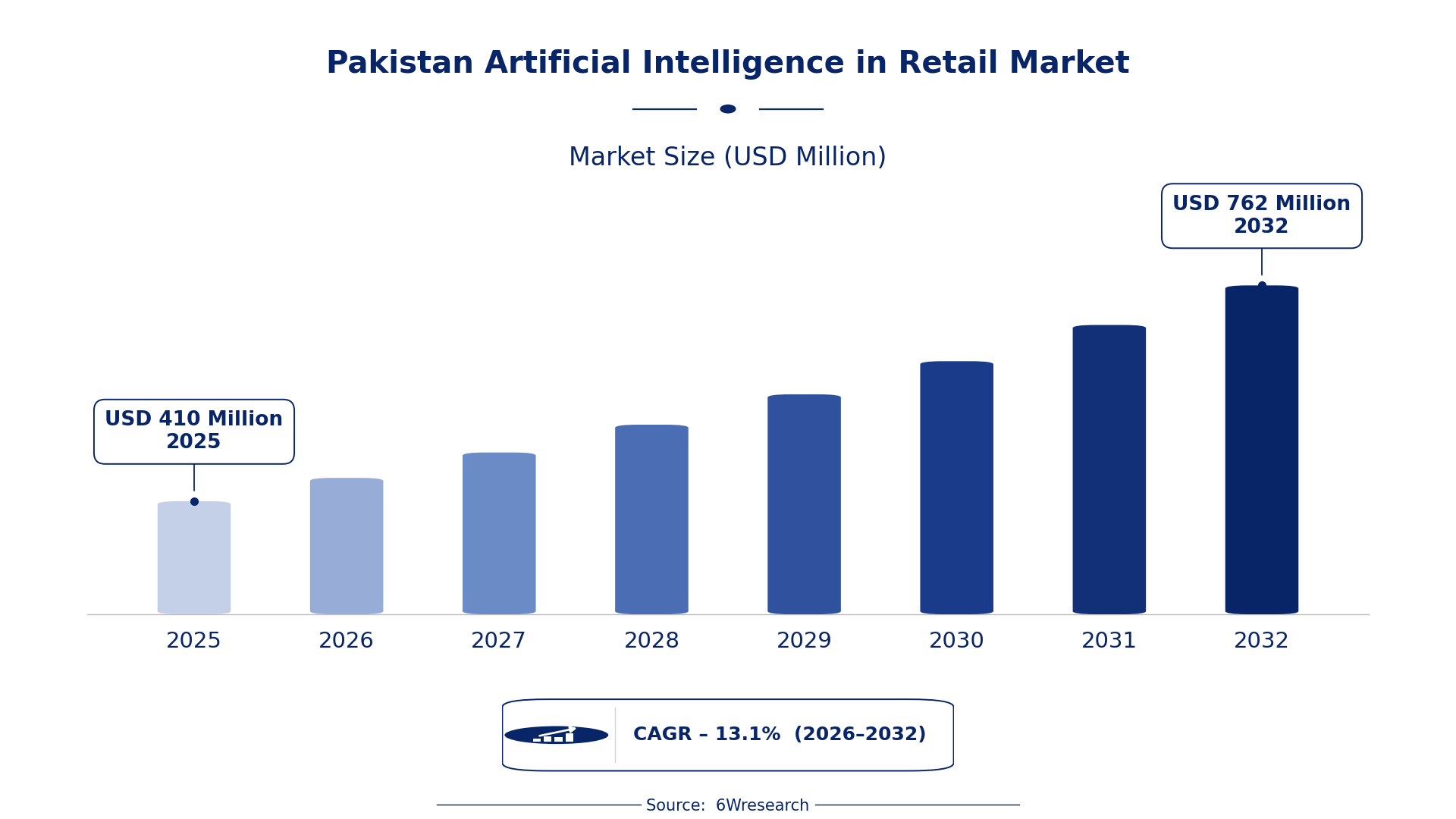
The Pakistan Artificial Intelligence in Retail Market was estimated at USD 410 Million in 2025 and is projected to reach USD 762 Million by 2032, growing at a CAGR of 13.1% from 2026 to 2032.
Pakistan Artificial Intelligence in Retail Market Synopsis
The integration of artificial intelligence in Pakistan's retail sector is rapidly transforming the shopping experience. Retailers are increasingly harnessing AI technologies to tailor services to consumer preferences, streamline operations, and enhance overall efficiency.
As e-commerce flourishes and internet access expands, the demand for AI solutions is surging. Retailers are implementing innovations like personalized recommendations and automated inventory management to stay competitive in a dynamic market.
Pakistan Artificial Intelligence in Retail Market Year-wise Growth Rate and Key Drivers
This graph illustrates the annual growth rates of the Pakistan Artificial Intelligence in Retail Market from 2021 to 2032, highlighting a steady upward trajectory and projected expansion over the forecast period.
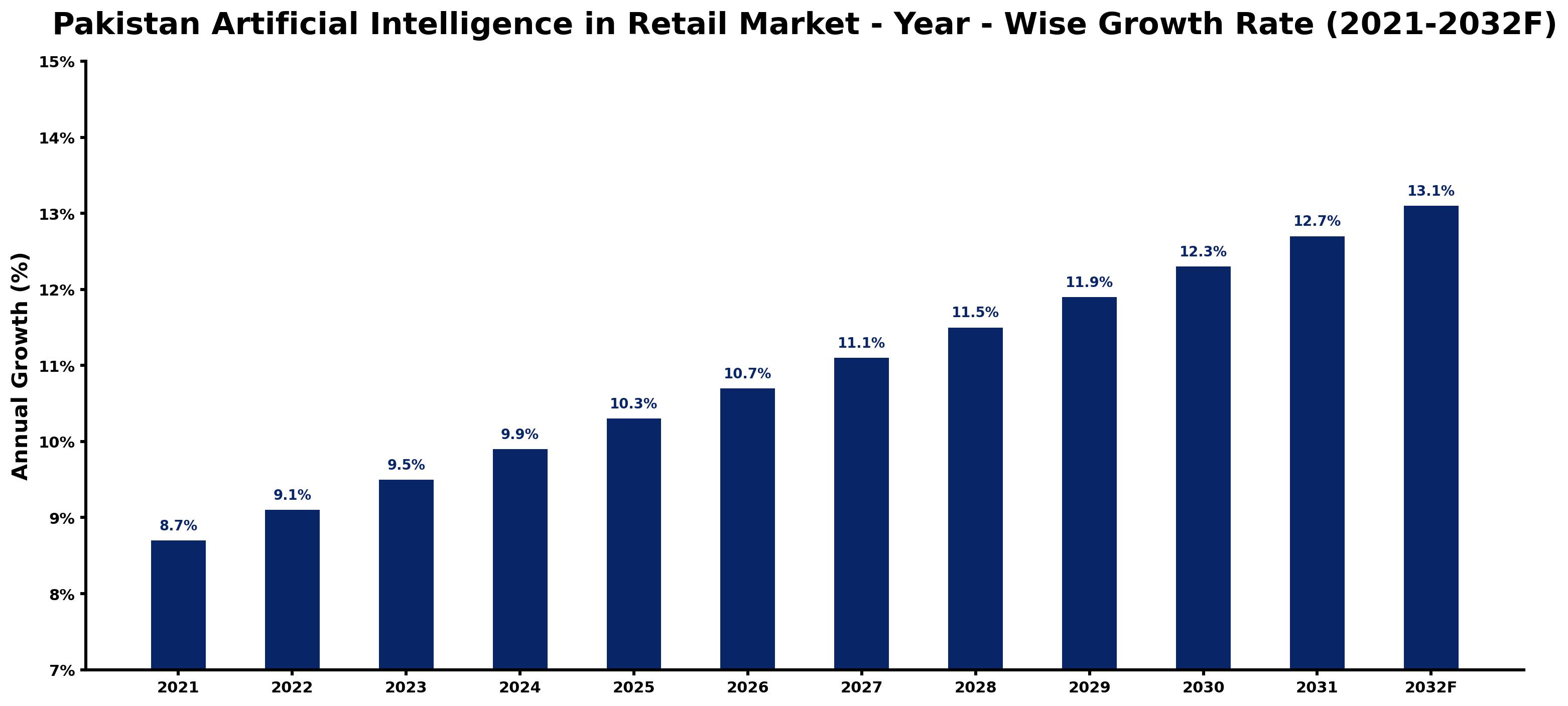
The table below presents the year‑wise growth rates along with the key drivers influencing the market
| Year | Growth Rate | Major Drivers |
| 2021 | 8.7% | Government's Digital Pakistan initiative supports tech adoption. |
| 2022 | 9.1% | Rise of e-commerce driving AI adoption in retail. |
| 2023 | 9.5% | Increased smartphone penetration facilitating AI retail solutions. |
| 2024 | 9.9% | Local startups innovating in AI-driven consumer insights. |
| 2025 | 10.3% | Gujranwala retail hubs adopting AI for inventory management. |
| 2026 | 10.7% | Karachi's tech incubators promoting AI retail applications. |
| 2027 | 11.1% | Lahore's digital marketplaces leveraging AI for personalization. |
| 2028 | 11.5% | Remote work trends boosting online retail AI tools. |
| 2029 | 11.9% | Increased foreign investment in Pakistan's AI sector. |
| 2030 | 12.3% | Emergence of AI-focused courses enhancing local workforce skills. |
| 2031 | 12.7% | Government tax incentives for AI technology in retail. |
| 2032 | 13.1% | Growing consumer preference for personalized AI shopping experiences. |
Note: Market size estimations and growth projections presented in this report are based on 6Wresearch's proprietary forecasting methodology, utilizing the latest available industry data, government publications, and primary research inputs.
Pakistan Artificial Intelligence in Retail Market Key Takeaways
Below are some of the specific key takeaways from the market, including:
- The market is experiencing a shift towards personalized shopping experiences driven by AI technologies.
- Retailers are utilizing predictive analytics to optimize inventory management and anticipate consumer demand.
- Investment in AI-powered chatbots and customer service tools is on the rise, enhancing customer engagement.
- Data privacy concerns are a critical issue for retailers implementing AI solutions.
- The government is actively promoting AI initiatives to foster growth in the retail sector.
Evaluation of Restraints in Pakistan Artificial Intelligence in Retail Market
Despite the promising outlook, several obstacles hinder the growth of AI in the retail sector. A primary concern is the shortage of skilled AI professionals and data scientists, which limits the effective implementation of these technologies. Additionally, retailers face challenges related to data privacy and security, as handling sensitive customer information raises potential risks. Infrastructure issues, including inadequate internet connectivity in certain regions, can also impede the adoption of AI solutions. Lastly, traditional retailers may hesitate to invest in AI due to perceived costs and uncertainties regarding returns, making it essential to address these challenges to foster growth.
Pakistan Artificial Intelligence in Retail Market Trends
Key trends are shaping the Pakistan Artificial Intelligence in Retail Market. Personalized customer recommendations are gaining traction as retailers strive to meet individual consumer needs. Inventory management optimization is another critical area, with AI helping retailers maintain optimal stock levels. The use of predictive analytics for demand forecasting is becoming increasingly popular, allowing retailers to adapt quickly to changing market conditions. Additionally, the introduction of AI-driven chatbots is revolutionizing customer service, providing instant support and engagement.
Pakistan Artificial Intelligence in Retail Market Opportunities
The future of AI in Pakistan's retail sector is brimming with opportunities. Retailers can invest in AI-powered chatbots to enhance customer interactions and streamline service processes. The implementation of facial recognition technology can create personalized shopping experiences while also bolstering security. on top of that, AI-driven data analytics can help businesses refine their marketing strategies through targeted campaigns. As e-commerce continues to grow, the demand for innovative AI solutions will only intensify, opening doors for technology providers and retailers alike.
Government Initiatives in the Pakistan Artificial Intelligence in Retail Market
The government of Pakistan is playing an active role in promoting the use of artificial intelligence within the retail sector. Through policies such as the National Artificial Intelligence Policy, the government is fostering the development and adoption of AI technologies. Initiatives like the National Incubation Center are designed to support startups and businesses seeking to implement AI solutions. A regulatory framework is also being developed to ensure responsible AI use, addressing data privacy and security concerns.
- A National Artificial Intelligence Policy introduced in 2023 aims to enhance AI integration across various sectors, including retail.
- The National Incubation Center, launched in 2022, provides resources for AI startups and businesses focused on retail innovation.
- A regulatory framework is currently being developed to address ethical AI practices and data protection in the retail sector.
- Upcoming initiatives are expected to include public-private partnerships aimed at expanding digital infrastructure for AI applications in retail.
- A digital skills enhancement program is planned for late 2024 to address the shortage of AI professionals in the retail market.
Future Insights of the Pakistan Artificial Intelligence in Retail Market
Looking ahead to 2026-2032, the Pakistan Artificial Intelligence in Retail Market is set for significant growth. As retailers increasingly recognize the advantages of AI technology, adoption rates are expected to rise. Key trends such as personalized shopping experiences, enhanced inventory management, and automated customer service will dominate the landscape. Advancements in AI, including machine learning and natural language processing, will empower retailers to gain competitive advantages, ultimately driving market expansion.
Pakistan Artificial Intelligence in Retail Market Latest Developments
Recent activity in the Pakistan Artificial Intelligence in Retail Market has highlighted a growing interest in innovative technologies and solutions. Retailers are increasingly exploring AI applications to enhance customer engagement and operational efficiency. As the market matures, new partnerships and technology rollouts are becoming more frequent.
- A major technology vendor launched an AI-powered recommendation engine in Q1 2023, aimed at enhancing online shopping experiences.
- In early 2023, a leading regional operator initiated a pilot program for AI-driven inventory management solutions in select retail outlets.
- An ongoing partnership between technology firms aims to develop AI chatbots for customer service, with implementation expected by mid-2024.
- A planned rollout of facial recognition technology for personalized shopping experiences is set to begin in late 2025.
- In Q2 2023, a regional startup completed the development of an AI analytics platform tailored for retail market insights.
Pakistan Artificial Intelligence in Retail Market - Key Attractiveness of the Report
- 10 Years of Market Numbers
- Historical Data Starting from 2022 to 2025
- Base Year: 2025
- Forecast Data until 2032
- Key Performance Indicators Impacting the Market
- Major Upcoming Developments and Projects
Key Highlights of the Report:
- Pakistan Artificial Intelligence in Retail Market Outlook
- Market Size of Pakistan Artificial Intelligence in Retail Market, 2025
- Forecast of Pakistan Artificial Intelligence in Retail Market, 2032
- Historical Data and Forecast of Pakistan Artificial Intelligence in Retail Revenues & Volume for the Period 2022-2032F
- Pakistan Artificial Intelligence in Retail Market Trend Evolution
- Pakistan Artificial Intelligence in Retail Market Drivers and Challenges
- Pakistan Artificial Intelligence in Retail Price Trends
- Pakistan Artificial Intelligence in Retail Porter's Five Forces
- Pakistan Artificial Intelligence in Retail Industry Life Cycle
- Historical Data and Forecast of Pakistan Artificial Intelligence in Retail Market Revenues & Volume By Type for the Period 2022-2032F
- Historical Data and Forecast of Pakistan Artificial Intelligence in Retail Market Revenues & Volume By Online for the Period 2022-2032F
- Historical Data and Forecast of Pakistan Artificial Intelligence in Retail Market Revenues & Volume By Offline for the Period 2022-2032F
- Historical Data and Forecast of Pakistan Artificial Intelligence in Retail Market Revenues & Volume By Service for the Period 2022-2032F
- Historical Data and Forecast of Pakistan Artificial Intelligence in Retail Market Revenues & Volume By Professional for the Period 2022-2032F
- Historical Data and Forecast of Pakistan Artificial Intelligence in Retail Market Revenues & Volume By Managed for the Period 2022-2032F
- Historical Data and Forecast of Pakistan Artificial Intelligence in Retail Market Revenues & Volume By Technology for the Period 2022-2032F
- Historical Data and Forecast of Pakistan Artificial Intelligence in Retail Market Revenues & Volume By Machine Learning for the Period 2022-2032F
- Historical Data and Forecast of Pakistan Artificial Intelligence in Retail Market Revenues & Volume By Deep Learning for the Period 2022-2032F
- Historical Data and Forecast of Pakistan Artificial Intelligence in Retail Market Revenues & Volume By NLP for the Period 2022-2032F
- Pakistan Artificial Intelligence in Retail Import Export Trade Statistics
- Market Opportunity Assessment By Type
- Market Opportunity Assessment By Service
- Market Opportunity Assessment By Technology
- Pakistan Artificial Intelligence in Retail Top Companies Market Share
- Pakistan Artificial Intelligence in Retail Competitive Benchmarking By Technical and Operational Parameters
- Pakistan Artificial Intelligence in Retail Company Profiles
- Pakistan Artificial Intelligence in Retail Key Strategic Recommendations






































