Pakistan BBQ Charcoal Market Size, Share & Growth Rate
The Pakistan BBQ Charcoal Market was estimated at USD 231 Million in 2025 and is projected to reach USD 299 Million by 2032, growing at a CAGR of 3.8% from 2026 to 2032. This growth trajectory is primarily driven by the increasing disposable income of consumers, which enables more outdoor cooking and grilling experiences. Furthermore, cultural preferences for BBQ gatherings during festivals and social events continue to enhance the market's attractiveness.
Pakistan BBQ Charcoal Market Year-wise Growth Rate and Key Drivers
This graph highlights how the Pakistan BBQ Charcoal Market has steadily grown over the years, supported by major growth factors.
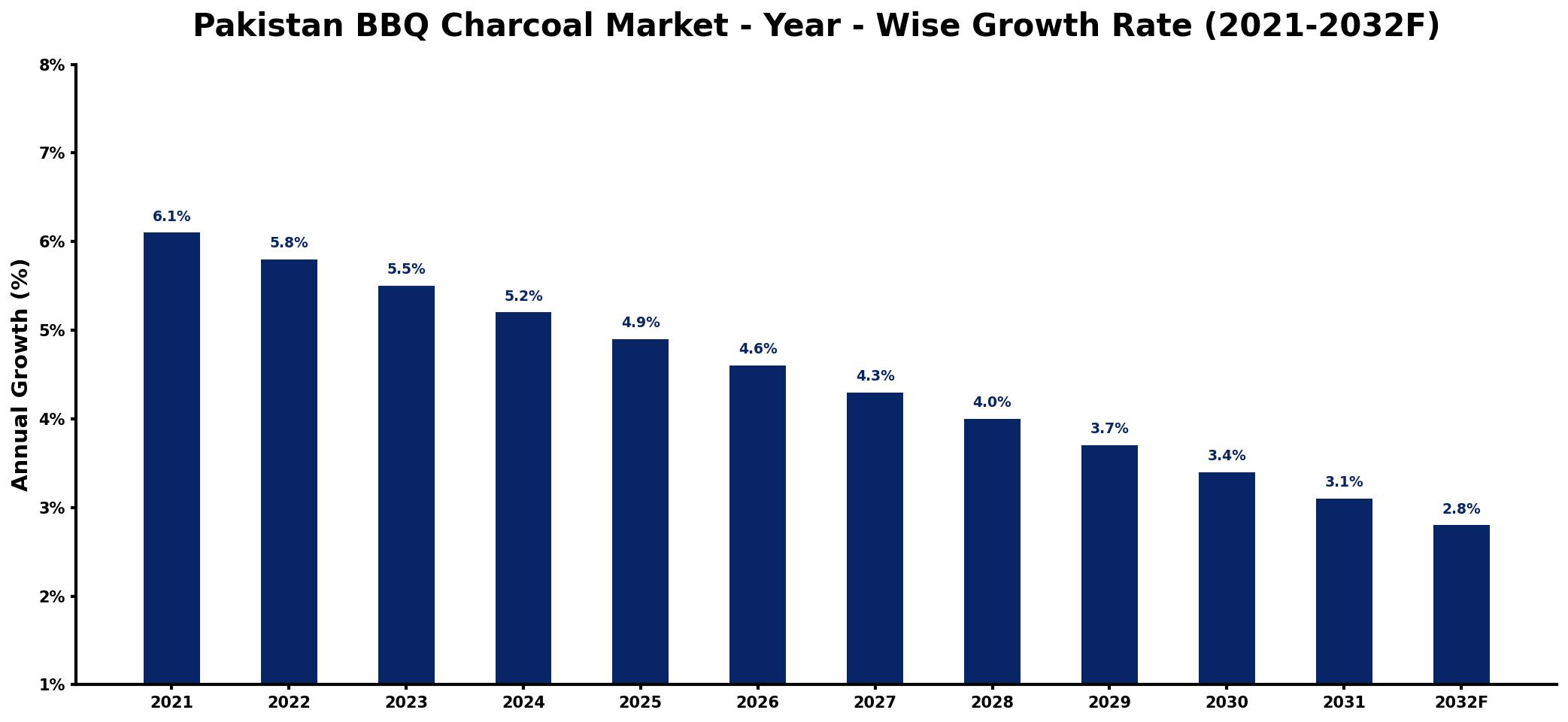
The table below presents the year‑wise growth rates along with the key drivers influencing the market
| Year | Growth Rate | Major Drivers |
| 2021 | 6.1% | Rising outdoor cooking popularity |
| 2022 | 5.8% | Increased disposable income levels |
| 2023 | 5.5% | Growing urbanization trends observed |
| 2024 | 5.2% | Expansion of hospitality sector growth |
| 2025 | 4.9% | Surge in domestic tourism activities |
| 2026 | 4.6% | Emergence of eco-friendly alternatives |
| 2027 | 4.3% | Increased focus on home entertainment |
| 2028 | 4.0% | Growth in food delivery services |
| 2029 | 3.7% | Investment in retail distribution networks |
| 2030 | 3.4% | Development of local manufacturing facilities |
| 2031 | 3.1% | Strengthening of regional trade partnerships |
| 2032 | 2.8% | Rising popularity of outdoor events |
Note: Market size estimations and growth projections presented in this report are based on 6Wresearch's proprietary forecasting methodology, utilizing the latest available industry data, government publications, and primary research inputs.
Pakistan BBQ Charcoal Market Synopsis
The demand for BBQ charcoal in Pakistan is significantly influenced by a rise in outdoor recreational activities, with BBQ restaurants and cafes popping up across urban centers. This trend reflects a shift towards leisure-driven lifestyles, where family and friends gather to enjoy grilled meals. Furthermore, the aromatic qualities of BBQ charcoal enhance cooking, making it a popular choice among consumers.
On the supply side, the market is witnessing an influx of products that boast environmentally friendly production methods, responding to growing consumer awareness about sustainability. Companies are investing in better practices to meet the demand for high-quality, clean-burning charcoal, which is essential for maintaining both customer satisfaction and regulatory compliance.
Pakistan BBQ Charcoal Market Key Takeaways
- The market is poised for steady growth driven by increased outdoor cooking popularity.
- Growing disposable incomes are enhancing consumer spending on BBQ-related products.
- Environmental concerns are leading to innovations in sustainable charcoal production.
- Social gatherings and festive events are key demand drivers for BBQ charcoal.
- The entrance of alternative fuel sources could reshape market dynamics.
Evaluation of Restraints in Pakistan BBQ Charcoal Market
The BBQ charcoal market in Pakistan faces significant restraints, primarily from environmental concerns surrounding traditional charcoal production methods. Deforestation, air pollution, and carbon emissions associated with charcoal production are drawing scrutiny from both consumers and regulatory bodies. Additionally, the rise of alternative cooking methods, such as gas and electric grills, poses a challenge to the traditional charcoal market. This competition can lead to fluctuations in consumer preferences, necessitating strategic adaptations from market players.
Pakistan BBQ Charcoal Market Trends
Current trends within the Pakistan BBQ Charcoal Market indicate a shift towards eco-friendly products. As consumers become more environmentally conscious, the demand for sustainably produced charcoal is on the rise. Furthermore, innovations in production technology are enhancing the quality and efficiency of charcoal manufacturing, catering to a market that values both performance and environmental responsibility.
Pakistan BBQ Charcoal Market Opportunities
Genuine growth opportunities are emerging within the market through the promotion of sustainable practices. Companies focusing on eco-friendly charcoal production methods can capitalize on this growing awareness among consumers. Additionally, partnerships with BBQ restaurants and cafes can provide direct access to a larger consumer base, allowing for enhanced brand visibility and sales. Innovations in packaging and product offerings also represent areas ripe for investment and development.
Government Initiatives in the Pakistan BBQ Charcoal Market
The Pakistani government is actively supporting the BBQ charcoal market through policies that promote sustainable forestry practices. Regulatory frameworks are being established to ensure quality standards in charcoal production, which not only helps in maintaining market integrity but also fosters a sense of responsibility among producers. Incentives for environmentally friendly production methods are also being introduced, encouraging investments in greener technologies and practices.
Future Insights of the Pakistan BBQ Charcoal Market
Looking ahead to 2026-2032, the Pakistan BBQ Charcoal Market is set to evolve with the increasing integration of sustainability in production processes. As consumer preferences shift towards cleaner and greener options, the market will likely see an expansion in the range of eco-friendly products. Additionally, continued urbanization and the proliferation of outdoor dining experiences will further drive demand, making this market one to watch in the coming years.
Pakistan BBQ Charcoal Market Latest Developments (2025 - 2026)
In recent months, the BBQ charcoal market in Pakistan has seen a growing number of initiatives aimed at promoting sustainable practices among producers. This includes the introduction of new technologies that enhance charcoal quality while reducing environmental impact. Additionally, there has been a noticeable uptick in collaborative efforts between local producers and international entities to improve market access and develop better practices, signaling a positive shift in industry dynamics.
Pakistan BBQ Charcoal Market - Key Attractiveness of the Report
- 10 Years of Market Numbers
- Historical Data Starting from 2022 to 2025
- Base Year: 2025
- Forecast Data until 2032
- Key Performance Indicators Impacting the Market
- Major Upcoming Developments and Projects
Key Highlights of the Report:
- Pakistan BBQ Charcoal Market Outlook
- Market Size of Pakistan BBQ Charcoal Market, 2025
- Forecast of Pakistan BBQ Charcoal Market, 2032
- Historical Data and Forecast of Pakistan BBQ Charcoal Revenues & Volume for the Period 2022-2032F
- Pakistan BBQ Charcoal Market Trend Evolution
- Pakistan BBQ Charcoal Market Drivers and Challenges
- Pakistan BBQ Charcoal Price Trends
- Pakistan BBQ Charcoal Porter's Five Forces
- Pakistan BBQ Charcoal Industry Life Cycle
- Historical Data and Forecast of Pakistan BBQ Charcoal Market Revenues & Volume By Form for the Period 2022-2032F
- Historical Data and Forecast of Pakistan BBQ Charcoal Market Revenues & Volume By Briquettes BBQ Charcoal for the Period 2022-2032F
- Historical Data and Forecast of Pakistan BBQ Charcoal Market Revenues & Volume By Lump Wood BBQ Charcoal for the Period 2022-2032F
- Historical Data and Forecast of Pakistan BBQ Charcoal Market Revenues & Volume By Sales Channel for the Period 2022-2032F
- Historical Data and Forecast of Pakistan BBQ Charcoal Market Revenues & Volume By Direct BBQ Charcoal Sales for the Period 2022-2032F
- Historical Data and Forecast of Pakistan BBQ Charcoal Market Revenues & Volume By Retail BBQ Charcoal Sales for the Period 2022-2032F
- Historical Data and Forecast of Pakistan BBQ Charcoal Market Revenues & Volume By End User for the Period 2022-2032F
- Historical Data and Forecast of Pakistan BBQ Charcoal Market Revenues & Volume By BBQ Charcoal for Hotels, Restaurants and Catering (HoReCa) for the Period 2022-2032F
- Historical Data and Forecast of Pakistan BBQ Charcoal Market Revenues & Volume By BBQ Charcoal for Households for the Period 2022-2032F
- Historical Data and Forecast of Pakistan BBQ Charcoal Market Revenues & Volume By Source for the Period 2022-2032F
- Historical Data and Forecast of Pakistan BBQ Charcoal Market Revenues & Volume By BBQ Charcoal made from Agricultural Waste for the Period 2022-2032F
- Historical Data and Forecast of Pakistan BBQ Charcoal Market Revenues & Volume By BBQ Charcoal made from Coconut Shells for the Period 2022-2032F
- Historical Data and Forecast of Pakistan BBQ Charcoal Market Revenues & Volume By BBQ Charcoal made from Nutshells for the Period 2022-2032F
- Historical Data and Forecast of Pakistan BBQ Charcoal Market Revenues & Volume By BBQ Charcoal made from Hardwood for the Period 2022-2032F
- Historical Data and Forecast of Pakistan BBQ Charcoal Market Revenues & Volume By BBQ Charcoal made from Bamboo for the Period 2022-2032F
- Pakistan BBQ Charcoal Import Export Trade Statistics
- Market Opportunity Assessment By Form
- Market Opportunity Assessment By Sales Channel
- Market Opportunity Assessment By End User
- Market Opportunity Assessment By Source
- Pakistan BBQ Charcoal Top Companies Market Share
- Pakistan BBQ Charcoal Competitive Benchmarking By Technical and Operational Parameters
- Pakistan BBQ Charcoal Company Profiles
- Pakistan BBQ Charcoal Key Strategic Recommendations






































