Pakistan Construction Glass Market: Import Trend Analysis
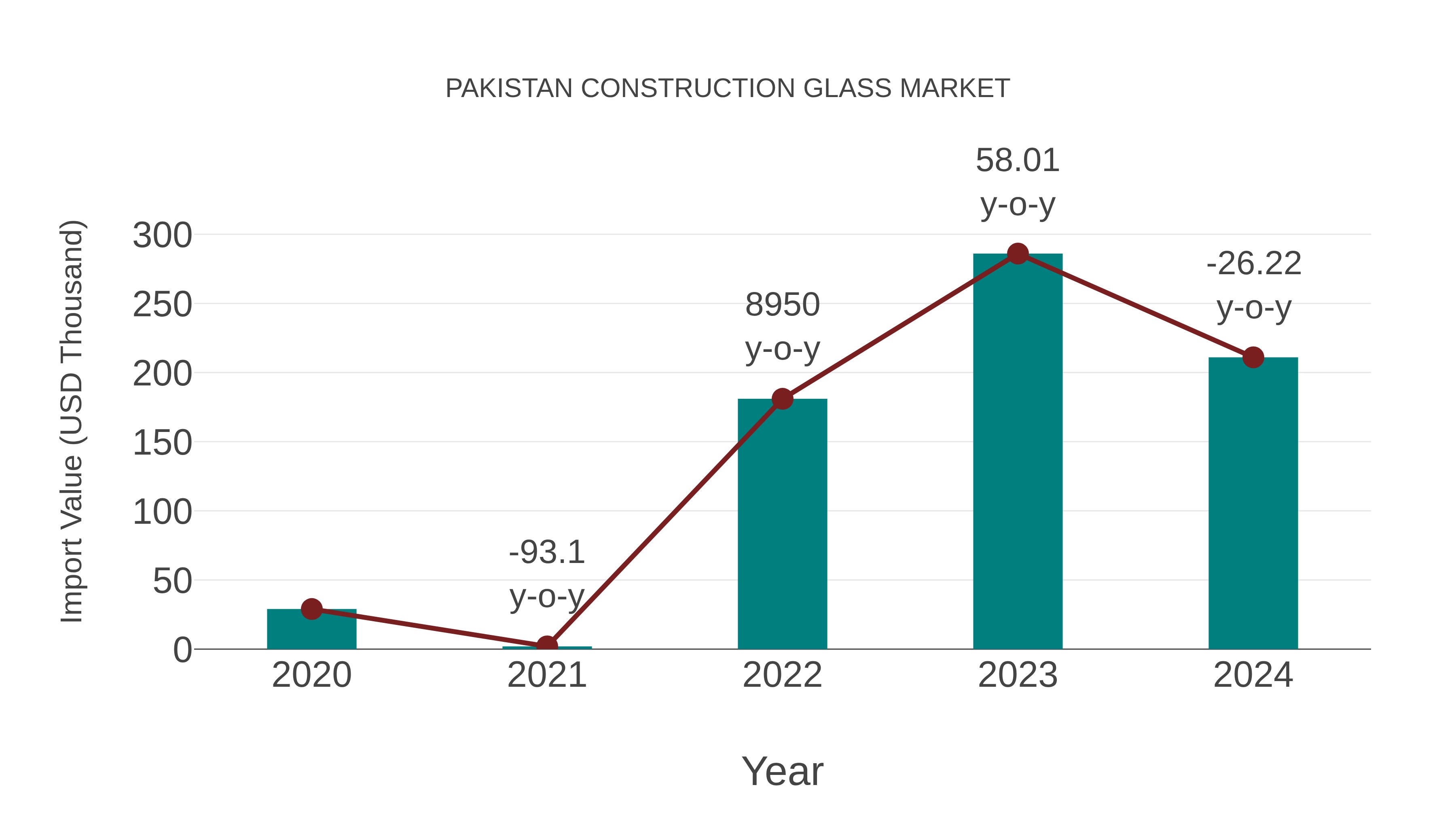
Pakistan construction glass market witnessed a notable import trend, with a growth rate of -26.22% from 2023 to 2024. The compound annual growth rate (CAGR) for imports in the period 2020-2024 stood at 64.24%. This decline in import momentum could be attributed to shifting demand patterns or potential market stabilization efforts.
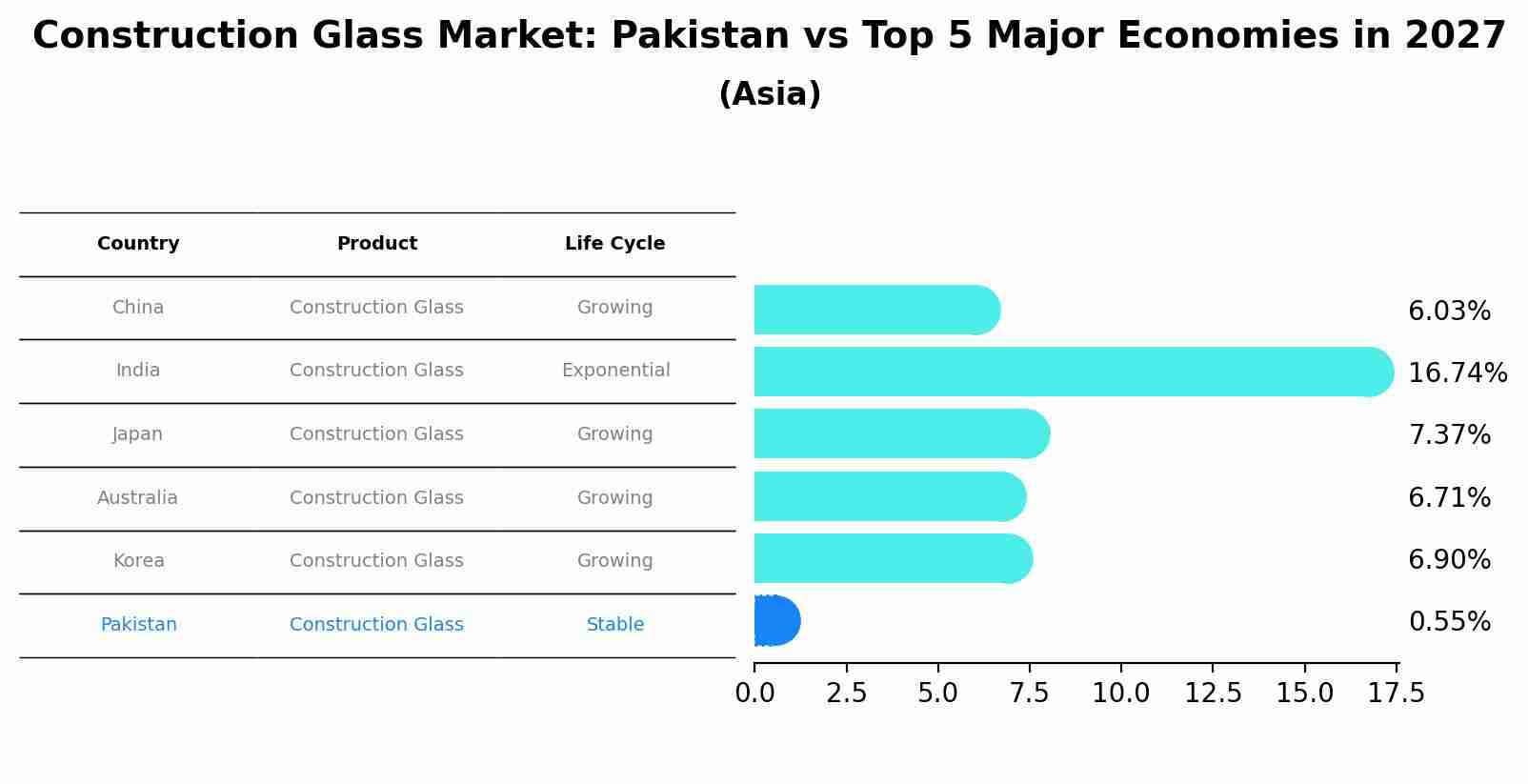
Construction Glass Market: Pakistan vs Top 5 Major Economies in 2027 (Asia)
Pakistan's Construction Glass market is anticipated to experience a stable growth rate of 0.55% by 2027, reflecting trends observed in the largest economy China, followed by India, Japan, Australia and South Korea.
Pakistan Construction Glass Market Overview
The construction glass market in Pakistan is expanding rapidly, driven by the booming construction industry and the increasing emphasis on energy efficiency and aesthetics in building design. Innovative glass products with features like thermal insulation and soundproofing are in high demand.
Drivers of the market
The market is driven by the increasing use of glass in modern architecture, both for aesthetic purposes and energy efficiency. Government regulations promoting energy-efficient buildings also contribute to the demand for construction glass.
Challenges of the market
Challenges in the Pakistan Construction Glass Market include the high costs associated with high-quality glass, limited domestic production capacity, transportation challenges, and the need for efficient glass recycling infrastructure. These factors impact the availability and affordability of glass for construction projects.
Government Policy of the market
In the construction glass market, the government focuses on promoting energy-efficient and safety-enhancing glass products to meet building codes and standards. Policies include incentives for manufacturers to invest in advanced glass manufacturing technologies and product innovations that reduce heat gain, glare, and UV radiation while improving thermal insulation and soundproofing properties. Additionally, there are regulations to enforce the use of safety glass in high-rise buildings and public spaces to mitigate the risk of accidents and enhance occupant safety. The government also supports research and development initiatives to develop locally sourced raw materials for glass production and reduce dependency on imports.
Key Highlights of the Report:
- Pakistan Construction Glass Market Outlook
- Market Size of Pakistan Construction Glass Market, 2025
- Forecast of Pakistan Construction Glass Market, 2032
- Historical Data and Forecast of Pakistan Construction Glass Revenues & Volume for the Period 2022-2032F
- Pakistan Construction Glass Market Trend Evolution
- Pakistan Construction Glass Market Drivers and Challenges
- Pakistan Construction Glass Price Trends
- Pakistan Construction Glass Porter's Five Forces
- Pakistan Construction Glass Industry Life Cycle
- Historical Data and Forecast of Pakistan Construction Glass Market Revenues & Volume By Chemical Composition for the Period 2022-2032F
- Historical Data and Forecast of Pakistan Construction Glass Market Revenues & Volume By Soda-lime for the Period 2022-2032F
- Historical Data and Forecast of Pakistan Construction Glass Market Revenues & Volume By Potash-lime for the Period 2022-2032F
- Historical Data and Forecast of Pakistan Construction Glass Market Revenues & Volume By Potash-lead for the Period 2022-2032F
- Historical Data and Forecast of Pakistan Construction Glass Market Revenues & Volume By Type for the Period 2022-2032F
- Historical Data and Forecast of Pakistan Construction Glass Market Revenues & Volume By Low-e Glass for the Period 2022-2032F
- Historical Data and Forecast of Pakistan Construction Glass Market Revenues & Volume By Special Glass for the Period 2022-2032F
- Historical Data and Forecast of Pakistan Construction Glass Market Revenues & Volume By Manufacturing Process for the Period 2022-2032F
- Historical Data and Forecast of Pakistan Construction Glass Market Revenues & Volume By Float Process for the Period 2022-2032F
- Historical Data and Forecast of Pakistan Construction Glass Market Revenues & Volume By Rolled/sheet Process for the Period 2022-2032F
- Historical Data and Forecast of Pakistan Construction Glass Market Revenues & Volume By Application for the Period 2022-2032F
- Historical Data and Forecast of Pakistan Construction Glass Market Revenues & Volume By Residential for the Period 2022-2032F
- Historical Data and Forecast of Pakistan Construction Glass Market Revenues & Volume By Commercial for the Period 2022-2032F
- Historical Data and Forecast of Pakistan Construction Glass Market Revenues & Volume By Others for the Period 2022-2032F
- Pakistan Construction Glass Import Export Trade Statistics
- Market Opportunity Assessment By Chemical Composition
- Market Opportunity Assessment By Type
- Market Opportunity Assessment By Manufacturing Process
- Market Opportunity Assessment By Application
- Pakistan Construction Glass Top Companies Market Share
- Pakistan Construction Glass Competitive Benchmarking By Technical and Operational Parameters
- Pakistan Construction Glass Company Profiles
- Pakistan Construction Glass Key Strategic Recommendations






































