Pakistan Decentralized Identity Market Size & Growth Rate (2026-2032)
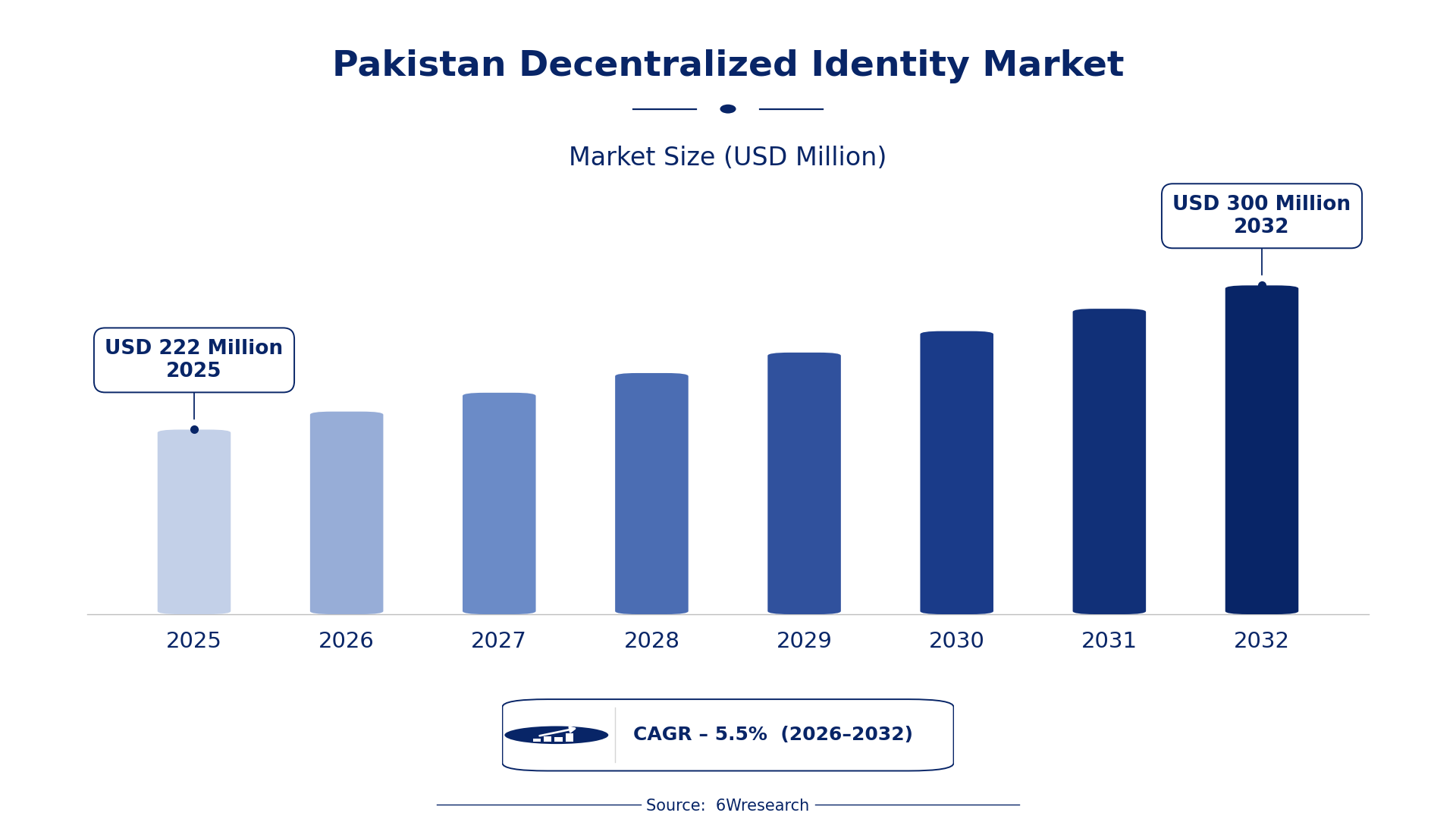
The Pakistan Decentralized Identity Market was estimated at USD 222 Million in 2025 and is projected to reach USD 300 Million by 2032, growing at a CAGR of 5.5% from 2026 to 2032.
Pakistan Decentralized Identity Market Synopsis
In Pakistan, the demand for decentralized identity solutions is rapidly increasing due to a heightened focus on data privacy and security. Citizens are becoming increasingly aware of the risks associated with traditional identity management systems, pushing the market towards innovative blockchain technologies that prioritize user control.
Current market dynamics reveal that businesses and governmental agencies are exploring decentralized identities to streamline authentication processes while ensuring compliance with emerging data protection regulations. This trend signifies a shift in how identity management is conceptualized and executed in the country.
Pakistan Decentralized Identity Market Year-wise Growth Rate and Key Drivers
This graph illustrates the annual growth rates of the Pakistan Decentralized Identity Market from 2021 to 2032, highlighting a steady upward trajectory and projected expansion over the forecast period.
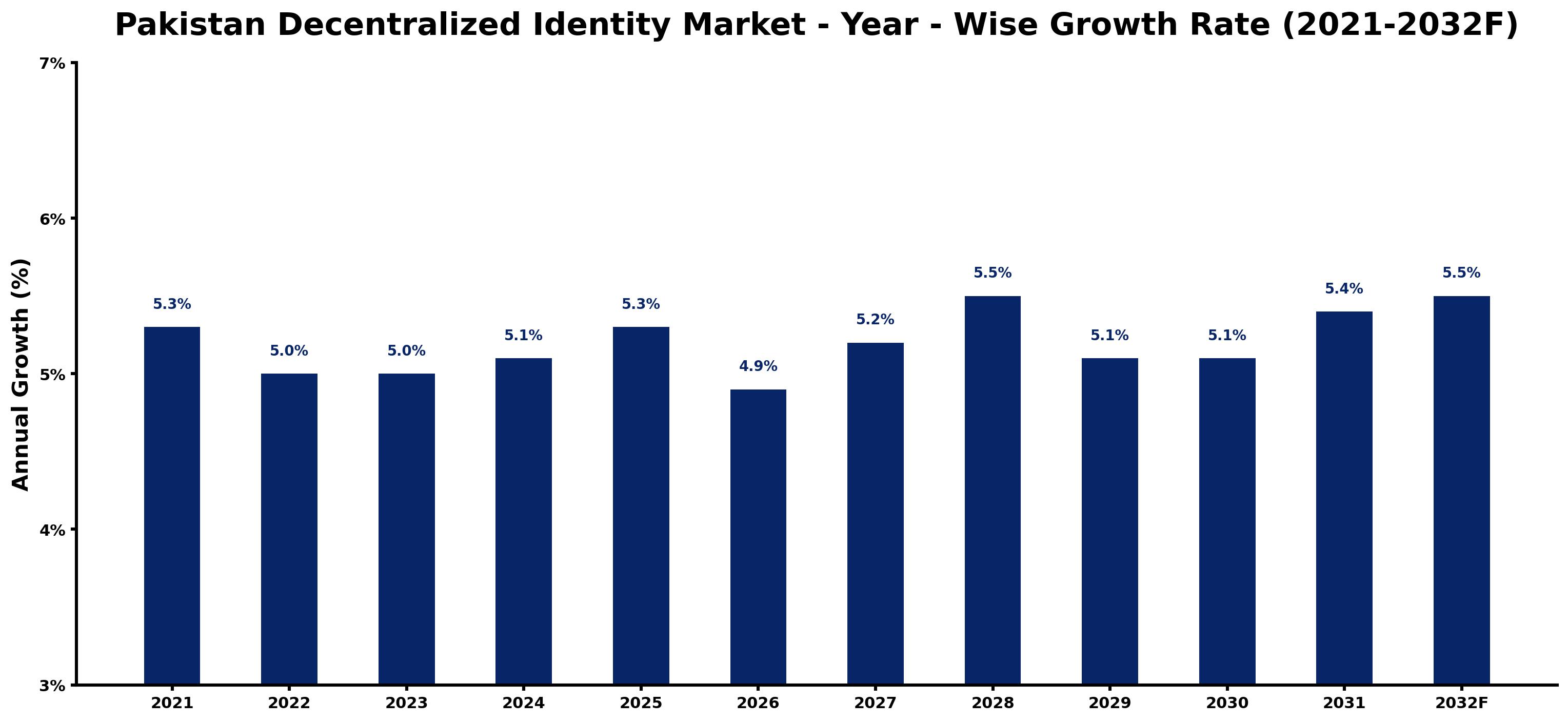
The table below presents the year‑wise growth rates along with the key drivers influencing the market
| Year | Growth Rate | Major Drivers |
| 2021 | 5.3% | State Bank of Pakistan's digital identity initiatives launched. |
| 2022 | 5.0% | Increased mobile penetration enhances digital identity adoption. |
| 2023 | 5.0% | National Digital Policy promoting biometric verification systems. |
| 2024 | 5.1% | Growing fintech sector demands reliable identity verification solutions. |
| 2025 | 5.3% | Collaboration with international organizations to strengthen ID frameworks. |
| 2026 | 4.9% | Rising awareness about cybersecurity and identity theft concerns. |
| 2027 | 5.2% | Broadband expansion facilitates access to digital identity tools. |
| 2028 | 5.5% | Government support for startups developing identity verification solutions. |
| 2029 | 5.1% | Public sector digitization increasing need for secure identities. |
| 2030 | 5.1% | Regulatory mandates push for KYC compliance in financial sector. |
| 2031 | 5.4% | Establishment of local blockchain initiatives for ID security. |
| 2032 | 5.5% | Increasing focus on user privacy fuels decentralized identity solutions. |
Note: Market size estimations and growth projections presented in this report are based on 6Wresearch's proprietary forecasting methodology, utilizing the latest available industry data, government publications, and primary research inputs.
Pakistan Decentralized Identity Market Key Takeaways
Below are some of the specific key takeaways from the market, including:
- Decentralized identity solutions are driven by increasing concerns over data privacy among Pakistani citizens.
- The market is supported by government initiatives aiming to modernize digital identity security frameworks.
- Interoperability remains a critical issue, impacting the widespread adoption of decentralized identity solutions.
- Blockchain technology is at the forefront, providing a foundation for secure identity management.
- Education and awareness campaigns are essential to foster trust in decentralized systems among users.
Evaluation of Restraints in Pakistan Decentralized Identity Market
The Pakistan Decentralized Identity Market faces notable restraints that could hinder its growth. One of the primary challenges is establishing interoperability among different decentralized identity solutions. As various technologies emerge, the lack of standardized protocols may lead to fragmentation, making integration difficult for users and organizations alike. Furthermore, ongoing concerns regarding privacy and security can erode trust in these systems, deterring potential adopters.
Building trust is crucial; without a clear understanding of how data is managed and secured, potential users may remain hesitant to transition from traditional systems to decentralized alternatives. This uncertainty complicates efforts to promote the adoption of decentralized identities across different sectors.
Pakistan Decentralized Identity Market Trends
Several trends are currently shaping the Pakistan Decentralized Identity Market. The rise of privacy-preserving technologies is gaining traction, with individuals seeking control over their personal information. This shift aligns with global movements emphasizing user empowerment in data management.
Additionally, as regulatory frameworks evolve, there is a growing alignment with decentralized identity solutions. Companies are increasingly looking to adopt systems that comply with new regulations while enhancing their operational efficiencies. These developments signal a transformative phase for identity management in Pakistan.
Pakistan Decentralized Identity Market Opportunities
The market presents a variety of growth and investment opportunities. As digital transformation accelerates, sectors such as finance, healthcare, and e-governance can benefit significantly from implementing decentralized identity systems. Collaborations between private and public sectors can foster innovation, creating tailored solutions that address local needs.
Furthermore, educational initiatives aimed at increasing awareness about decentralized identities will play a pivotal role in driving adoption. These opportunities signify a potential for significant market expansion, as more organizations recognize the importance of secure, privacy-preserving identity solutions.
Government Initiatives in the Pakistan Decentralized Identity Market
Government policy is increasingly favorable towards the promotion of decentralized identity systems in Pakistan. As the digital economy grows, policymakers are keen on adopting solutions that enhance data privacy and security. This regulatory posture is essential for nurturing an ecosystem conducive to innovation and trust in digital identity frameworks.
- A national initiative launched in 2025 aimed at introducing a blockchain-based identity framework to enhance governmental services.
- Current efforts involve the establishment of regulatory guidelines designed to ensure the privacy and security of decentralized identity systems.
- Ongoing partnerships with technology firms are expected to bolster infrastructure development necessary for decentralized identity solutions.
- A planned public education campaign scheduled for late 2026 aims to improve understanding and trust in decentralized identities among citizens.
Future Insights of the Pakistan Decentralized Identity Market
Looking ahead to 2026-2032, the Pakistan Decentralized Identity Market is expected to witness substantial advancements, propelled by regulatory support and increasing public awareness. As more sectors adopt these solutions, the market will become more diversified, with various applications emerging.
Continuous investments in technology and infrastructure will be crucial, facilitating a more integrated approach to digital identity management. The next few years will be a transformative period as both private and public sectors strive to unlock the full potential of decentralized identity systems.
Pakistan Decentralized Identity Market Latest Developments
In the past year, activity in the Pakistan Decentralized Identity Market has accelerated significantly. Multiple stakeholders are embracing decentralized solutions, showcasing a collective effort towards more secure identity management practices. Increased collaboration between technology vendors and governmental organizations signals a broader recognition of the importance of decentralized identities.
- A technology pilot program was launched in Q3 2025 aimed at integrating decentralized identity solutions into government services.
- Partnerships among local tech startups have emerged, focusing on developing user-friendly decentralized identity applications currently underway since early 2025.
- A planned conference in early 2026 will gather industry leaders to discuss trends and innovations related to decentralized identity technologies.
- A recent collaboration between public and private entities aims to enhance cybersecurity measures for decentralized identity systems, expected to commence in mid-2026.
Pakistan Decentralized Identity Market - Key Attractiveness of the Report
- 10 Years of Market Numbers
- Historical Data Starting from 2022 to 2025
- Base Year: 2025
- Forecast Data until 2032
- Key Performance Indicators Impacting the Market
- Major Upcoming Developments and Projects
Key Highlights of the Report:
- Pakistan Decentralized Identity Market Outlook
- Market Size of Pakistan Decentralized Identity Market, 2025
- Forecast of Pakistan Decentralized Identity Market, 2032
- Historical Data and Forecast of Pakistan Decentralized Identity Revenues & Volume for the Period 2022-2032F
- Pakistan Decentralized Identity Market Trend Evolution
- Pakistan Decentralized Identity Market Drivers and Challenges
- Pakistan Decentralized Identity Price Trends
- Pakistan Decentralized Identity Porter's Five Forces
- Pakistan Decentralized Identity Industry Life Cycle
- Historical Data and Forecast of Pakistan Decentralized Identity Market Revenues & Volume By Vertical for the Period 2022-2032F
- Historical Data and Forecast of Pakistan Decentralized Identity Market Revenues & Volume By BFSI for the Period 2022-2032F
- Historical Data and Forecast of Pakistan Decentralized Identity Market Revenues & Volume By Government for the Period 2022-2032F
- Historical Data and Forecast of Pakistan Decentralized Identity Market Revenues & Volume By Healthcare and Life Sciences for the Period 2022-2032F
- Historical Data and Forecast of Pakistan Decentralized Identity Market Revenues & Volume By Retail and eCommerce for the Period 2022-2032F
- Historical Data and Forecast of Pakistan Decentralized Identity Market Revenues & Volume By Telecom and IT for the Period 2022-2032F
- Historical Data and Forecast of Pakistan Decentralized Identity Market Revenues & Volume By Transport and Logistics for the Period 2022-2032F
- Historical Data and Forecast of Pakistan Decentralized Identity Market Revenues & Volume By Real Estate for the Period 2022-2032F
- Historical Data and Forecast of Pakistan BFSI Decentralized Identity Market Revenues & Volume By Others for the Period 2022-2032F
- Historical Data and Forecast of Pakistan Decentralized Identity Market Revenues & Volume By Identity Type for the Period 2022-2032F
- Historical Data and Forecast of Pakistan Decentralized Identity Market Revenues & Volume By Non- biometrics for the Period 2022-2032F
- Historical Data and Forecast of Pakistan Decentralized Identity Market Revenues & Volume By Biometrics for the Period 2022-2032F
- Historical Data and Forecast of Pakistan Decentralized Identity Market Revenues & Volume By End User for the Period 2022-2032F
- Historical Data and Forecast of Pakistan Decentralized Identity Market Revenues & Volume By Enterprises for the Period 2022-2032F
- Historical Data and Forecast of Pakistan Decentralized Identity Market Revenues & Volume By Individual for the Period 2022-2032F
- Historical Data and Forecast of Pakistan Decentralized Identity Market Revenues & Volume By Organization Size for the Period 2022-2032F
- Historical Data and Forecast of Pakistan Decentralized Identity Market Revenues & Volume By Large Enterprises for the Period 2022-2032F
- Historical Data and Forecast of Pakistan Decentralized Identity Market Revenues & Volume By SMEs for the Period 2022-2032F
- Pakistan Decentralized Identity Import Export Trade Statistics
- Market Opportunity Assessment By Vertical
- Market Opportunity Assessment By Identity Type
- Market Opportunity Assessment By End User
- Market Opportunity Assessment By Organization Size
- Pakistan Decentralized Identity Top Companies Market Share
- Pakistan Decentralized Identity Competitive Benchmarking By Technical and Operational Parameters
- Pakistan Decentralized Identity Company Profiles
- Pakistan Decentralized Identity Key Strategic Recommendations






































