Pakistan EdTech and Smart Classrooms Market Size & Growth Rate (2026-2032)
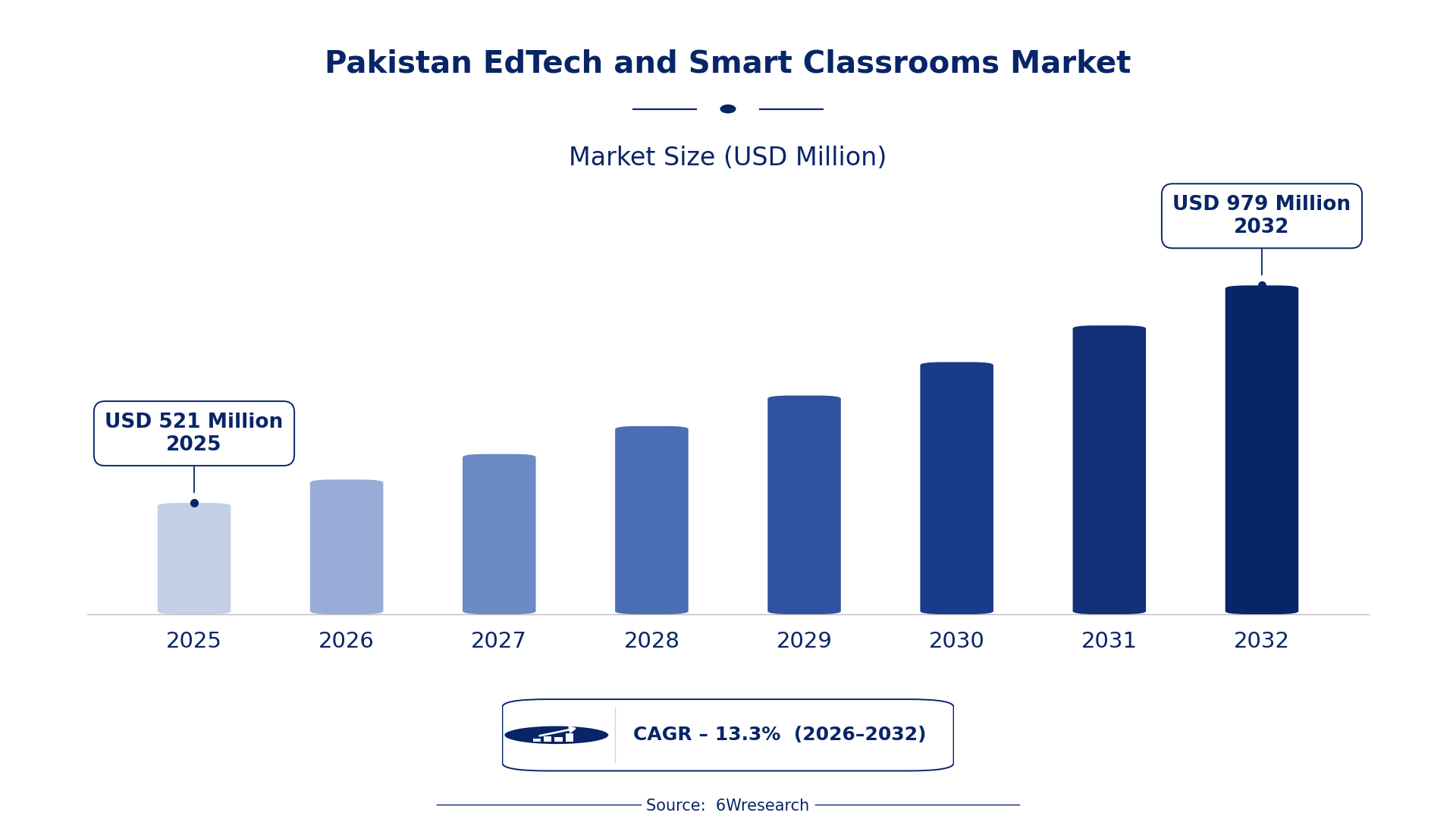
The Pakistan EdTech and Smart Classrooms Market was estimated at USD 521 Million in 2025 and is projected to reach USD 979 Million by 2032, growing at a CAGR of 13.3% from 2026 to 2032.
Pakistan EdTech and Smart Classrooms Market Synopsis
The driving force behind the Pakistan EdTech and Smart Classrooms market is the accelerating digitalization in education. With a large youth demographic and increasing internet access, educational institutions are shifting towards interactive learning methodologies.
The COVID-19 pandemic acted as a catalyst, pushing schools and colleges to adopt online learning platforms swiftly. This trend is supported by government initiatives aimed at improving educational standards and integrating technology into classrooms.
Pakistan EdTech and Smart Classrooms Market Year-wise Growth Rate and Key Drivers
This graph illustrates the annual growth rates of the Pakistan EdTech and Smart Classrooms Market from 2021 to 2032, highlighting a steady upward trajectory and projected expansion over the forecast period.
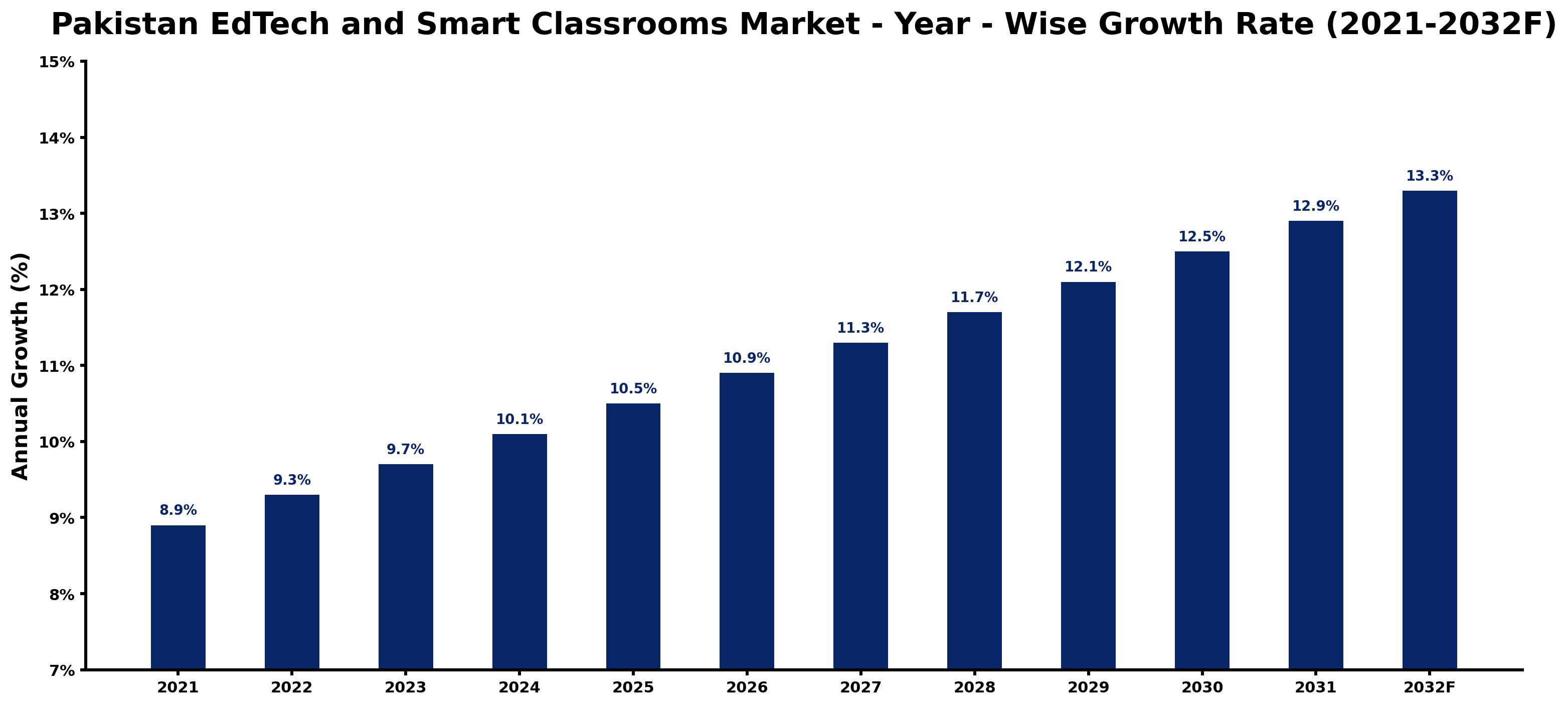
The table below presents the year‑wise growth rates along with the key drivers influencing the market
| Year | Growth Rate | Major Drivers |
| 2021 | 8.9% | Government funding for technology integration in education. |
| 2022 | 9.3% | Growing trend of online tutoring platforms across Pakistan. |
| 2023 | 9.7% | Launch of Smart School initiative by Ministry of Education. |
| 2024 | 10.1% | Rising smartphone adoption rates among students and parents. |
| 2025 | 10.5% | Partnerships with local tech firms for classroom solutions. |
| 2026 | 10.9% | National Digital Learning Strategy encouraging EdTech adoption. |
| 2027 | 11.3% | Increasing focus on STEM education in school curricula. |
| 2028 | 11.7% | Rising parent investment in educational technologies at home. |
| 2029 | 12.1% | Emergence of regional educational startups boosting innovation. |
| 2030 | 12.5% | Enhanced connectivity through government broadband initiatives. |
| 2031 | 12.9% | Collaboration with international EdTech firms for growth. |
| 2032 | 13.3% | Increased awareness of digital skills importance in careers. |
Note: Market size estimations and growth projections presented in this report are based on 6Wresearch's proprietary forecasting methodology, utilizing the latest available industry data, government publications, and primary research inputs.
Pakistan EdTech and Smart Classrooms Market Key Takeaways
Below are some of the specific key takeaways from the market, including:
- The market is expected to continue expanding as technology becomes an integral part of the education system.
- Personalized learning solutions are gaining traction among educational institutions, enhancing student engagement.
- Government policies are increasingly supporting the integration of digital tools in classrooms.
- Challenges such as internet connectivity and digital literacy still need addressing for equitable access.
- There is a growing interest in gamification and AI-driven educational tools among educators.
Evaluation of Restraints in Pakistan EdTech and Smart Classrooms Market
Despite the positive growth trajectory, the Pakistan EdTech and Smart Classrooms market faces hurdles that cannot be overlooked. Limited internet connectivity remains a substantial barrier in rural regions, making it difficult for students to access online resources. on top of that, many educators lack the necessary training to effectively implement technology into their teaching practices. The affordability of digital solutions for schools with constrained budgets also presents a challenge. Addressing these issues will require a concerted effort from various stakeholders to ensure inclusive and equitable education.
Pakistan EdTech and Smart Classrooms Market Trends
Several trends are emerging that are shaping the direction of the Pakistan EdTech and Smart Classrooms market. The demand for personalized learning experiences continues to rise, driven by the need for tailored educational approaches that cater to diverse learning styles. Virtual classrooms are becoming a staple in educational institutions, facilitating flexible learning environments. Additionally, gamification strategies are gaining popularity, as they make learning more engaging and enjoyable for students. The integration of AI-powered tools into educational platforms is also on the rise, enhancing the learning experience through adaptive technologies.
Pakistan EdTech and Smart Classrooms Market Opportunities
The future of the Pakistan EdTech and Smart Classrooms market is brimming with opportunities. Companies have the chance to create tailored solutions that address the unique needs of the Pakistani education sector, particularly in underserved areas. Collaboration with educational institutions can lead to the effective integration of technology in classrooms, which is essential for enhancing the quality of education. As digital literacy initiatives gain momentum, there is an opening for investment in platforms that provide access to quality educational resources.
Government Initiatives in the Pakistan EdTech and Smart Classrooms Market
Government initiatives play a critical role in shaping the Pakistan EdTech and Smart Classrooms market. With a focus on enhancing educational quality and access to technology, the government is implementing various policies that benefit the sector. These initiatives aim to foster a conducive environment for the growth of EdTech companies and improve digital literacy across the nation.
- A recently completed initiative, the Smart Schools program, aims to equip classrooms with modern interactive technology.
- Currently underway is the Digital Pakistan Vision, promoting digital literacy and access to educational technology.
- Planned initiatives include funding for training programs targeting teachers to enhance their proficiency in using EdTech tools.
- The National Education Policy 2021 encourages the integration of technology to improve learning outcomes in schools.
- Efforts are being made to establish digital infrastructure in remote areas, enhancing connectivity for educational purposes.
Future Insights of the Pakistan EdTech and Smart Classrooms Market
Looking ahead to 2026-2032, the Pakistan EdTech and Smart Classrooms market is set for substantial growth. With increasing smartphone penetration and internet connectivity, the demand for digital learning tools will rise. The government's commitment to modernizing education, combined with a youthful population eager to embrace technology, will create a fertile environment for innovative EdTech solutions. The integration of technology in education will not only enhance teaching methodologies but also improve learning outcomes for students across the country.
Pakistan EdTech and Smart Classrooms Market Latest Developments
In the past year, the Pakistan EdTech and Smart Classrooms market has witnessed notable developments that indicate a dynamic evolution in the sector. Educational institutions are increasingly adopting innovative tools and platforms, driven by a desire to enhance educational experiences and outcomes.
- A leading regional operator launched an interactive learning management system in early 2025, aiming to streamline the online learning experience.
- In mid-2025, a major technology vendor began an initiative to equip rural schools with internet access and digital learning resources.
- A partnership between local universities and EdTech firms is currently underway to develop AI-powered educational tools for personalized learning.
- Upcoming in late 2026, a rollout is planned for a nationwide digital literacy campaign targeting both students and educators.
- By mid-2025, a consortium of educational institutions is expected to implement gamification strategies into their curricula, enhancing student engagement.
Pakistan EdTech and Smart Classrooms Market - Key Attractiveness of the Report
- 10 Years of Market Numbers
- Historical Data Starting from 2022 to 2025
- Base Year: 2025
- Forecast Data until 2032
- Key Performance Indicators Impacting the Market
- Major Upcoming Developments and Projects
Key Highlights of the Report:
- Pakistan EdTech and Smart Classrooms Market Outlook
- Market Size of Pakistan EdTech and Smart Classrooms Market, 2025
- Forecast of Pakistan EdTech and Smart Classrooms Market, 2032
- Historical Data and Forecast of Pakistan EdTech and Smart Classrooms Revenues & Volume for the Period 2022-2032F
- Pakistan EdTech and Smart Classrooms Market Trend Evolution
- Pakistan EdTech and Smart Classrooms Market Drivers and Challenges
- Pakistan EdTech and Smart Classrooms Price Trends
- Pakistan EdTech and Smart Classrooms Porter's Five Forces
- Pakistan EdTech and Smart Classrooms Industry Life Cycle
- Historical Data and Forecast of Pakistan EdTech and Smart Classrooms Market Revenues & Volume By Hardware for the Period 2022-2032F
- Historical Data and Forecast of Pakistan EdTech and Smart Classrooms Market Revenues & Volume By Interactive Displays for the Period 2022-2032F
- Historical Data and Forecast of Pakistan EdTech and Smart Classrooms Market Revenues & Volume By Interactive Projectors for the Period 2022-2032F
- Historical Data and Forecast of Pakistan EdTech and Smart Classrooms Market Revenues & Volume By Education System Solution for the Period 2022-2032F
- Historical Data and Forecast of Pakistan EdTech and Smart Classrooms Market Revenues & Volume By Learning Management System for the Period 2022-2032F
- Historical Data and Forecast of Pakistan EdTech and Smart Classrooms Market Revenues & Volume By Student Information and Administration System for the Period 2022-2032F
- Historical Data and Forecast of Pakistan EdTech and Smart Classrooms Market Revenues & Volume By Student Collaboration System for the Period 2022-2032F
- Historical Data and Forecast of Pakistan EdTech and Smart Classrooms Market Revenues & Volume By Student Response System for the Period 2022-2032F
- Historical Data and Forecast of Pakistan EdTech and Smart Classrooms Market Revenues & Volume By Learning and Gamification for the Period 2022-2032F
- Historical Data and Forecast of Pakistan EdTech and Smart Classrooms Market Revenues & Volume By Test Preparation for the Period 2022-2032F
- Historical Data and Forecast of Pakistan EdTech and Smart Classrooms Market Revenues & Volume By Classroom Management System for the Period 2022-2032F
- Historical Data and Forecast of Pakistan EdTech and Smart Classrooms Market Revenues & Volume By Document Management System for the Period 2022-2032F
- Historical Data and Forecast of Pakistan EdTech and Smart Classrooms Market Revenues & Volume By Deployment Type for the Period 2022-2032F
- Historical Data and Forecast of Pakistan EdTech and Smart Classrooms Market Revenues & Volume By Cloud for the Period 2022-2032F
- Historical Data and Forecast of Pakistan EdTech and Smart Classrooms Market Revenues & Volume By On-Premises for the Period 2022-2032F
- Historical Data and Forecast of Pakistan EdTech and Smart Classrooms Market Revenues & Volume By End User for the Period 2022-2032F
- Historical Data and Forecast of Pakistan EdTech and Smart Classrooms Market Revenues & Volume By K-12 for the Period 2022-2032F
- Historical Data and Forecast of Pakistan EdTech and Smart Classrooms Market Revenues & Volume By Higher Education for the Period 2022-2032F
- Pakistan EdTech and Smart Classrooms Import Export Trade Statistics
- Market Opportunity Assessment By Hardware
- Market Opportunity Assessment By Education System Solution
- Market Opportunity Assessment By Deployment Type
- Market Opportunity Assessment By End User
- Pakistan EdTech and Smart Classrooms Top Companies Market Share
- Pakistan EdTech and Smart Classrooms Competitive Benchmarking By Technical and Operational Parameters
- Pakistan EdTech and Smart Classrooms Company Profiles
- Pakistan EdTech and Smart Classrooms Key Strategic Recommendations






































