Pakistan Pressure Sensor Market: Import Trend Analysis
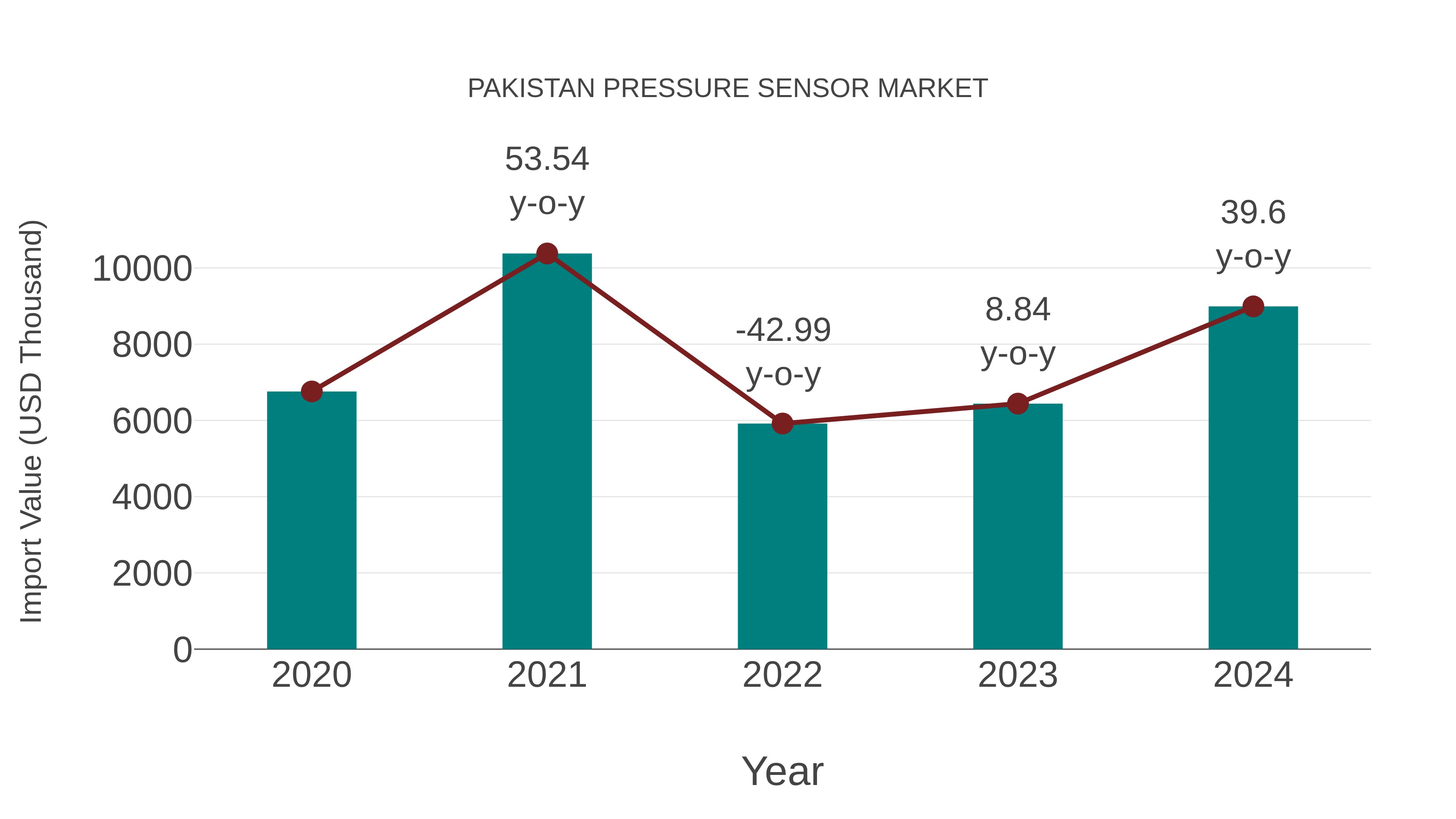
Pakistan import trend for the pressure sensor market showed significant growth, with a 39.6% increase from 2023 to 2024. The compound annual growth rate (CAGR) for imports from 2020 to 2024 stood at 7.39%. This surge in imports can be attributed to the increasing demand for advanced technology in various industries within the country.
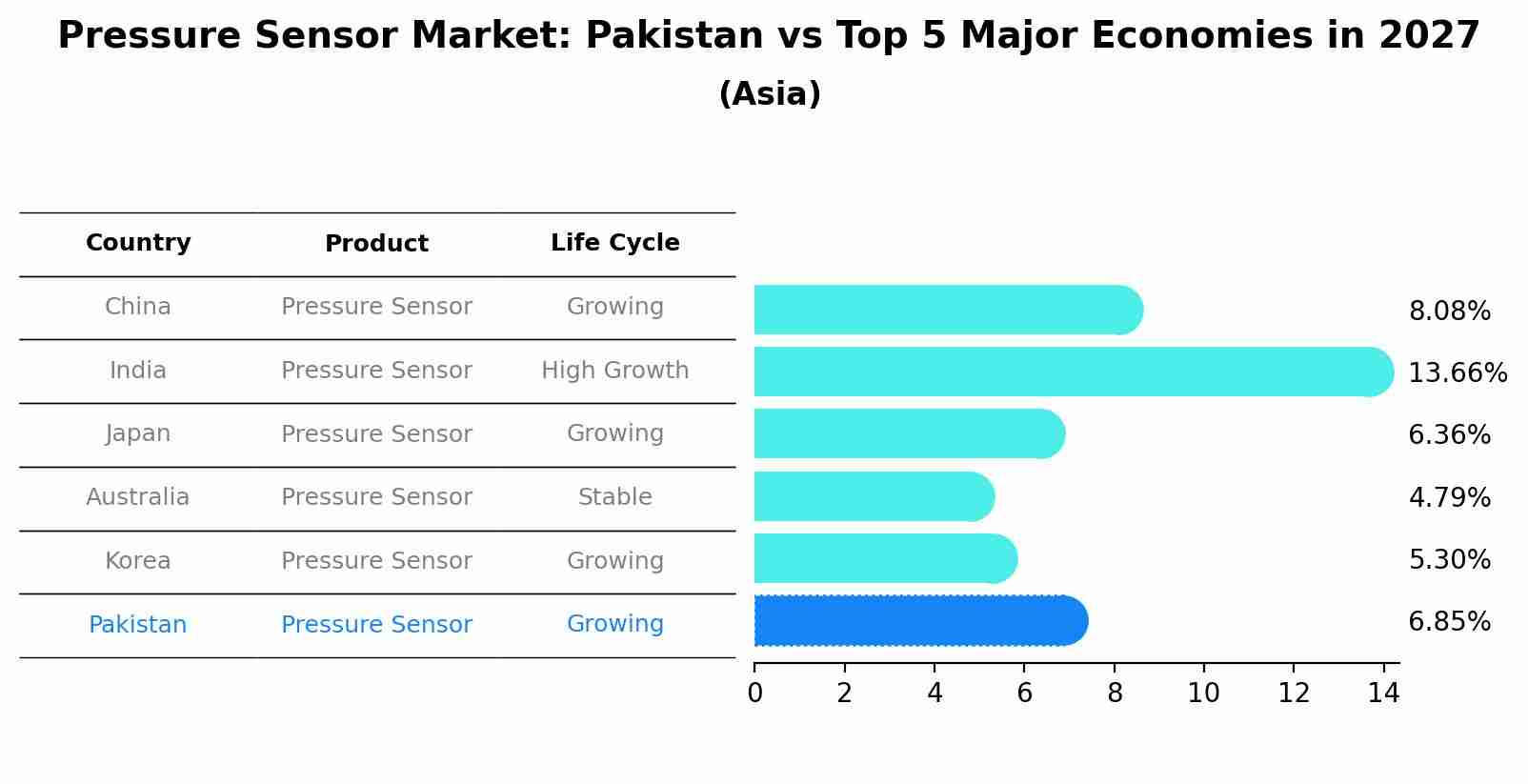
Pressure Sensor Market: Pakistan vs Top 5 Major Economies in 2027 (Asia)
By 2027, the Pressure Sensor market in Pakistan is anticipated to reach a growth rate of 6.85%, as part of an increasingly competitive Asia region, where China remains at the forefront, supported by India, Japan, Australia and South Korea, driving innovations and market adoption across sectors.
Pakistan Pressure Sensor Market Overview
The pressure sensor market in Pakistan is experiencing significant growth, propelled by rising automation across industries, including automotive, aerospace, and healthcare. Demand for precise pressure sensing solutions for monitoring and control purposes is a key driver.
Drivers of the market
In Pakistan, the pressure sensor market is experiencing rapid growth due to several factors. One of the primary drivers is the rising adoption of automation across various industries, including automotive, healthcare, and manufacturing. Pressure sensors play a crucial role in monitoring and controlling processes in these sectors, driving their demand. Additionally, technological advancements, such as the development of MEMS-based pressure sensors, are further fueling market growth.
Challenges of the market
The Pakistan Pressure Sensor Market faces obstacles such as the high cost of sophisticated pressure sensors and the limited availability of high-quality raw materials. There is also a lack of awareness and understanding of the benefits of pressure sensors across various industries. Furthermore, the market struggles with limited research and development initiatives and inadequate local manufacturing capabilities.
Government Policy of the market
The government of Pakistan has implemented policies to stimulate the growth of the pressure sensor market, recognizing its applications in various sectors such as automotive, aerospace, healthcare, and consumer electronics. These policies include investment incentives for research and development in pressure sensor technology, support for establishing sensor manufacturing facilities, and trade promotion measures to enhance the competitiveness of Pakistani pressure sensor products in domestic and international markets. Furthermore, the government has introduced regulations to ensure product quality, performance standards, and safety requirements in pressure sensor design, production, and usage.
Key Highlights of the Report:
- Pakistan Pressure Sensor Market Outlook
- Market Size of Pakistan Pressure Sensor Market, 2024
- Forecast of Pakistan Pressure Sensor Market, 2031
- Historical Data and Forecast of Pakistan Pressure Sensor Revenues & Volume for the Period 2018 - 2031
- Pakistan Pressure Sensor Market Trend Evolution
- Pakistan Pressure Sensor Market Drivers and Challenges
- Pakistan Pressure Sensor Price Trends
- Pakistan Pressure Sensor Porter's Five Forces
- Pakistan Pressure Sensor Industry Life Cycle
- Historical Data and Forecast of Pakistan Pressure Sensor Market Revenues & Volume By Application for the Period 2018 - 2031
- Historical Data and Forecast of Pakistan Pressure Sensor Market Revenues & Volume By Automotive for the Period 2018 - 2031
- Historical Data and Forecast of Pakistan Pressure Sensor Market Revenues & Volume By Medical for the Period 2018 - 2031
- Historical Data and Forecast of Pakistan Pressure Sensor Market Revenues & Volume By Consumer Electronics for the Period 2018 - 2031
- Historical Data and Forecast of Pakistan Pressure Sensor Market Revenues & Volume By Industrial for the Period 2018 - 2031
- Historical Data and Forecast of Pakistan Pressure Sensor Market Revenues & Volume By Aerospace and Defense for the Period 2018 - 2031
- Historical Data and Forecast of Pakistan Pressure Sensor Market Revenues & Volume By Food and Beverage for the Period 2018 - 2031
- Historical Data and Forecast of Pakistan Pressure Sensor Market Revenues & Volume By HVAC for the Period 2018 - 2031
- Pakistan Pressure Sensor Import Export Trade Statistics
- Market Opportunity Assessment By Application
- Pakistan Pressure Sensor Top Companies Market Share
- Pakistan Pressure Sensor Competitive Benchmarking By Technical and Operational Parameters
- Pakistan Pressure Sensor Company Profiles
- Pakistan Pressure Sensor Key Strategic Recommendations






































