Pakistan Sulfuric Acid Market: Import Trend Analysis
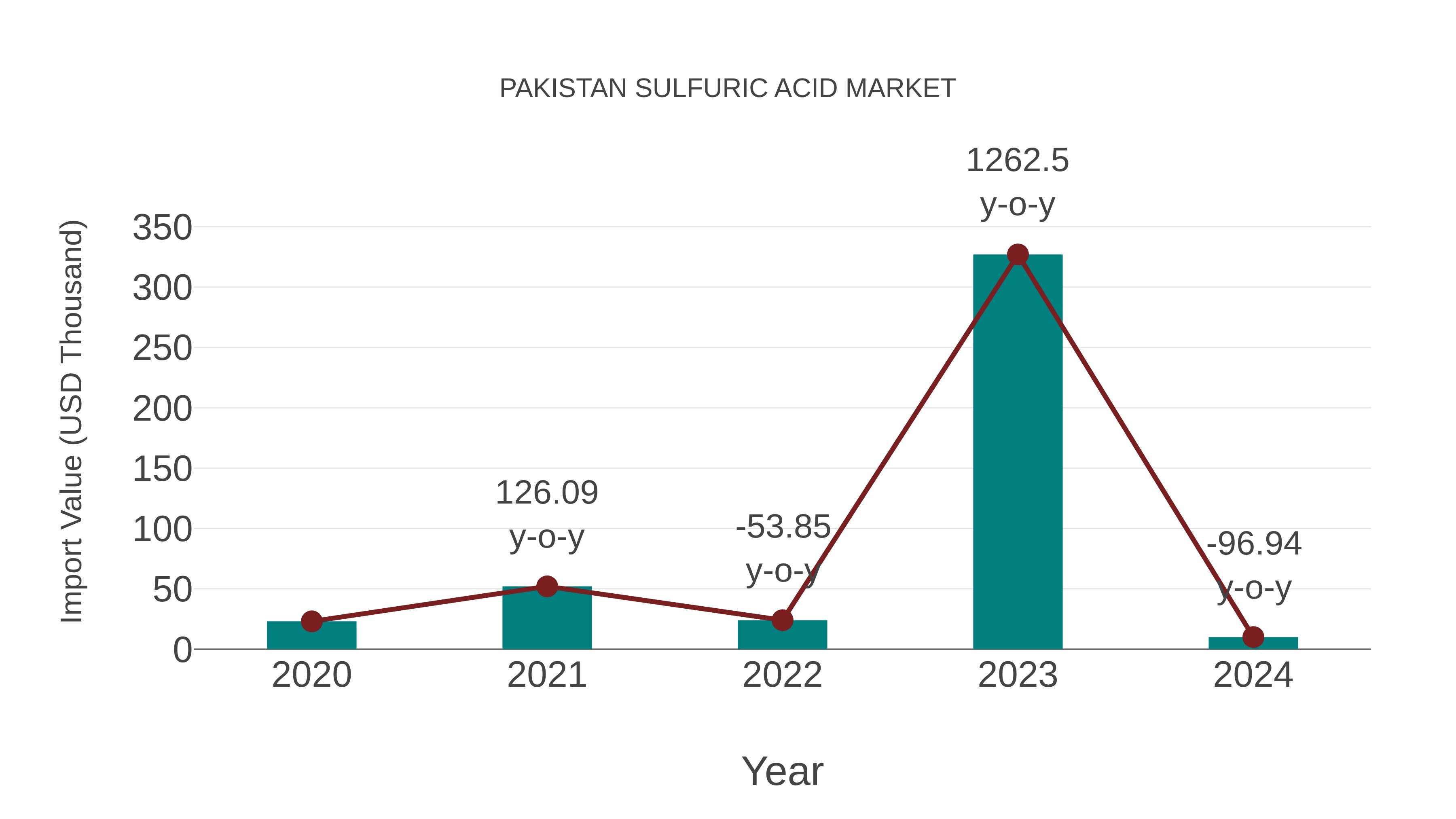
Pakistan sulfuric acid market witnessed a significant decline in imports from 2023 to 2024, with a growth rate of -96.94%. The compound annual growth rate (CAGR) for imports from 2020 to 2024 stood at -18.8%. This drastic decrease could be attributed to shifts in demand or changes in trade policies impacting import volumes.
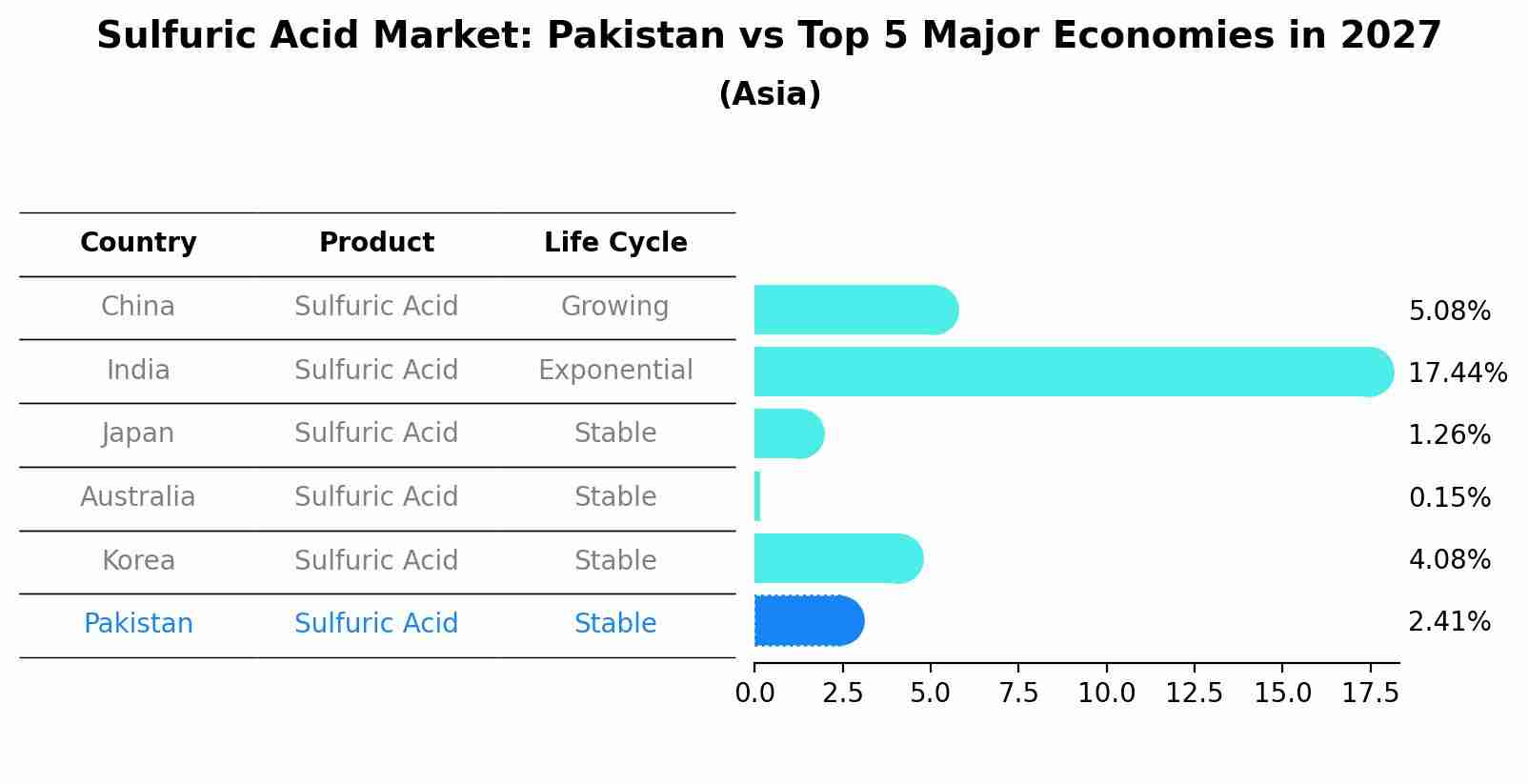
Sulfuric Acid Market: Pakistan vs Top 5 Major Economies in 2027 (Asia)
By 2027, the Sulfuric Acid market in Pakistan is anticipated to reach a growth rate of 2.41%, as part of an increasingly competitive Asia region, where China remains at the forefront, supported by India, Japan, Australia and South Korea, driving innovations and market adoption across sectors.
Pakistan Sulfuric Acid Market Overview
The Pakistan sulfuric acid market is primarily driven by the chemical industry`s demand for sulfuric acid in various applications such as fertilizer production, metal processing, and wastewater treatment. The market is witnessing steady growth due to increasing industrial activities and agriculture sector development. Imports play a significant role in meeting the country`s sulfuric acid requirements, with major suppliers including China, Saudi Arabia, and Belgium. However, efforts to boost domestic production capacity are being made to reduce reliance on imports and ensure supply chain stability. The market is also influenced by factors like government regulations, raw material availability, and economic conditions. Overall, the Pakistan sulfuric acid market is expected to experience moderate growth in the coming years, driven by industrial expansion and infrastructure development initiatives.
Pakistan Sulfuric Acid Market Trends
The Pakistan sulfuric acid market is witnessing steady growth due to increasing demand from various industries such as agriculture, mining, and chemical production. The agriculture sector is a major consumer of sulfuric acid for fertilizer production, which is driving market growth. Additionally, the mining industry`s requirement for sulfuric acid in ore processing and extraction is contributing to market expansion. The chemical industry also plays a significant role in the demand for sulfuric acid for the production of various chemicals. With the government`s initiatives to boost industrialization and infrastructure development in Pakistan, the sulfuric acid market is expected to continue its growth trajectory in the coming years. Increasing investments in the manufacturing sector and the rise in export opportunities further propel the market`s growth prospects.
Pakistan Sulfuric Acid Market Challenges
In the Pakistan Sulfuric Acid Market, some of the key challenges faced include fluctuating raw material prices, inadequate infrastructure for transportation and storage, environmental regulations compliance, and intense competition among local manufacturers. Fluctuating prices of raw materials, such as sulfur, impact production costs and profitability for sulfuric acid manufacturers. Inadequate infrastructure for transportation and storage can lead to logistical issues, delays, and increased costs. Compliance with environmental regulations, especially regarding emissions and waste disposal, poses a challenge for companies operating in the market. Additionally, the presence of numerous local manufacturers vying for market share intensifies competition, leading to price wars and margin pressures. Overall, navigating these challenges requires strategic planning, efficient operations, and a keen understanding of market dynamics.
Pakistan Sulfuric Acid Market Investment Opportunities
The Pakistan sulfuric acid market presents several investment opportunities due to the increasing demand for sulfuric acid in various industries such as agriculture, chemicals, and pharmaceuticals. With Pakistan being an agricultural-based economy, the need for sulfuric acid as a key component in fertilizer production is expected to drive market growth. Additionally, the expanding chemical and pharmaceutical sectors in the country further contribute to the demand for sulfuric acid. Investing in sulfuric acid production facilities, distribution networks, or technology upgrades could be lucrative opportunities for investors looking to capitalize on the growing market demand. However, potential investors should consider factors such as regulatory environment, competition, and raw material sourcing to make informed investment decisions in the Pakistan sulfuric acid market.
Pakistan Sulfuric Acid Market Government Policy
The Pakistani government has implemented various policies to regulate the sulfuric acid market in the country. These policies include the imposition of import duties on sulfuric acid to protect domestic producers, ensuring compliance with environmental standards for sulfuric acid production facilities, and promoting the use of sulfuric acid in various industries such as agriculture, textiles, and chemicals. The government has also focused on promoting research and development activities in the sulfuric acid sector to enhance efficiency and competitiveness. Additionally, efforts have been made to monitor and control the use of sulfuric acid to prevent any misuse or harmful effects on the environment and public health. Overall, these policies aim to support the growth and sustainability of the sulfuric acid market in Pakistan while ensuring responsible and sustainable practices in its production and use.
Pakistan Sulfuric Acid Market Future Outlook
The Pakistan Sulfuric Acid Market is expected to witness steady growth in the coming years driven by increasing industrial activities, particularly in sectors such as agriculture, chemicals, and metal processing. The growing demand for sulfuric acid as a key chemical reagent in various industrial processes is anticipated to fuel market expansion. Additionally, the rising focus on environmental regulations and the need for wastewater treatment solutions are likely to contribute to the market`s growth. However, challenges such as fluctuating raw material prices and stringent regulatory frameworks may hinder market growth to some extent. Overall, the Pakistan Sulfuric Acid Market is poised for growth opportunities, driven by industrial development and the increasing application scope of sulfuric acid across various sectors.
Key Highlights of the Report:
- Pakistan Sulfuric Acid Market Outlook
- Market Size of Pakistan Sulfuric Acid Market, 2021
- Forecast of Pakistan Sulfuric Acid Market, 2031
- Historical Data and Forecast of Pakistan Sulfuric Acid Revenues & Volume for the Period 2018 - 2031
- Pakistan Sulfuric Acid Market Trend Evolution
- Pakistan Sulfuric Acid Market Drivers and Challenges
- Pakistan Sulfuric Acid Price Trends
- Pakistan Sulfuric Acid Porter's Five Forces
- Pakistan Sulfuric Acid Industry Life Cycle
- Historical Data and Forecast of Pakistan Sulfuric Acid Market Revenues & Volume By Raw Material Type for the Period 2018 - 2031
- Historical Data and Forecast of Pakistan Sulfuric Acid Market Revenues & Volume By Elemental Sulfur for the Period 2018 - 2031
- Historical Data and Forecast of Pakistan Sulfuric Acid Market Revenues & Volume By Pyrite Ore for the Period 2018 - 2031
- Historical Data and Forecast of Pakistan Sulfuric Acid Market Revenues & Volume By Other Raw Materials (Base Metal Smelters) for the Period 2018 - 2031
- Historical Data and Forecast of Pakistan Sulfuric Acid Market Revenues & Volume By End-user Industry for the Period 2018 - 2031
- Historical Data and Forecast of Pakistan Sulfuric Acid Market Revenues & Volume By Fertilizer for the Period 2018 - 2031
- Historical Data and Forecast of Pakistan Sulfuric Acid Market Revenues & Volume By Chemical & Pharmaceutical for the Period 2018 - 2031
- Historical Data and Forecast of Pakistan Sulfuric Acid Market Revenues & Volume By Automotive for the Period 2018 - 2031
- Historical Data and Forecast of Pakistan Sulfuric Acid Market Revenues & Volume By Petroleum Refining for the Period 2018 - 2031
- Historical Data and Forecast of Pakistan Sulfuric Acid Market Revenues & Volume By Other End-user Industries (Pulp & Paper, Metal Processing) for the Period 2018 - 2031
- Pakistan Sulfuric Acid Import Export Trade Statistics
- Market Opportunity Assessment By Raw Material Type
- Market Opportunity Assessment By End-user Industry
- Pakistan Sulfuric Acid Top Companies Market Share
- Pakistan Sulfuric Acid Competitive Benchmarking By Technical and Operational Parameters
- Pakistan Sulfuric Acid Company Profiles
- Pakistan Sulfuric Acid Key Strategic Recommendations






































