Peru Detergents Market (2026-2032) | Size, Companies, Trends, Growth, Value, Industry, Share, Analysis, Forecast & Revenue
Market Forecast By Type (Anionic Detergents, Cationic Detergents, Non-ionic Detergents, Zwitterionic (Amphoteric) Detergents), By Application (Laundry Cleaning Products, Household Cleaning Products, Dishwashing Products, Fuel Additives, Biological Reagent, Other Applications) And Competitive Landscape
| Product Code: ETC220566 | Publication Date: Aug 2022 | Updated Date: Mar 2026 | Product Type: Market Research Report | |
| Publisher: 6Wresearch | Author: Dhaval Chaurasia | No. of Pages: 75 | No. of Figures: 35 | No. of Tables: 20 |
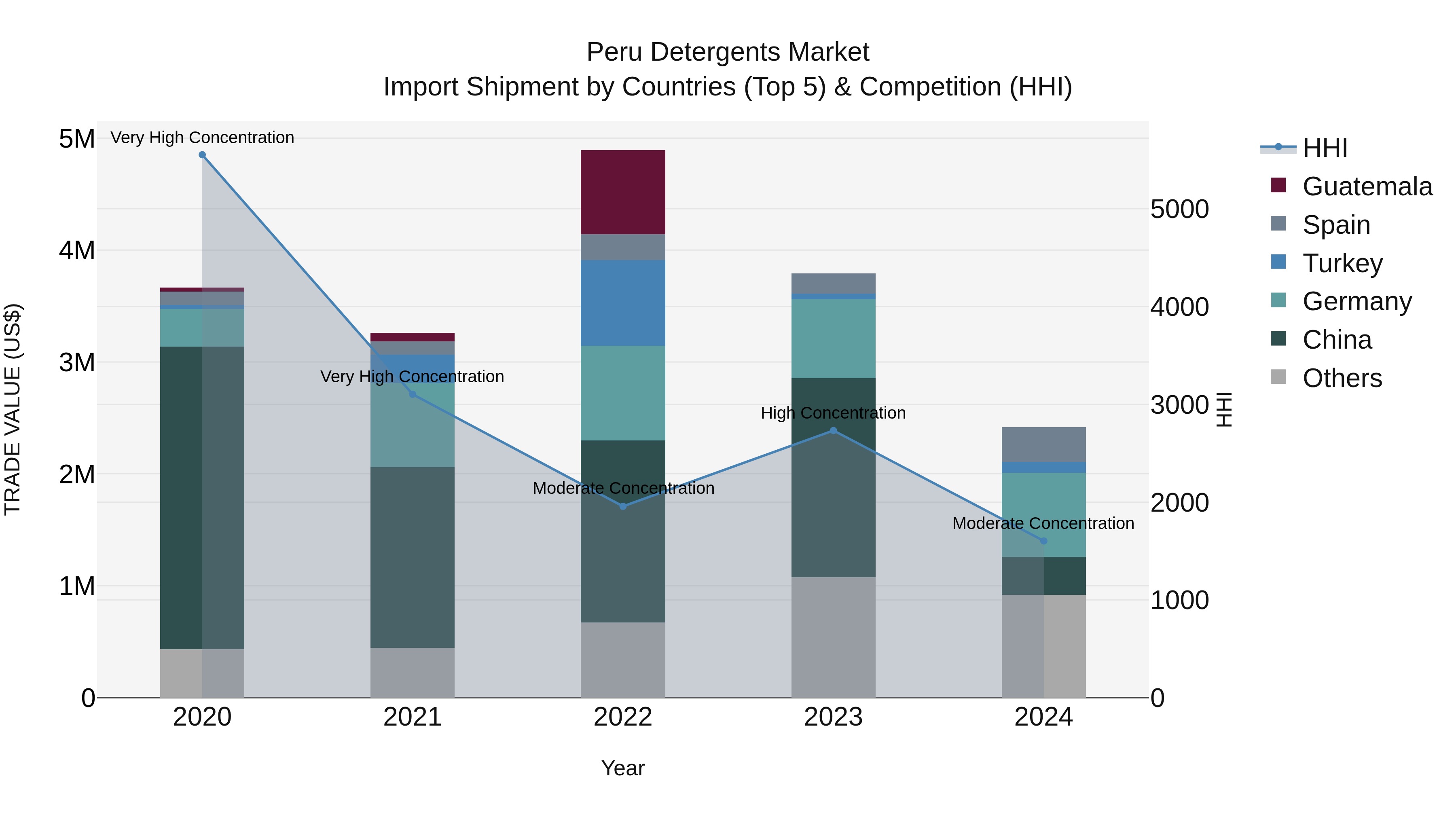
Peru Detergents Market Top 5 Importing Countries and Market Competition (HHI) Analysis
Peru`s detergents import market saw a notable shift in 2024, with top exporters being Germany, China, Spain, Colombia, and the USA. The market moved from high concentration in 2023 to a more moderate concentration in 2024, indicating increased competition. However, the overall CAGR for 2020-24 remained negative at -9.85%, with a significant decline in growth rate from 2023 to 2024 at -36.2%. These trends suggest a challenging environment for detergent importers in Peru, highlighting the need for strategic adaptation and differentiation to succeed in this competitive market.
Peru Detergents Market Growth Rate
According to 6Wresearch internal database and industry insights, the Peru Detergents Market is projected to grow at a compound annual growth rate (CAGR) of 5.8% during the forecast period from 2026 to 2032.
Topics Covered in the Peru Detergents Market Report
Peru Detergents Market report thoroughly covers the market by type and application. It provides an unbiased and detailed analysis of ongoing market trends, opportunities, challenges, and market drivers, helping stakeholders align their strategies with current and future market dynamics.
Peru Detergents Market Highlights
| Report Name | Peru Detergents Market |
| Forecast Period | 2026–2032 |
| CAGR | 5.8% |
| Growing Sector | Consumer Goods & Chemical Manufacturing |
Peru Detergents Market Synopsis
Peru Detergents Market is expected to accomplish unprecedented growth on account of increasing urban population, increased hygiene awareness, and the modernization of household chores. Along with this, key advancements in biodegradable chemical formulations, the proliferation of e-commerce platforms, and favorable trade dynamics within the Andean Community are also spurring the market. With a strong push toward sustainability and the growing popularity of liquid formats in the middle-class segment, the market is poised for a consistent expansion through 2032.
Evaluation of Growth Drivers in the Peru Detergents Market
Below mentioned are some major drivers and their impact on the Peru Detergents Market dynamics:
| Drivers | Primary Segment Affected | Why It Matters (Evidence) |
| Rapid Urbanization & Lifestyle Shifts | Laundry Cleaning Products | Over 78% of Peru’s population is urbanized, resulting in higher dependence on branded cleaning solutions over traditional soaps. |
| Washing Machine Penetration | Anionic & Non-ionic Detergents | Increasing middle-class incomes have led to a 12% increase in automatic washer sales, requiring compatible high-efficiency detergents. |
| Expanding E-commerce | All Segments | Digital marketplaces like Mercado Libre and specialized retail apps have abridged distribution barriers for premium and niche detergent brands. |
| Key Emphasis on Sustainability | Bio-based/Zwitterionic | Peruvian consumers are actively seeking "Green" certifications, propelling manufacturers to replace phosphates with eco-friendly builders. |
| Industrial Growth | Commercial Cleaning | The recovery of the hospitality and tourism sector in Cusco and Lima has spiked the demand for bulk industrial-grade detergents. |
Peru Detergents Market is expected to proliferate, growing at a CAGR of approximately 5.8% during the forecast period (2026-2032). With increasing awareness about hygiene, rising disposable income, and the growing adoption of both household and industrial cleaning solutions, the demand for detergents is projected to rise at rapid pace. On the other hand, the market for detergents in Peru is also witnessing major shifts towards eco-friendly and biodegradable solutions as consumers and manufacturers alike prioritize environmental sustainability. Due to growing awareness about the harmful impact of chemicals in traditional detergents, eco-conscious brands are becoming more prevalent, offering products that promise to reduce environmental footprints.
Evaluation of Restraints in the Peru Detergents Market
Below mentioned are some major restraints and their influence on the Peru Detergents Market dynamics:
| Restraints | Primary Segment Affected | What This Means (Evidence) |
| Volatility in Raw Material Prices | All Segments | Major reliance on imported surfactants makes local manufacturers vulnerable to global oil price fluctuations and currency deflation. |
| High Informal Market Share | Household Cleaning | Unbranded, bulk-sold detergents in local "mercados" offer price competition to established players. |
| Regulatory Compliance Costs | Small-scale Manufacturers | New environmental laws regarding wastewater discharge and chemical registration (RENASQ) upsurge operational overhead. |
| Infrastructure Restraints | Distribution & Logistics | Increasing transportation costs to the Andean and Amazonian regions curb the reach of liquid detergents due to their weight-to-value ratio. |
| Water Scarcity Concerns | Laundry & Dishwashing | Major water shortages in coastal regions like Ica may restrict the frequency of laundry cycles, affecting overall consumption volume. |
Peru Detergents Market Challenges
The Peru Detergents Industry faces challenges such as the high cost of transitioning to "green" chemistry, intense price competition from private labels, and logistical difficulties in reaching remote rural segments. Inconsistency in water hardness across different regions also complicates the efficacy of standard detergent formulations. However, policies such as those outlined in the National Plan for Environmental Action from the government of Peru, coupled with the increasing influence of social media (like TikTok and Instagram) for home-care advice, should provide continued momentum in the market for detergent products.
Emerging Trends in the Peru Detergents Market
The following are some of the current trends influencing the Peru Detergents Market growth:
- Rise of Liquid and Pod Formats - Powdered detergent is being outperformed by liquids and single-use pods, as they dissolve better in cold water, a common practice for decreasing energy usage in Peru.
- Growth of Probiotic Cleaning Products - There is a niche interest growing around the use of "good bacteria" in detergents that provide long term surface protection and odor.
- Development of Refill Model Stations - To address the growth of plastic waste, major retailers have started developing refill stations for liquid detergents, which appeals to environmentally conscious urbanites.
Investment Potential in the Peru Detergents Market
Key opportunities for investment include:
- Specialized industrial laundry services – With the boom in the mining and textile export industries in Peru, there is a strong opportunity to provide high-performance detergents for use in these industries, and potentially high margins.
- Tier-2 city distribution – There is an opportunity to enter growing urban areas such as Trujillo, Piura, and Huancayo, where branded penetration is still developing.
- Multi-Functional dishwashing solutions – There is a need to develop enzymatic dishwashing detergents that are able to cut through heavy grease associated with traditional Peruvian cuisine while being gentle on hands.
Top 5 Leading Players in the Peru Detergents Market
Below is a list of emerging companies operating in the Peru Detergents Market:
1. Unilever Peru S.A.
| Company Name | Unilever Peru S.A. |
| Headquarters | Lima, Peru |
| Established | 1929 |
| Website | - |
Unilever is a leading player in the detergent market in Peru, offering products such as OMO, Rinso, and Surf.
2. Procter & Gamble (P&G) Peru
| Company Name | Procter & Gamble (P&G) Peru |
| Headquarters | Lima, Peru |
| Established | 1982 |
| Website | - |
Procter & Gamble’s popular detergent brands, including Ariel and Tide, have a strong presence in the Peruvian market.
3. Colgate-Palmolive Peru
| Company Name | Colgate-Palmolive Peru |
| Headquarters | Lima, Peru |
| Established | 1920 |
| Website | - |
Colgate-Palmolive is a significant player in Peru’s detergent market, offering products under the brand names Axion and Palmolive.
4. Química Suiza S.A.
| Company Name | Química Suiza S.A. |
| Headquarters | Lima, Peru |
| Established | 1963 |
| Website | - |
Química Suiza is a leading manufacturer of detergents in Peru, with a focus on producing high-quality laundry and household cleaning products for both the retail and industrial sectors.
5. Corporación Lindley S.A.
| Company Name | Corporación Lindley S.A. |
| Headquarters | Lima, Peru |
| Established | 1950 |
| Website | - |
Lindley is another important player in the Peruvian detergents market, offering a range of cleaning products tailored to both consumer and industrial needs.
Government Regulations Introduced in the Peru Detergents Market
The Peruvian government has introduced several frameworks to regulate the chemical and environmental impact of detergents. A notable example is the Legislative Decree 1570 (2023), which established the National Registry of Chemical Substances (RENASQ). This requires all detergent importers and manufacturers to register hazardous components to ensure public health safety. Additionally, Supreme Decree No. 003-2025-MINAM provides guidelines for the gradual reduction of non-biodegradable surfactants in household products. The government also promotes the "Peru Limpio" (Clean Peru) initiative, which incentivizes companies to adopt circular economy practices, such as using post-consumer recycled (PCR) plastic in detergent packaging.
Future Insights of the Peru Detergents Market
In the next few years, the Peru Detergent Market is expected to transition to a new structure as premiumisation reaches mid-sized cities. Extensive investments will be made in digital sales methods and AI-driven supply chain management in order to increase efficiency by reducing processing times and lowering costs. The introduction of advanced enzymes that work at lower temperatures will change the face of the cold wash category and help meet national energy conservation targets. In addition, the expansion of the Direct to Consumer (D2C) model through subscription services for laundry pods is already projected to become major area of growth for the Peru Detergent Market by 2030.
Market Segmentation Analysis
The report offers a comprehensive study of the following market segments and their leading categories:
By Type - Anionic Detergents to dominate the market
Anionic Detergents segment is expected to maintain its dominance in the Peru Detergents Industry as these surfactants, such as Linear Alkylbenzene Sulfonate (LAS), are highly effective at removing oily stains and clay-based dirt, which are common in Peru's varied geography.
By Application - Laundry Cleaning Products to dominate the market
According to Rishil, Senior Research Analyst, 6Wresearch, Laundry Cleaning Products segment is expected to lead Peru Detergents Market share, driven by the fundamental need for garment care in a growing population. In Peru, laundry is a high-frequency task, and as consumers move from traditional laundry soaps to branded detergents, this segment sees consistent volume growth.
Key Attractiveness of the Report
- 10 Years of Market Numbers
- Historical Data Starting from 2022 to 2025
- Base Year: 2025
- Forecast Data until 2032
- Key Performance Indicators Impacting the Market
- Major Upcoming Developments and Projects
Key Highlights of the Report:
- Peru Detergents Market Outlook
- Market Size of Peru Detergents Market, 2025
- Forecast of Peru Detergents Market, 2032
- Historical Data and Forecast of Peru Detergents Revenues & Volume for the Period 2022 - 2032
- Peru Detergents Market Trend Evolution
- Peru Detergents Market Drivers and Challenges
- Peru Detergents Price Trends
- Peru Detergents Porter's Five Forces
- Peru Detergents Industry Life Cycle
- Historical Data and Forecast of Peru Detergents Market Revenues & Volume By Type for the Period 2022 - 2032
- Historical Data and Forecast of Peru Detergents Market Revenues & Volume By Anionic Detergents for the Period 2022 - 2032
- Historical Data and Forecast of Peru Detergents Market Revenues & Volume By Cationic Detergents for the Period 2022 - 2032
- Historical Data and Forecast of Peru Detergents Market Revenues & Volume By Non-ionic Detergents for the Period 2022 - 2032
- Historical Data and Forecast of Peru Detergents Market Revenues & Volume By Zwitterionic (Amphoteric) Detergents for the Period 2022 - 2032
- Historical Data and Forecast of Peru Detergents Market Revenues & Volume By Application for the Period 2022 - 2032
- Historical Data and Forecast of Peru Detergents Market Revenues & Volume By Laundry Cleaning Products for the Period 2022 - 2032
- Historical Data and Forecast of Peru Detergents Market Revenues & Volume By Household Cleaning Products for the Period 2022 - 2032
- Historical Data and Forecast of Peru Detergents Market Revenues & Volume By Dishwashing Products for the Period 2022 - 2032
- Historical Data and Forecast of Peru Detergents Market Revenues & Volume By Fuel Additives for the Period 2022 - 2032
- Historical Data and Forecast of Peru Detergents Market Revenues & Volume By Biological Reagent for the Period 2022 - 2032
- Historical Data and Forecast of Peru Detergents Market Revenues & Volume By Other Applications for the Period 2022 - 2032
- Peru Detergents Import Export Trade Statistics
- Market Opportunity Assessment By Type
- Market Opportunity Assessment By Application
- Peru Detergents Top Companies Market Share
- Peru Detergents Competitive Benchmarking By Technical and Operational Parameters
- Peru Detergents Company Profiles
- Peru Detergents Key Strategic Recommendations
Market Covered
The report offers a comprehensive study of the following Peru Detergents Market segments:
By Type
- Anionic Detergents
- Cationic Detergents
- Non-ionic Detergents
- Zwitterionic (Amphoteric) Detergents
By Application
- Laundry Cleaning Products
- Household Cleaning Products
- Dishwashing Products
- Fuel Additives
- Biological Reagent
- Other Applications
Peru Detergents Market (2026-2032): FAQs
Anionic Detergents are expected to dominate the market, particularly in laundry and household cleaning products, due to their efficiency in removing dirt and stains.
Emerging trends include the growth of online shopping and sustainability in packaging with biodegradable and recyclable materials.
Peru Detergents Market is expected to grow at a compound annual growth rate of 5.8% during the forecast period of 2026 to 2032.
Some of the challenges include price sensitivity in certain regions, especially rural areas, distribution limitations in remote areas, and compliance costs for eco-friendly production.
6Wresearch actively monitors the Peru Detergents Market and publishes its comprehensive annual report, highlighting emerging trends, growth drivers, revenue analysis, and forecast outlook. Our insights help businesses to make data-backed strategic decisions with ongoing market dynamics. Our analysts track relevent industries related to the Peru Detergents Market, allowing our clients with actionable intelligence and reliable forecasts tailored to emerging regional needs.
Yes, we provide customisation as per your requirements. To learn more, feel free to contact us on sales@6wresearch.com
|
1 Executive Summary |
|
2 Introduction |
|
2.1 Key Highlights of the Report |
|
2.2 Report Description |
|
2.3 Market Scope & Segmentation |
|
2.4 Research Methodology |
|
2.5 Assumptions |
|
3 Peru Detergents Market Overview |
|
3.1 Peru Country Macro Economic Indicators |
|
3.2 Peru Detergents Market Revenues & Volume, 2022 & 2032F |
|
3.3 Peru Detergents Market - Industry Life Cycle |
|
3.4 Peru Detergents Market - Porter's Five Forces |
|
3.5 Peru Detergents Market Revenues & Volume Share, By Type, 2022 & 2032F |
|
3.6 Peru Detergents Market Revenues & Volume Share, By Application, 2022 & 2032F |
|
4 Peru Detergents Market Dynamics |
|
4.1 Impact Analysis |
|
4.2 Market Drivers |
|
4.2.1 Increasing urbanization in Peru leading to a rise in demand for detergents |
|
4.2.2 Growing awareness about hygiene and cleanliness among the Peruvian population |
|
4.2.3 Expansion of retail channels and e-commerce platforms enhancing the accessibility of detergents |
|
4.3 Market Restraints |
|
4.3.1 Fluctuating raw material prices affecting the production costs of detergents |
|
4.3.2 Intense competition from local and international detergent manufacturers |
|
4.3.3 Regulatory constraints related to environmental sustainability and product safety standards |
|
5 Peru Detergents Market Trends |
|
6 Peru Detergents Market, By Types |
|
6.1 Peru Detergents Market, By Type |
|
6.1.1 Overview and Analysis |
|
6.1.2 Peru Detergents Market Revenues & Volume, By Type, 2022 - 2032F |
|
6.1.3 Peru Detergents Market Revenues & Volume, By Anionic Detergents, 2022 - 2032F |
|
6.1.4 Peru Detergents Market Revenues & Volume, By Cationic Detergents, 2022 - 2032F |
|
6.1.5 Peru Detergents Market Revenues & Volume, By Non-ionic Detergents, 2022 - 2032F |
|
6.1.6 Peru Detergents Market Revenues & Volume, By Zwitterionic (Amphoteric) Detergents, 2022 - 2032F |
|
6.2 Peru Detergents Market, By Application |
|
6.2.1 Overview and Analysis |
|
6.2.2 Peru Detergents Market Revenues & Volume, By Laundry Cleaning Products, 2022 - 2032F |
|
6.2.3 Peru Detergents Market Revenues & Volume, By Household Cleaning Products, 2022 - 2032F |
|
6.2.4 Peru Detergents Market Revenues & Volume, By Dishwashing Products, 2022 - 2032F |
|
6.2.5 Peru Detergents Market Revenues & Volume, By Fuel Additives, 2022 - 2032F |
|
6.2.6 Peru Detergents Market Revenues & Volume, By Biological Reagent, 2022 - 2032F |
|
6.2.7 Peru Detergents Market Revenues & Volume, By Other Applications, 2022 - 2032F |
|
7 Peru Detergents Market Import-Export Trade Statistics |
|
7.1 Peru Detergents Market Export to Major Countries |
|
7.2 Peru Detergents Market Imports from Major Countries |
|
8 Peru Detergents Market Key Performance Indicators |
|
8.1 Per capita detergent consumption in Peru |
|
8.2 Household penetration of detergent products |
|
8.3 Adoption rate of eco-friendly and sustainable detergents in the market |
|
9 Peru Detergents Market - Opportunity Assessment |
|
9.1 Peru Detergents Market Opportunity Assessment, By Type, 2022 & 2032F |
|
9.2 Peru Detergents Market Opportunity Assessment, By Application, 2022 & 2032F |
|
10 Peru Detergents Market - Competitive Landscape |
|
10.1 Peru Detergents Market Revenue Share, By Companies, 2025 |
|
10.2 Peru Detergents Market Competitive Benchmarking, By Operating and Technical Parameters |
|
11 Company Profiles |
|
12 Recommendations |
|
13 Disclaimer |
Global Go To Market Strategy - 2030
Export potential enables firms to identify high-growth global markets with greater confidence by combining advanced trade intelligence with a structured quantitative methodology. The framework analyzes emerging demand trends and country-level import patterns while integrating macroeconomic and trade datasets such as GDP and population forecasts, bilateral import–export flows, tariff structures, elasticity differentials between developed and developing economies, geographic distance, and import demand projections. Using weighted trade values from 2020–2024 as the base period to project country-to-country export potential for 2030, these inputs are operationalized through calculated drivers such as gravity model parameters, tariff impact factors, and projected GDP per-capita growth. Through an analysis of hidden potentials, demand hotspots, and market conditions that are most favorable to success, this method enables firms to focus on target countries, maximize returns, and global expansion with data, backed by accuracy.
By factoring in the projected importer demand gap that is currently unmet and could be potential opportunity, it identifies the potential for the Exporter (Country) among 190 countries, against the general trade analysis, which identifies the biggest importer or exporter.
To discover high-growth global markets and optimize your business strategy:
Click Here
Pricing
- Single User License$ 1,995
- Department License$ 2,400
- Site License$ 3,120
- Global License$ 3,795

Leadership Perspectives from Industry Events
Search
Thought Leadership and Analyst Meet





Our Clients








6WResearch In News
- India Air Conditioner Market Set for Strong Rebound in 2026 After Weather-Led Correction and GST-Driven Recovery: 6Wresearch
- ADAS in India: How Automatic Emergency Braking, Blind Spot Detection & Driver Monitoring are Transforming Road Safety
- Doha a strategic location for EV manufacturing hub: IPA Qatar
- Demand for luxury TVs surging in the GCC, says Samsung
- Empowering Growth: The Thriving Journey of Bangladesh’s Cable Industry
- Demand for luxury TVs surging in the GCC, says Samsung
Latest Reports
- Poland Fire Protection Systems Market (2026-2032)
- Cape Verde Portable Hand-Thrown Extinguisher Market (2026-2032)
- Canada Portable Hand-Thrown Extinguisher Market (2026-2032)
- Cameroon Portable Hand-Thrown Extinguisher Market (2026-2032)
- Burundi Portable Hand-Thrown Extinguisher Market (2026-2032)
- Burkina Faso Portable Hand-Thrown Extinguisher Market (2026-2032)
- Bulgaria Portable Hand-Thrown Extinguisher Market (2026-2032)
- Brunei Portable Hand-Thrown Extinguisher Market (2026-2032)
- Botswana Portable Hand-Thrown Extinguisher Market (2026-2032)
- Bosnia and Herzegovina Portable Hand-Thrown Extinguisher Market (2026-2032)
Industry Events and Analyst Meet

HIMTEX 2026

India Refining Summit 2026

India EV Show 2026

EV tech India Expo 2026

Auto Tech Asia 2026
Whitepaper
- Middle East & Africa Commercial Security Market Click here to view more.
- Middle East & Africa Fire Safety Systems & Equipment Market Click here to view more.
- GCC Drone Market Click here to view more.
- Middle East Lighting Fixture Market Click here to view more.
- GCC Physical & Perimeter Security Market Click here to view more.


