Peru Insect Repellent Market Top 5 Importing Countries and Market Competition (HHI) Analysis
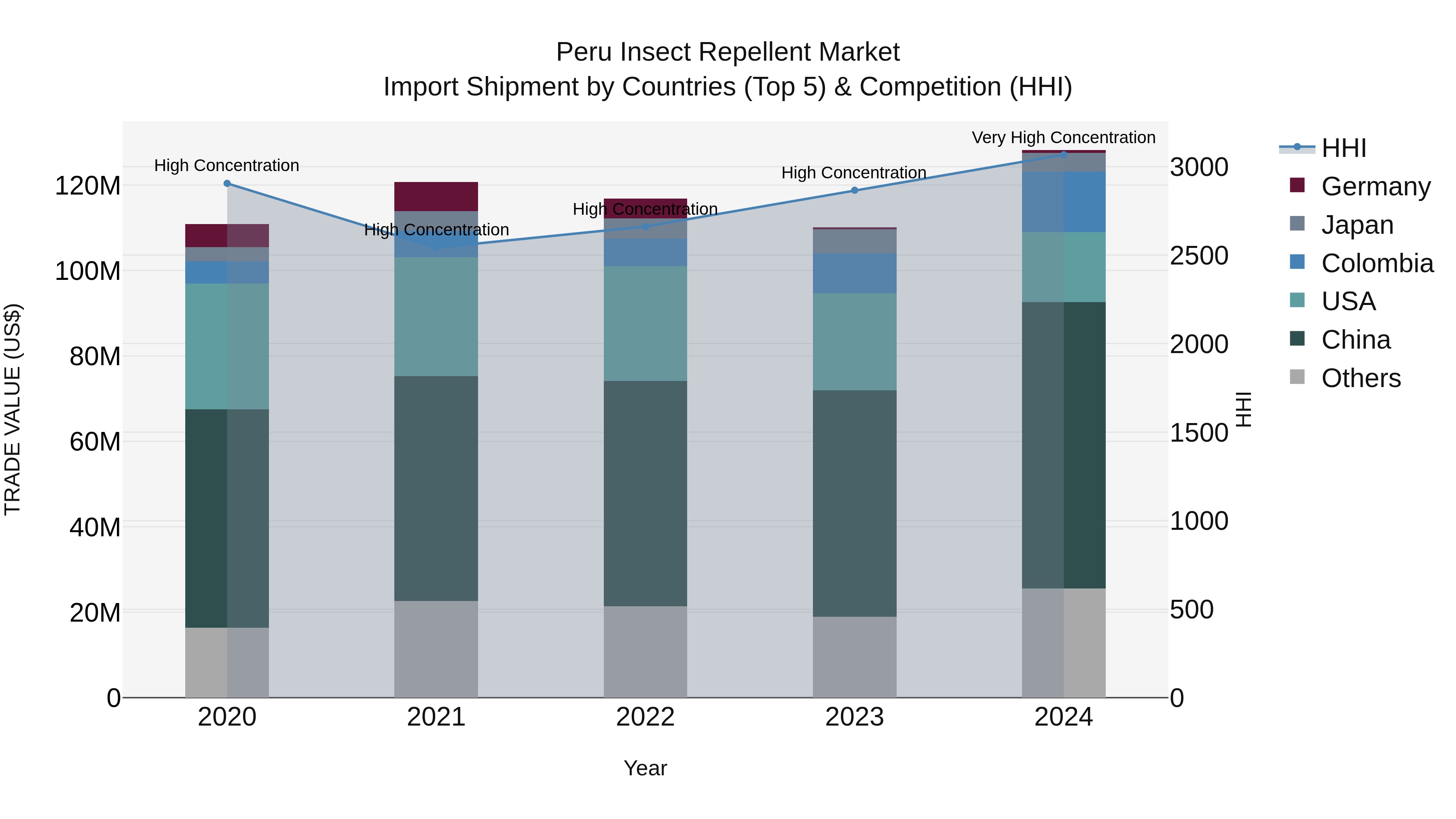
The insect repellent import market in Peru continues to show strong growth, with a significant increase in concentration among the top exporting countries. In 2024, China, USA, Colombia, Japan, and the UK maintained their positions as key suppliers. The high Herfindahl-Hirschman Index (HHI) in 2023 escalated to very high concentration in 2024, indicating a more consolidated market. The compound annual growth rate (CAGR) from 2020 to 2024 stands at a healthy 3.7%, with a notable growth rate of 16.39% from 2023 to 2024, suggesting a growing demand for insect repellent products in Peru.
Peru Insect Repellent Market Overview
The Peru insect repellent market is experiencing steady growth driven by increasing awareness about insect-borne diseases and a growing demand for protection against mosquitoes and other pests. Key players in the market offer a wide range of products including sprays, lotions, and wearable devices with various active ingredients such as DEET, picaridin, and natural oils. The market is characterized by intense competition, with companies focusing on product innovation, marketing strategies, and expanding distribution channels to gain a competitive edge. Factors such as rising disposable income, changing lifestyles, and a growing tourism industry contribute to the market`s growth. Additionally, the government`s initiatives to control mosquito-borne diseases further boost the demand for insect repellents in Peru. Overall, the Peru insect repellent market presents opportunities for both established players and new entrants to capitalize on the increasing demand for effective protection against insects.
Peru Insect Repellent Market Trends and Opportunities
The Peru insect repellent market is witnessing a shift towards more natural and eco-friendly products, driven by increasing consumer awareness of the harmful effects of chemical-based repellents. There is a rising demand for products containing natural ingredients like citronella, eucalyptus, and neem due to their perceived safety and effectiveness. Additionally, the market is ripe with opportunities for innovative packaging solutions, convenient application methods such as sprays and wipes, and products targeting specific demographics like children and outdoor enthusiasts. With the growing concern over mosquito-borne diseases like dengue and Zika virus, there is a significant opportunity for companies to capitalize on the increasing need for reliable and sustainable insect repellent solutions in Peru.
Peru Insect Repellent Market Challenges
The Peru Insect Repellent Market faces challenges related to consumer awareness and education, as there is a need to educate the population about the importance of using insect repellents to prevent insect-borne diseases like dengue fever and malaria. Additionally, there may be issues with the availability and affordability of quality insect repellent products in certain regions of Peru, leading to inconsistent usage patterns. Competition from traditional remedies and natural alternatives also poses a challenge for insect repellent manufacturers in penetrating the market. Furthermore, regulatory hurdles and concerns about the environmental impact of certain chemical ingredients used in insect repellents may affect the market growth. Overall, addressing these challenges through targeted marketing campaigns, product diversification, and sustainable practices will be crucial for the Peru Insect Repellent Market to thrive.
Peru Insect Repellent Market Drivers
The Peru Insect Repellent Market is primarily driven by increasing awareness about insect-borne diseases such as dengue fever, Zika virus, and malaria, leading to a growing demand for insect repellent products. Additionally, the rise in outdoor recreational activities, tourism, and agriculture activities further fuels the need for effective insect protection. The preference for natural and organic insect repellents due to concerns over chemical exposure also drives market growth. Government initiatives to control insect-borne diseases and promote public health awareness contribute to the market expansion. Moreover, the availability of a wide range of innovative products, convenient packaging options, and aggressive marketing strategies by key players are key drivers propelling the growth of the insect repellent market in Peru.
Peru Insect Repellent Market Government Policies
The government of Peru has established regulations and policies related to insect repellents to ensure the safety and efficacy of products in the market. The General Directorate of Environmental Health (DIGESA) oversees the registration and approval of insect repellents, requiring manufacturers to comply with specific guidelines and quality standards. Additionally, the Ministry of Health monitors the advertising and labeling of insect repellent products to prevent misleading claims and ensure consumer protection. These regulations aim to safeguard public health and promote the use of safe and effective insect repellents in Peru, contributing to the overall well-being of the population and preventing vector-borne diseases.
Peru Insect Repellent Market Future Outlook
The Peru insect repellent market is expected to witness steady growth in the coming years due to increasing awareness about the health risks associated with insect-borne diseases such as dengue fever and Zika virus. With a growing emphasis on personal hygiene and protection against mosquitoes and other insects, there is a rising demand for insect repellent products in Peru. The market is also likely to benefit from the introduction of innovative formulations and technologies that offer longer-lasting and more effective protection. Additionally, a shift towards natural and organic insect repellents is anticipated, driven by consumer preferences for eco-friendly and chemical-free products. Overall, the Peru insect repellent market is poised for expansion as consumers become more proactive in safeguarding their health against insect-borne illnesses.
Key Highlights of the Report:
- Peru Insect Repellent Market Outlook
- Market Size of Peru Insect Repellent Market, 2024
- Forecast of Peru Insect Repellent Market, 2031
- Historical Data and Forecast of Peru Insect Repellent Revenues & Volume for the Period 2021- 2031
- Peru Insect Repellent Market Trend Evolution
- Peru Insect Repellent Market Drivers and Challenges
- Peru Insect Repellent Price Trends
- Peru Insect Repellent Porter's Five Forces
- Peru Insect Repellent Industry Life Cycle
- Historical Data and Forecast of Peru Insect Repellent Market Revenues & Volume By Type for the Period 2021- 2031
- Historical Data and Forecast of Peru Insect Repellent Market Revenues & Volume By Mosquito Repellent for the Period 2021- 2031
- Historical Data and Forecast of Peru Insect Repellent Market Revenues & Volume By Bugs Repellent for the Period 2021- 2031
- Historical Data and Forecast of Peru Insect Repellent Market Revenues & Volume By Fly Repellent for the Period 2021- 2031
- Historical Data and Forecast of Peru Insect Repellent Market Revenues & Volume By Others for the Period 2021- 2031
- Historical Data and Forecast of Peru Insect Repellent Market Revenues & Volume By Product Type for the Period 2021- 2031
- Historical Data and Forecast of Peru Insect Repellent Market Revenues & Volume By Vaporizers for the Period 2021- 2031
- Historical Data and Forecast of Peru Insect Repellent Market Revenues & Volume By Spray for the Period 2021- 2031
- Historical Data and Forecast of Peru Insect Repellent Market Revenues & Volume By Cream for the Period 2021- 2031
- Historical Data and Forecast of Peru Insect Repellent Market Revenues & Volume By Others for the Period 2021- 2031
- Peru Insect Repellent Import Export Trade Statistics
- Market Opportunity Assessment By Type
- Market Opportunity Assessment By Product Type
- Peru Insect Repellent Top Companies Market Share
- Peru Insect Repellent Competitive Benchmarking By Technical and Operational Parameters
- Peru Insect Repellent Company Profiles
- Peru Insect Repellent Key Strategic Recommendations






































