Peru Pressure Sensitive Labels Market Top 5 Importing Countries and Market Competition (HHI) Analysis
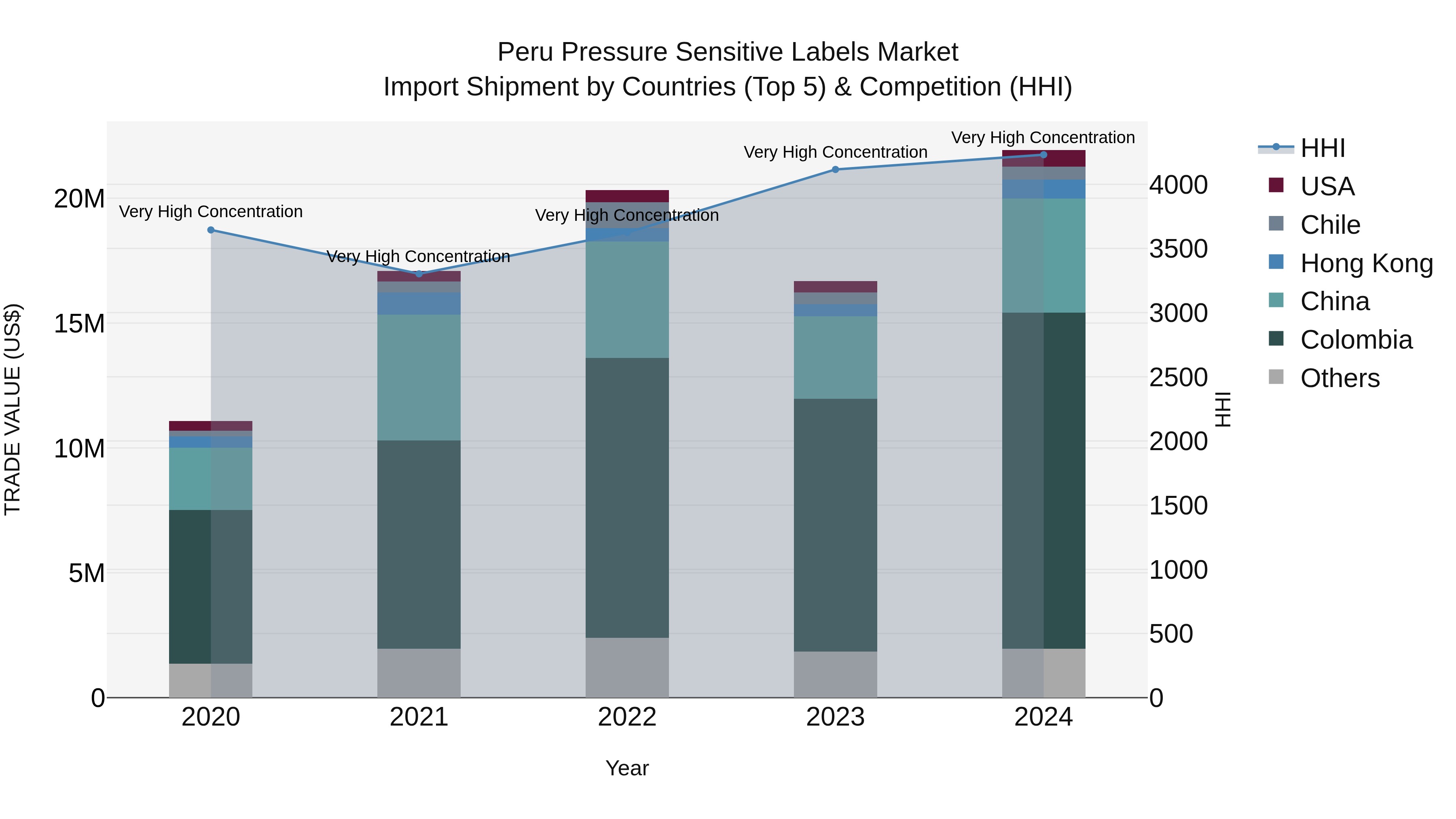
Peru continues to be a key destination for pressure sensitive labels imports, with top exporting countries like Colombia, China, Hong Kong, USA, and Mexico dominating the market in 2024. The high Herfindahl-Hirschman Index (HHI) indicates a concentrated market landscape. The impressive compound annual growth rate (CAGR) of 18.61% from 2020 to 2024 demonstrates strong market expansion, further accelerated by a notable growth rate of 31.37% from 2023 to 2024. This signifies a robust demand for pressure sensitive labels in Peru, attracting a diverse range of suppliers and fostering a competitive market environment.
Peru Pressure Sensitive Labels Market Synopsis
The Peru Pressure Sensitive Labels Market is experiencing significant growth driven by the increasing demand for packaged goods across various industries such as food and beverage, pharmaceuticals, and personal care. The market is witnessing a shift towards more sustainable and eco-friendly labeling solutions, leading to the adoption of recyclable materials and advanced printing technologies. Key players in the market are focusing on product innovation and customization to cater to the diverse requirements of end-users. The rising e-commerce sector is also contributing to the growth of the market, as brands are utilizing pressure sensitive labels for effective branding and product identification. With a favorable regulatory environment and a growing economy, the Peru Pressure Sensitive Labels Market is poised for further expansion in the coming years.
Peru Pressure Sensitive Labels Market Trends
The Peru Pressure Sensitive Labels Market is experiencing significant growth driven by increasing demand from sectors such as food and beverage, pharmaceuticals, and personal care. One of the key trends in the market is the rising preference for sustainable and eco-friendly labels, driving manufacturers to invest in recyclable materials and environmentally friendly production processes. Another notable trend is the growing adoption of digital printing technologies, enabling faster turnaround times, customization, and improved quality. Additionally, the market is witnessing a shift towards tamper-evident and security labels to ensure product authenticity and combat counterfeiting. Overall, the Peru Pressure Sensitive Labels Market is expected to continue its growth trajectory, fueled by innovation, sustainability, and technological advancements.
Peru Pressure Sensitive Labels Market Challenges
In the Peru Pressure Sensitive Labels Market, some key challenges include increasing competition from alternative labeling technologies like in-mold labeling and sleeve labeling, which offer more visually appealing options. Additionally, fluctuating raw material prices, particularly for adhesives and facestock materials, can impact profitability for label manufacturers. Another challenge is the need for investment in advanced printing and finishing equipment to meet evolving customer demands for customization and shorter lead times. Regulatory requirements for labeling in industries such as food and beverages also pose a challenge, as companies must ensure compliance while maintaining cost-effectiveness. Overall, staying competitive in the Peru Pressure Sensitive Labels Market requires continuous innovation, cost management, and a thorough understanding of customer needs and industry trends.
Peru Pressure Sensitive Labels Market Investment Opportunities
The Peru Pressure Sensitive Labels Market presents several attractive investment opportunities due to its steady growth driven by increasing demand from various industries such as food and beverage, pharmaceuticals, and personal care. With a growing economy and an expanding consumer base, there is a rising need for innovative labeling solutions, offering potential for growth in the market. Investing in technology upgrades and product development to meet the evolving demands for sustainable, high-quality labels could be a strategic move. Additionally, partnerships with local manufacturers or distributors can help access the market more effectively. Overall, the Peru Pressure Sensitive Labels Market offers a promising investment landscape for those looking to capitalize on the country`s economic growth and industrial development.
Peru Pressure Sensitive Labels Market Future Outlook
The Peru Pressure Sensitive Labels Market is poised for steady growth in the coming years, driven by expanding applications across various industries such as food and beverage, pharmaceuticals, and retail. The increasing demand for convenient packaging solutions, coupled with the rising trend of product differentiation and branding, will fuel the growth of the market. Additionally, advancements in label printing technologies, such as digital printing and RFID integration, will further boost market expansion. The growing emphasis on sustainability and eco-friendly labeling solutions is also expected to drive market growth as consumers become more environmentally conscious. Overall, the Peru Pressure Sensitive Labels Market is projected to experience sustained growth as companies continue to invest in innovative labeling solutions to enhance product visibility and consumer engagement.
Key Highlights of the Report:
- Peru Pressure Sensitive Labels Market Outlook
- Market Size of Peru Pressure Sensitive Labels Market, 2024
- Forecast of Peru Pressure Sensitive Labels Market, 2031
- Historical Data and Forecast of Peru Pressure Sensitive Labels Revenues & Volume for the Period 2021- 2031
- Peru Pressure Sensitive Labels Market Trend Evolution
- Peru Pressure Sensitive Labels Market Drivers and Challenges
- Peru Pressure Sensitive Labels Price Trends
- Peru Pressure Sensitive Labels Porter's Five Forces
- Peru Pressure Sensitive Labels Industry Life Cycle
- Historical Data and Forecast of Peru Pressure Sensitive Labels Market Revenues & Volume By Face Stock Material for the Period 2021- 2031
- Historical Data and Forecast of Peru Pressure Sensitive Labels Market Revenues & Volume By Paper for the Period 2021- 2031
- Historical Data and Forecast of Peru Pressure Sensitive Labels Market Revenues & Volume By Polypropylene for the Period 2021- 2031
- Historical Data and Forecast of Peru Pressure Sensitive Labels Market Revenues & Volume By Polyethylene for the Period 2021- 2031
- Historical Data and Forecast of Peru Pressure Sensitive Labels Market Revenues & Volume By PET for the Period 2021- 2031
- Historical Data and Forecast of Peru Pressure Sensitive Labels Market Revenues & Volume By Application for the Period 2021- 2031
- Historical Data and Forecast of Peru Pressure Sensitive Labels Market Revenues & Volume By Food and Beverage for the Period 2021- 2031
- Historical Data and Forecast of Peru Pressure Sensitive Labels Market Revenues & Volume By Pharmaceuticals for the Period 2021- 2031
- Historical Data and Forecast of Peru Pressure Sensitive Labels Market Revenues & Volume By Transportation and Logistics for the Period 2021- 2031
- Historical Data and Forecast of Peru Pressure Sensitive Labels Market Revenues & Volume By Home and Personal Care for the Period 2021- 2031
- Historical Data and Forecast of Peru Pressure Sensitive Labels Market Revenues & Volume By Semiconductor and Electronics for the Period 2021- 2031
- Historical Data and Forecast of Peru Pressure Sensitive Labels Market Revenues & Volume By Retail for the Period 2021- 2031
- Historical Data and Forecast of Peru Pressure Sensitive Labels Market Revenues & Volume By Label Type for the Period 2021- 2031
- Historical Data and Forecast of Peru Pressure Sensitive Labels Market Revenues & Volume By Permanent for the Period 2021- 2031
- Historical Data and Forecast of Peru Pressure Sensitive Labels Market Revenues & Volume By Removable for the Period 2021- 2031
- Peru Pressure Sensitive Labels Import Export Trade Statistics
- Market Opportunity Assessment By Face Stock Material
- Market Opportunity Assessment By Application
- Market Opportunity Assessment By Label Type
- Peru Pressure Sensitive Labels Top Companies Market Share
- Peru Pressure Sensitive Labels Competitive Benchmarking By Technical and Operational Parameters
- Peru Pressure Sensitive Labels Company Profiles
- Peru Pressure Sensitive Labels Key Strategic Recommendations






































