Peru Table Olives Market Top 5 Importing Countries and Market Competition (HHI) Analysis
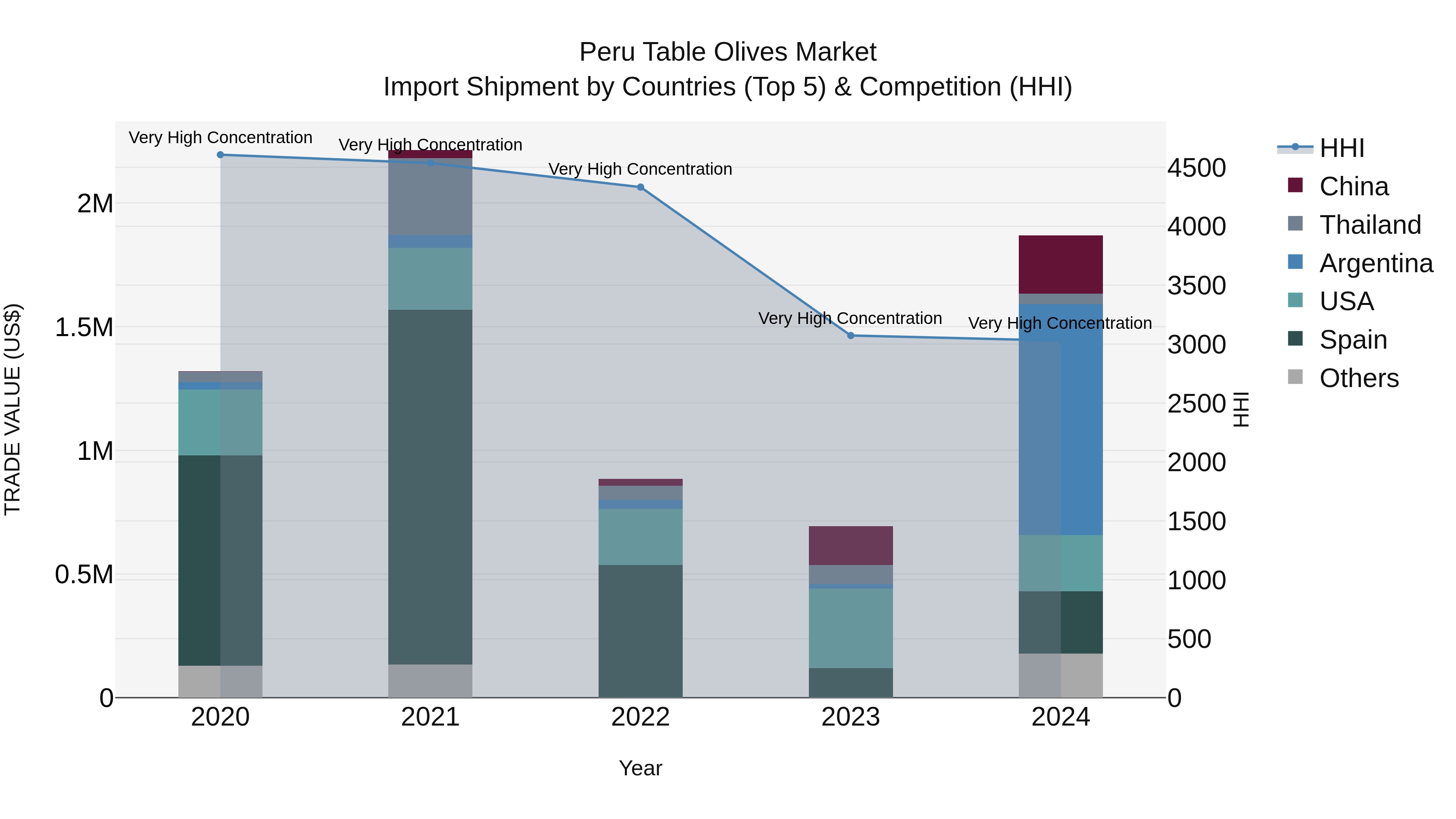
Peru`s table olives import market saw continued dominance from top exporting countries such as Argentina, Spain, China, USA, and Egypt in 2024. The high Herfindahl-Hirschman Index (HHI) indicates a concentrated market landscape. With a strong compound annual growth rate (CAGR) of 9.08% from 2020 to 2024 and an impressive growth rate of 169.48% in 2024, the table olives import sector in Peru is showing significant expansion and potential for further development.
Peru Table Olives Market Synopsis
The Peru table olives market is experiencing steady growth driven by increasing consumer awareness of the health benefits associated with olives, such as their high content of antioxidants and healthy fats. The market is primarily dominated by domestic producers, with a focus on traditional olive varieties like Manzanilla and Hojiblanca. However, there is also a growing trend towards the cultivation of new olive varieties to cater to changing consumer preferences. The market is characterized by a mix of small-scale family-owned olive groves and larger commercial farms, with a strong emphasis on quality and sustainable production practices. Export opportunities are also expanding, particularly to markets in North America and Europe, as Peru`s reputation for high-quality olives continues to grow. Overall, the Peru table olives market presents promising opportunities for both domestic producers and exporters looking to capitalize on the increasing demand for premium olives.
Peru Table Olives Market Trends
The Peru Table Olives Market is experiencing a surge in demand due to the increasing popularity of Mediterranean cuisine and the growing awareness of the health benefits associated with olives. Consumers are seeking healthier and more natural food options, driving the demand for table olives as a nutritious and flavorful ingredient. Additionally, there is a rising interest in gourmet and specialty olives, creating opportunities for premium products in the market. Producers in Peru have the advantage of favorable growing conditions and expertise in olive cultivation, positioning them well to capitalize on these trends. To stay competitive, companies can focus on product innovation, sustainable practices, and targeted marketing to attract a wider consumer base and tap into the growing market opportunities in the Peru Table Olives sector.
Peru Table Olives Market Challenges
In the Peru Table Olives Market, some of the key challenges faced include intense competition from imported table olives, particularly from European countries like Spain and Italy, which have established reputations for high-quality products. This competition can make it difficult for local producers to differentiate themselves and capture market share. Additionally, fluctuating global olive prices and currency exchange rates can impact the cost of production and affect the profitability of domestic producers. Other challenges include limited access to technology and resources for olive cultivation and processing, as well as stringent regulations and quality standards that must be adhered to for export markets. Overall, navigating these challenges requires strategic planning, investment in technology and quality control, and efforts to enhance the competitiveness of Peru`s table olive industry.
Peru Table Olives Market Investment Opportunities
The Peru Table Olives Market is primarily driven by factors such as increasing consumer awareness about the health benefits of table olives, rising demand for natural and organic food products, and the growing popularity of Mediterranean cuisine. Additionally, the expanding retail sector and the convenience of ready-to-eat table olives are boosting market growth. The influence of food bloggers and social media platforms in promoting table olives as a versatile and flavorful ingredient is also a significant driver. Furthermore, government initiatives to support olive cultivation and processing activities in Peru are contributing to the market`s positive trajectory. Overall, these drivers are expected to continue propelling the growth of the Peru Table Olives Market in the forecast period.
Peru Table Olives Market Government Polices
Peru`s government has implemented policies to support and promote the Table Olives Market in the country. This includes providing subsidies and incentives to olive producers to encourage cultivation and increase production. The government has also focused on improving infrastructure and providing technical assistance to enhance the quality of table olives. Additionally, there are regulations in place to ensure food safety standards are met in the production and processing of table olives. Overall, Peru`s government is actively involved in supporting the growth and competitiveness of the Table Olives Market through various policy measures aimed at boosting production, quality, and market access for local producers.
Peru Table Olives Market Future Outlook
The future outlook for the Peru Table Olives Market appears promising with a projected steady growth trajectory driven by increasing consumer awareness of the health benefits associated with table olives. The growing demand for natural and organic food products, coupled with a rising trend towards Mediterranean cuisine, is expected to boost the market further. Additionally, advancements in technology and agricultural practices are likely to enhance production efficiency, leading to improved quality and variety of table olives. Export opportunities are also anticipated to expand as Peru leverages its reputation for high-quality agricultural products in the international market. Overall, the Peru Table Olives Market is poised for growth in the coming years, offering ample opportunities for both domestic producers and exporters.
Key Highlights of the Report:
- Peru Table Olives Market Outlook
- Market Size of Peru Table Olives Market, 2024
- Forecast of Peru Table Olives Market, 2031
- Historical Data and Forecast of Peru Table Olives Revenues & Volume for the Period 2021- 2031
- Peru Table Olives Market Trend Evolution
- Peru Table Olives Market Drivers and Challenges
- Peru Table Olives Price Trends
- Peru Table Olives Porter's Five Forces
- Peru Table Olives Industry Life Cycle
- Historical Data and Forecast of Peru Table Olives Market Revenues & Volume By Type for the Period 2021- 2031
- Historical Data and Forecast of Peru Table Olives Market Revenues & Volume By Black Olive for the Period 2021- 2031
- Historical Data and Forecast of Peru Table Olives Market Revenues & Volume By Green Olive for the Period 2021- 2031
- Historical Data and Forecast of Peru Table Olives Market Revenues & Volume By Application for the Period 2021- 2031
- Historical Data and Forecast of Peru Table Olives Market Revenues & Volume By Online Store for the Period 2021- 2031
- Historical Data and Forecast of Peru Table Olives Market Revenues & Volume By Supermarket for the Period 2021- 2031
- Historical Data and Forecast of Peru Table Olives Market Revenues & Volume By Convenience Store for the Period 2021- 2031
- Historical Data and Forecast of Peru Table Olives Market Revenues & Volume By Other for the Period 2021- 2031
- Peru Table Olives Import Export Trade Statistics
- Market Opportunity Assessment By Type
- Market Opportunity Assessment By Application
- Peru Table Olives Top Companies Market Share
- Peru Table Olives Competitive Benchmarking By Technical and Operational Parameters
- Peru Table Olives Company Profiles
- Peru Table Olives Key Strategic Recommendations






































