Philippines Anise Seed Market Top 5 Importing Countries and Market Competition (HHI) Analysis
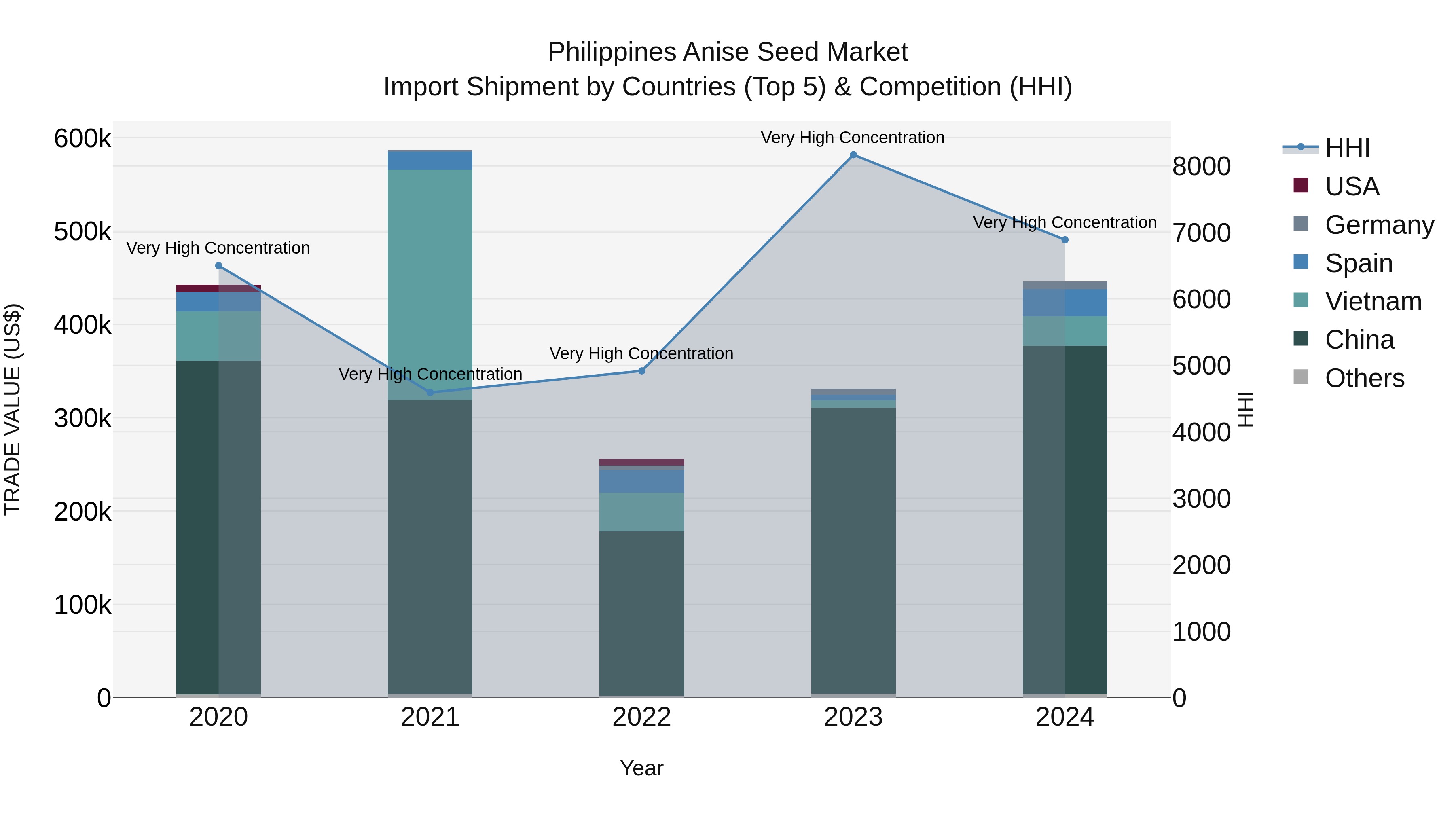
In 2024, Philippines continued to source anise seeds primarily from China, Vietnam, Spain, Germany, and India. The market remained highly concentrated, with a high Herfindahl-Hirschman Index (HHI). Despite a modest compound annual growth rate (CAGR) of 0.19% from 2020 to 2024, the year-on-year growth rate spiked significantly by 34.69% from 2023 to 2024. This indicates a notable uptick in demand for anise seeds in the Philippines, suggesting potential opportunities for market players to capitalize on the growing trend.
Philippines Anise Seed Market Synopsis
The Philippines Anise Seed Market is a growing market, with an increasing demand for the spice due to its distinct sweet flavor and aroma. The country produces both wild and cultivated varieties of Anise Seeds, which are used in various culinary dishes as well as herbal teas and medicinal remedies. Other uses include flavoring alcoholic beverages such as ouzo or pastis.
Drivers of the market
The Philippines anise seed market is driven by the growing demand for aromatic and flavorful spices used in culinary and medicinal applications. Anise seeds are known for their distinct taste and potential health benefits, driving consumer interest in incorporating them into various dishes and herbal remedies. The market`s growth is also fueled by the trend towards exploring diverse flavor profiles and traditional cuisines.
Challenges of the market
The Philippines anise seed market has faced challenges such as disruptions in supply chains and transportation, impacting the availability of this aromatic spice. Fluctuating demand patterns due to closures of eateries and changes in consumer preferences have also posed difficulties for market players in ensuring consistent supply and distribution of anise seeds.
Covid-19 Impact of the market
The Philippines anise seed market witnessed a mix of challenges and adaptations due to the COVID-19 pandemic. With the hospitality industry being significantly impacted by lockdowns and restrictions, the demand for anise seed products used in culinary establishments faced a decline. However, the increased focus on home cooking and the demand for unique flavors presented an opportunity for the anise seed market to cater to retail consumers seeking to enhance their homemade dishes. Manufacturers and suppliers had to pivot their strategies to emphasize retail distribution and engage with consumers through online platforms. Ensuring a consistent supply of high-quality anise seeds became paramount, as disruptions in supply chains and transportation were faced. The Philippines anise seed market navigated through these challenges by adapting to changing consumption patterns, aligning with retail needs, and enhancing supply chain resilience.
Key Players of the market
The Philippines anise seed market is influenced by key players who contribute to the cultivation, processing, and distribution of this aromatic spice. Companies like AniseHarvest Farms, SpiceCrafters Inc., and NutriAnise Producers are significant players in this sector. These players play a crucial role in supplying anise seeds that are known for their distinct flavor and used in various culinary and medicinal applications.
Key Highlights of the Report:
- Philippines Anise Seed Market Outlook
- Market Size of Philippines Anise Seed Market, 2023
- Forecast of Philippines Anise Seed Market, 2030
- Historical Data and Forecast of Philippines Anise Seed Revenues & Volume for the Period 2020-2030
- Philippines Anise Seed Market Trend Evolution
- Philippines Anise Seed Market Drivers and Challenges
- Philippines Anise Seed Price Trends
- Philippines Anise Seed Porter's Five Forces
- Philippines Anise Seed Industry Life Cycle
- Historical Data and Forecast of Philippines Anise Seed Market Revenues & Volume By Form for the Period 2020-2030
- Historical Data and Forecast of Philippines Anise Seed Market Revenues & Volume By Whole for the Period 2020-2030
- Historical Data and Forecast of Philippines Anise Seed Market Revenues & Volume By Ground for the Period 2020-2030
- Historical Data and Forecast of Philippines Anise Seed Market Revenues & Volume By Oil for the Period 2020-2030
- Historical Data and Forecast of Philippines Anise Seed Market Revenues & Volume By Application for the Period 2020-2030
- Historical Data and Forecast of Philippines Anise Seed Market Revenues & Volume By Pharma for the Period 2020-2030
- Historical Data and Forecast of Philippines Anise Seed Market Revenues & Volume By Food and beverages for the Period 2020-2030
- Historical Data and Forecast of Philippines Anise Seed Market Revenues & Volume By Personal care & Cosmetic for the Period 2020-2030
- Historical Data and Forecast of Philippines Anise Seed Market Revenues & Volume By Others for the Period 2020-2030
- Historical Data and Forecast of Philippines Anise Seed Market Revenues & Volume By Distribution Channel for the Period 2020-2030
- Historical Data and Forecast of Philippines Anise Seed Market Revenues & Volume By Business to Business (B2B) for the Period 2020-2030
- Historical Data and Forecast of Philippines Anise Seed Market Revenues & Volume By Business to Consumers (B2C) for the Period 2020-2030
- Philippines Anise Seed Import Export Trade Statistics
- Market Opportunity Assessment By Form
- Market Opportunity Assessment By Application
- Market Opportunity Assessment By Distribution Channel
- Philippines Anise Seed Top Companies Market Share
- Philippines Anise Seed Competitive Benchmarking By Technical and Operational Parameters
- Philippines Anise Seed Company Profiles
- Philippines Anise Seed Key Strategic Recommendations






































