Philippines Anti-aging Products Market Size, Share & Growth Rate
The Philippines Anti-aging Products Market was estimated at USD 1069 Million in 2025 and is projected to reach USD 1531 Million by 2032, growing at a CAGR of 5.3% from 2026 to 2032. This projected growth underscores the increasing consumer focus on skincare and aesthetics, as more Filipinos seek products that promise to combat the visible signs of aging. The rising influence of social media, combined with evolving beauty standards, significantly drives the demand for innovative and effective anti-aging solutions.
Philippines Anti-aging Products Market Year-wise Growth Rate and Key Drivers
This graph highlights how the Philippines Anti-aging Products Market has steadily grown over the years, supported by major growth factors.
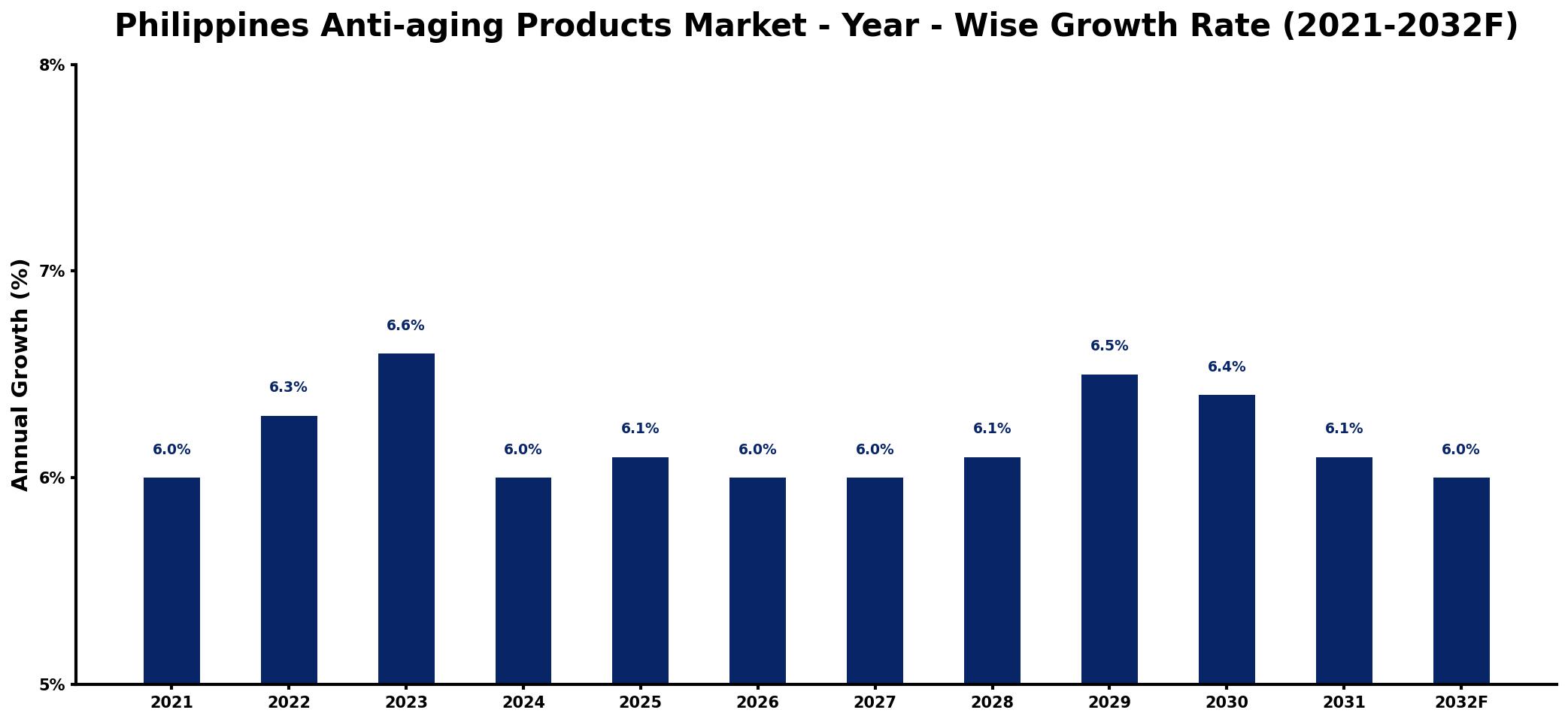
The table below presents the year‑wise growth rates along with the key drivers influencing the market
| Year | Growth Rate | Major Drivers |
| 2021 | 6.0% | Increase in consumer health awareness |
| 2022 | 6.3% | Rising popularity of natural ingredients |
| 2023 | 6.6% | Growth in e-commerce platforms |
| 2024 | 6.0% | Expansion of premium product lines |
| 2025 | 6.1% | Surge in wellness tourism investments |
| 2026 | 6.0% | Growing influence of social media |
| 2027 | 6.0% | rising procurement volume requirements |
| 2028 | 6.1% | Emergence of innovative formulations |
| 2029 | 6.5% | Rise in personalized skincare solutions |
| 2030 | 6.4% | Strengthening of regulatory frameworks |
| 2031 | 6.1% | enhanced product quality standards |
| 2032 | 6.0% | increased production capacity utilization |
Note: Market size estimations and growth projections presented in this report are based on 6Wresearch's proprietary forecasting methodology, utilizing the latest available industry data, government publications, and primary research inputs.
Philippines Anti-aging Products Market Synopsis
Recent momentum in the Philippines Anti-aging Products market has been notable, primarily fueled by advances in formulation technology and heightened consumer awareness regarding skincare. Looking ahead, the market is poised for continued expansion as consumer preferences shift towards holistic skincare approaches and personalized products that cater to diverse skin types.
While the market exhibited resilience, the ongoing influence of the COVID-19 pandemic has prompted consumers to prioritize essential goods over luxury items. Nevertheless, the renewed focus on self-care and wellness indicates a promising recovery trajectory for the anti-aging segment, aligning with global trends emphasizing health and beauty.
Philippines Anti-aging Products Market Key Takeaways
- Skincare and aesthetics are becoming central to Filipino consumer preferences, driving demand for anti-aging products.
- Advancements in formulation technology continue to enhance product efficacy and consumer trust.
- COVID-19 has shifted consumer spending patterns, impacting the market but also encouraging a focus on wellness.
- Personalization in skincare products is on the rise, addressing the unique needs of various skin types.
- Government initiatives aimed at promoting public health indirectly benefit the anti-aging sector.
Evaluation of Restraints in Philippines Anti-aging Products Market
The Philippines Anti-aging Products market faces certain restraints that could inhibit its growth trajectory. A prominent challenge is the need for tangible results; consumers are increasingly discerning, demanding proof that products can effectively mitigate the signs of aging. Additionally, addressing the diverse skincare concerns of the population requires meticulous formulation strategies. Companies must invest in clinical evidence and effective marketing strategies to communicate the benefits of their offerings adequately. Awareness around responsible skincare practices remains crucial, as education plays a vital role in shaping consumer choices.
Philippines Anti-aging Products Market Trends
Current trends indicate a rising preference for natural and organic ingredients in anti-aging products. Consumers are becoming more informed and selective, gravitating towards brands that emphasize clean beauty. Furthermore, the integration of technology, such as artificial intelligence and augmented reality, is shaping the purchasing experience, offering tailored solutions and enhancing consumer engagement. As a result, brands that harness these innovations are likely to gain a competitive edge in the marketplace.
Philippines Anti-aging Products Market Opportunities
Significant growth opportunities exist for companies willing to innovate and meet the evolving demands of consumers. The burgeoning middle class in the Philippines, combined with increasing disposable incomes, presents a ripe market for premium anti-aging products. Additionally, leveraging e-commerce platforms can enhance accessibility, allowing brands to reach wider audiences. The potential for collaboration with dermatologists and skincare professionals could also enhance product credibility, fostering consumer trust and loyalty.
Government Initiatives in the Philippines Anti-aging Products Market
The Philippine government has taken steps to bolster the healthcare sector, which indirectly influences the anti-aging products market. Initiatives aimed at improving public health infrastructure and promoting wellness create a conducive environment for market growth. Additionally, educational campaigns focused on skincare and healthy living are critical in raising awareness and encouraging responsible consumption of beauty products.
Future Insights of the Philippines Anti-aging Products Market
From 2026 to 2032, the Philippines Anti-aging Products market is anticipated to thrive due to a growing emphasis on self-care and wellness. As consumers increasingly prioritize skin health, demand for innovative, effective products will rise. Moreover, the industry will likely see a greater push towards sustainability, with eco-friendly packaging and sourcing becoming essential. As these trends solidify, brands that adapt swiftly and effectively will find themselves well-positioned to capitalize on the market's evolution.
Philippines Anti-aging Products Market Latest Developments (2025 - 2026)
In recent months, there has been a notable trend towards personalization in the anti-aging products sector, with companies increasingly offering tailored skincare regimens. Collaborations with influencers and dermatologists have become more common, enhancing product credibility and consumer engagement. Additionally, the market has seen a rise in the availability of innovative delivery systems, such as serums and micro-needling devices, further enriching consumer experience and satisfaction.
Philippines Anti-aging Products Market - Key Attractiveness of the Report
- 10 Years of Market Numbers
- Historical Data Starting from 2022 to 2025
- Base Year: 2025
- Forecast Data until 2032
- Key Performance Indicators Impacting the Market
- Major Upcoming Developments and Projects
Key Highlights of the Report:
- Philippines Anti-aging Products Market Outlook
- Market Size of Philippines Anti-aging Products Market, 2025
- Forecast of Philippines Anti-aging Products Market, 2032
- Historical Data and Forecast of Philippines Anti-aging Products Revenues & Volume for the Period 2022-2032F
- Philippines Anti-aging Products Market Trend Evolution
- Philippines Anti-aging Products Market Drivers and Challenges
- Philippines Anti-aging Products Price Trends
- Philippines Anti-aging Products Porter's Five Forces
- Philippines Anti-aging Products Industry Life Cycle
- Historical Data and Forecast of Philippines Anti-aging Products Market Revenues & Volume By Product for the Period 2022-2032F
- Historical Data and Forecast of Philippines Anti-aging Products Market Revenues & Volume By Body Wash for the Period 2022-2032F
- Historical Data and Forecast of Philippines Anti-aging Products Market Revenues & Volume By Body Moisturizer for the Period 2022-2032F
- Historical Data and Forecast of Philippines Anti-aging Products Market Revenues & Volume By Eye Cream & Lotion for the Period 2022-2032F
- Historical Data and Forecast of Philippines Anti-aging Products Market Revenues & Volume By Facial Cleanser for the Period 2022-2032F
- Historical Data and Forecast of Philippines Anti-aging Products Market Revenues & Volume By Facial Mask for the Period 2022-2032F
- Historical Data and Forecast of Philippines Anti-aging Products Market Revenues & Volume By Facial Serum for the Period 2022-2032F
- Historical Data and Forecast of Philippines Anti-aging Products Market Revenues & Volume By Facial Cream & Lotion for the Period 2022-2032F
- Historical Data and Forecast of Philippines Anti-aging Products Market Revenues & Volume By Distribution Channel for the Period 2022-2032F
- Historical Data and Forecast of Philippines Anti-aging Products Market Revenues & Volume By Hypermarket & Supermarket for the Period 2022-2032F
- Historical Data and Forecast of Philippines Anti-aging Products Market Revenues & Volume By Pharmacy & Drug Stores for the Period 2022-2032F
- Historical Data and Forecast of Philippines Anti-aging Products Market Revenues & Volume By Specialty Store for the Period 2022-2032F
- Historical Data and Forecast of Philippines Anti-aging Products Market Revenues & Volume By Online for the Period 2022-2032F
- Historical Data and Forecast of Philippines Anti-aging Products Market Revenues & Volume By Others for the Period 2022-2032F
- Philippines Anti-aging Products Import Export Trade Statistics
- Market Opportunity Assessment By Product
- Market Opportunity Assessment By Distribution Channel
- Philippines Anti-aging Products Top Companies Market Share
- Philippines Anti-aging Products Competitive Benchmarking By Technical and Operational Parameters
- Philippines Anti-aging Products Company Profiles
- Philippines Anti-aging Products Key Strategic Recommendations






































