Philippines Anti-money Laundering Market Size & Growth Rate (2026-2032)
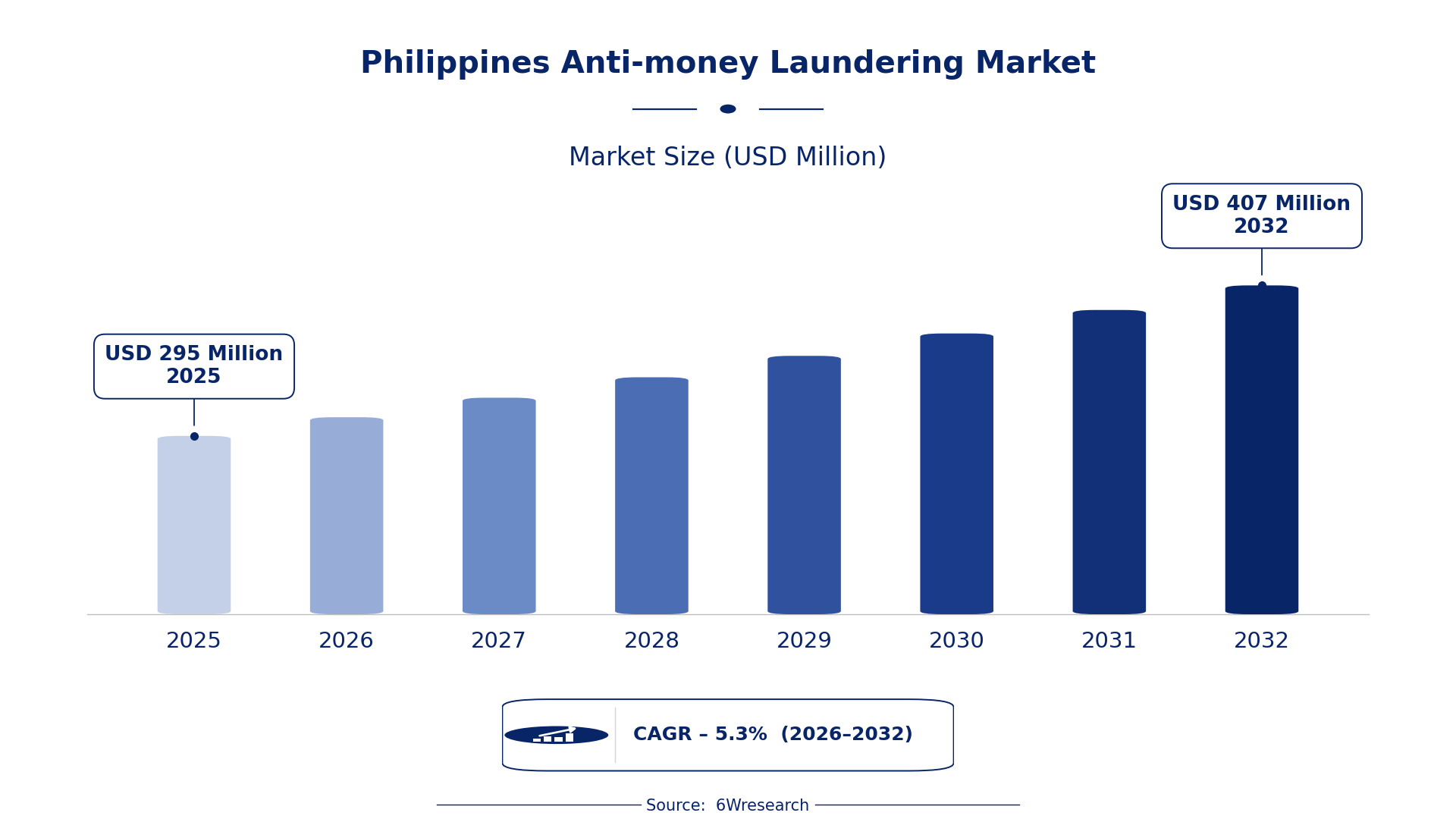
The Philippines Anti-money Laundering Market was estimated at USD 295 Million in 2025 and is projected to reach USD 407 Million by 2032, growing at a CAGR of 5.3% from 2026 to 2032.
Philippines Anti-money Laundering Market Synopsis
The Philippines Anti-money Laundering (AML) market is at a critical juncture, evolving in response to both local and global financial crime threats. As compliance demands grow, institutions are pushed to adopt advanced solutions, reinforcing the market's momentum. However, challenges remain in balancing stringent regulations with operational efficiency.
Looking forward, the market is expected to see increased investment in technology and personnel. Financial entities are becoming more proactive, driven by the urgency to meet international AML standards, especially as the digital landscape expands.
Philippines Anti-money Laundering Market Year-wise Growth Rate and Key Drivers
This graph illustrates the annual growth rates of the Philippines Anti-money Laundering Market from 2021 to 2032, highlighting a steady upward trajectory and projected expansion over the forecast period.
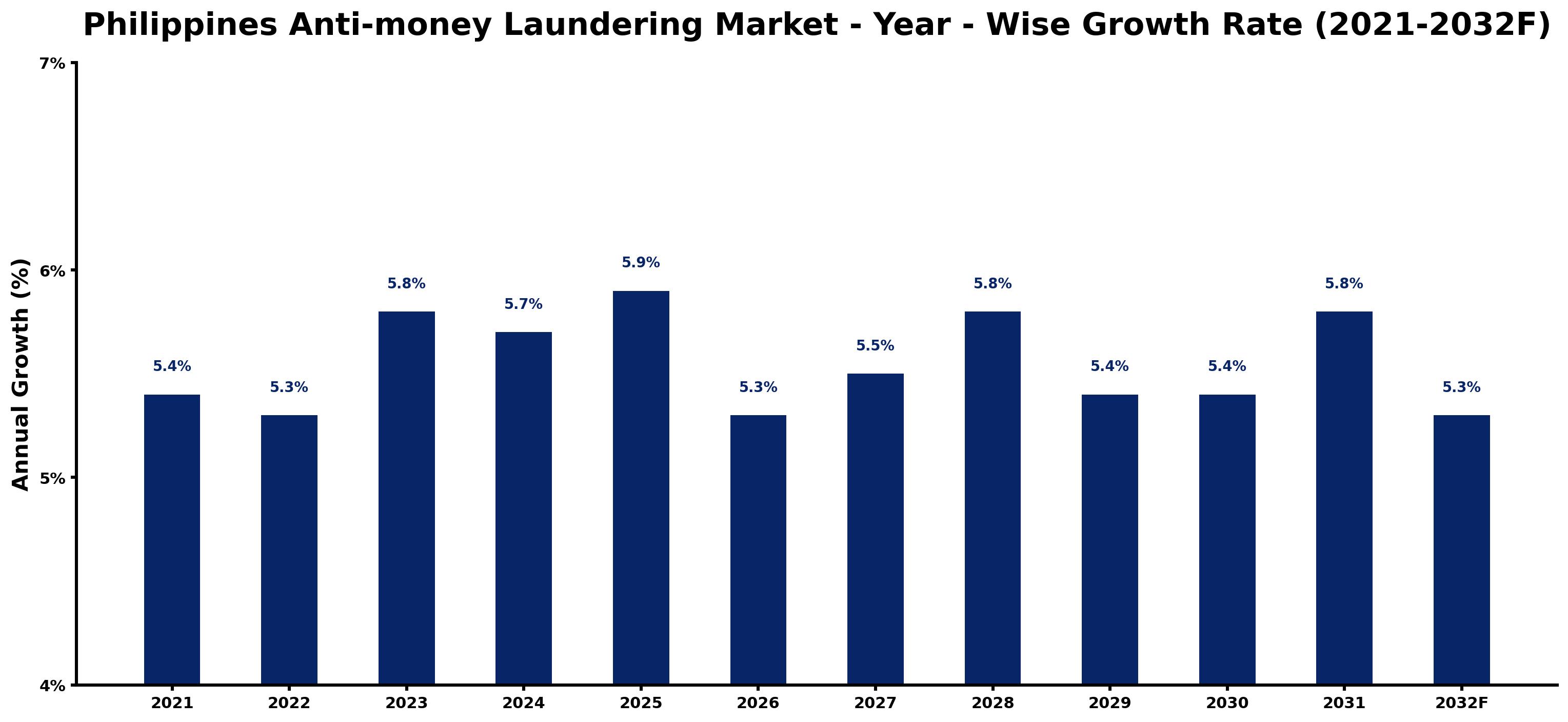
The table below presents the year‑wise growth rates along with the key drivers influencing the market
| Year | Growth Rate | Major Drivers |
| 2021 | 5.4% | Strengthened regulations from the Anti-Money Laundering Council |
| 2022 | 5.3% | Enhanced monitoring compliance by financial institutions mandated |
| 2023 | 5.8% | Increased penalties for non-compliance with regulations |
| 2024 | 5.7% | Growing foreign investments driving stricter AML measures |
| 2025 | 5.9% | Digital banking surge prompting improved anti-fraud protocols |
| 2026 | 5.3% | NEDA's initiatives push for stricter financial regulations |
| 2027 | 5.5% | Rising remittances leading to increased scrutiny requirements |
| 2028 | 5.8% | Emergence of fintech creating demand for AML solutions |
| 2029 | 5.4% | Increased collaboration with international AML organizations |
| 2030 | 5.4% | Public awareness campaigns highlighting risks of money laundering |
| 2031 | 5.8% | Legislative enhancements in the AML Act driving adoption |
| 2032 | 5.3% | Government's push for transparency in financial transactions |
Note: Market size estimations and growth projections presented in this report are based on 6Wresearch's proprietary forecasting methodology, utilizing the latest available industry data, government publications, and primary research inputs.
Philippines Anti-money Laundering Market Key Takeaways
Below are some of the specific key takeaways from the market, including:
- Growing importance of AML solutions due to heightened regulatory scrutiny.
- Financial institutions are increasingly investing in advanced analytics and AI-driven technologies.
- The surge in online financial services creates new challenges for AML compliance.
- Enhanced public-private partnerships are emerging to combat financial crimes.
- Regulatory bodies are tightening enforcement, compelling institutions to adapt quickly.
Evaluation of Restraints in Philippines Anti-money Laundering Market
Several constraints hinder the efficiency of the AML market in the Philippines. The rapid evolution of financial crimes has outpaced existing detection technologies, leaving institutions vulnerable. Compliance costs are escalating, straining resources, especially for smaller entities. Additionally, the lack of adequate training for personnel in many organizations limits the effectiveness of AML initiatives. These factors create a challenging environment for financial institutions striving to meet regulatory expectations.
Philippines Anti-money Laundering Market Trends
Several trends are driving the Philippines Anti-money Laundering market. The shift towards digital banking is compelling institutions to enhance their AML capabilities, with emphasis on real-time monitoring systems. The increasing use of artificial intelligence and machine learning technologies aids in identifying and mitigating potential risks. Collaboration between financial institutions and law enforcement agencies is intensifying, fostering a unified front against financial crimes.
Philippines Anti-money Laundering Market Opportunities
There are substantial opportunities in the Philippine AML market for innovative technology providers. The demand for integrated solutions that combine data analytics and reporting capabilities is rising. Furthermore, regulatory changes will create openings for consulting services, particularly in compliance training and systems implementation. As financial institutions seek to fortify their defenses, the need for tailored solutions that address unique challenges will become increasingly critical.
Government Initiatives in the Philippines Anti-money Laundering Market
The Philippine government is actively shaping the AML market through a variety of initiatives aimed at strengthening regulatory frameworks and compliance measures. Public policy is focused on enhancing transparency and accountability within the financial sector, a critical requirement in meeting international standards. The push for greater public-private collaboration highlights the government's commitment to combating financial crime effectively.
- A regulatory framework established in 2025 mandated enhanced reporting protocols for financial transactions.
- A national training program currently underway aims to equip bank personnel with the skills necessary to recognize and address money laundering activities.
- A public awareness campaign launched in early 2026 seeks to educate citizens on the importance of reporting suspicious financial activities.
- Planned amendments to the Anti-Money Laundering Act are expected to be introduced in 2028, addressing digital currencies and online transactions.
Future Insights of the Philippines Anti-money Laundering Market
In the 2026-2032 timeframe, the Philippines Anti-money Laundering market is expected to evolve rapidly. The growing sophistication of financial crimes will demand more advanced technological solutions. Regulatory bodies will likely impose stricter compliance mandates, pushing institutions to innovate continuously. As the financial sector embraces digital transformation, the need for agile and responsive AML strategies will be paramount.
Philippines Anti-money Laundering Market Latest Developments
Recent developments in the Philippines AML market indicate a dynamic shift towards enhanced compliance strategies. Financial institutions are rapidly adapting to new regulatory requirements, focusing on integrating advanced technologies into their operations.
- A major technology vendor launched a new AML compliance platform in early 2025, featuring AI-driven analytics for transaction monitoring.
- An ongoing initiative started in Q2 2025 aims to strengthen inter-agency collaboration on financial crime investigations.
- A financial institution is currently enhancing its transaction monitoring systems, expected to be completed by mid-2026.
- A series of workshops to improve compliance knowledge among banking professionals is planned for late 2025, targeting increased awareness on AML issues.
Philippines Anti-money Laundering Market - Key Attractiveness of the Report
- 10 Years of Market Numbers
- Historical Data Starting from 2022 to 2025
- Base Year: 2025
- Forecast Data until 2032
- Key Performance Indicators Impacting the Market
- Major Upcoming Developments and Projects
Key Highlights of the Report:
- Philippines Anti-money Laundering Market Outlook
- Market Size of Philippines Anti-money Laundering Market, 2025
- Forecast of Philippines Anti-money Laundering Market, 2032
- Historical Data and Forecast of Philippines Anti-money Laundering Revenues & Volume for the Period 2022-2032F
- Philippines Anti-money Laundering Market Trend Evolution
- Philippines Anti-money Laundering Market Drivers and Challenges
- Philippines Anti-money Laundering Price Trends
- Philippines Anti-money Laundering Porter's Five Forces
- Philippines Anti-money Laundering Industry Life Cycle
- Historical Data and Forecast of Philippines Anti-money Laundering Market Revenues & Volume By Component for the Period 2022-2032F
- Historical Data and Forecast of Philippines Anti-money Laundering Market Revenues & Volume By Services for the Period 2022-2032F
- Historical Data and Forecast of Philippines Anti-money Laundering Market Revenues & Volume By Solutions for the Period 2022-2032F
- Historical Data and Forecast of Philippines Anti-money Laundering Market Revenues & Volume By Deployment Mode for the Period 2022-2032F
- Historical Data and Forecast of Philippines Anti-money Laundering Market Revenues & Volume By On-Premises for the Period 2022-2032F
- Historical Data and Forecast of Philippines Anti-money Laundering Market Revenues & Volume By Cloud for the Period 2022-2032F
- Historical Data and Forecast of Philippines Anti-money Laundering Market Revenues & Volume By End User for the Period 2022-2032F
- Historical Data and Forecast of Philippines Anti-money Laundering Market Revenues & Volume By Banking & Financial Institutes for the Period 2022-2032F
- Historical Data and Forecast of Philippines Anti-money Laundering Market Revenues & Volume By Insurance for the Period 2022-2032F
- Historical Data and Forecast of Philippines Anti-money Laundering Market Revenues & Volume By Gaming & Gambling for the Period 2022-2032F
- Historical Data and Forecast of Philippines Anti-money Laundering Market Revenues & Volume By Organization Size for the Period 2022-2032F
- Historical Data and Forecast of Philippines Anti-money Laundering Market Revenues & Volume By Large Enterprises for the Period 2022-2032F
- Historical Data and Forecast of Philippines Anti-money Laundering Market Revenues & Volume By SMEs for the Period 2022-2032F
- Philippines Anti-money Laundering Import Export Trade Statistics
- Market Opportunity Assessment By Component
- Market Opportunity Assessment By Deployment Mode
- Market Opportunity Assessment By End User
- Market Opportunity Assessment By Organization Size
- Philippines Anti-money Laundering Top Companies Market Share
- Philippines Anti-money Laundering Competitive Benchmarking By Technical and Operational Parameters
- Philippines Anti-money Laundering Company Profiles
- Philippines Anti-money Laundering Key Strategic Recommendations






































