Philippines Aromatic Compounds Market Top 5 Importing Countries and Market Competition (HHI) Analysis
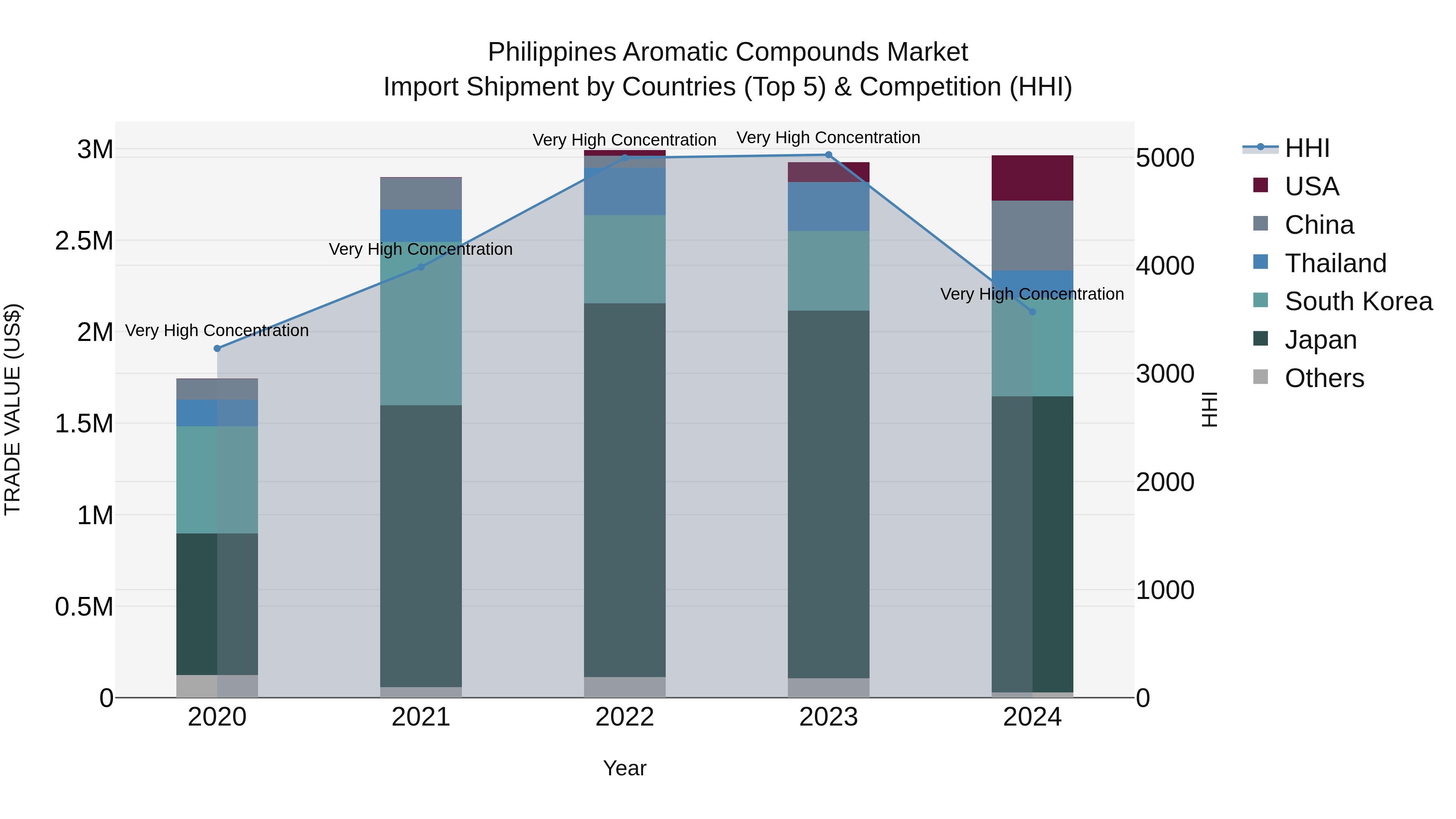
The Philippines continues to see a strong demand for aromatic compounds, with top exporting countries such as Japan, South Korea, and China leading the way in 2024. The high Herfindahl-Hirschman Index (HHI) suggests a concentration of imports among these key players. With a notable compound annual growth rate (CAGR) of 14.17% from 2020 to 2024, the market is showing steady expansion. Although the growth rate slightly slowed to 1.27% in 2024 compared to the previous year, the overall outlook for aromatic compounds import shipments in the Philippines remains positive.
philippines aromatic compounds market Synopsis
The Philippines aromatic compounds market showcases a dynamic landscape characterized by the production and consumption of benzene, toluene, xylene, and related derivatives. These compounds serve as crucial building blocks for the petrochemical and chemical industries, finding application in plastics, textiles, and pharmaceuticals. The market`s growth is intertwined with industrial expansion and manufacturing activities. As sustainability gains prominence, efforts are underway to develop eco-friendly processes and optimize the value chain of aromatic compound production.
Drivers of the Market
The Philippines aromatic compounds market is driven by the demand for these chemicals in various industries, including petrochemicals, pharmaceuticals, plastics, and synthetic fibers. Aromatic compounds such as benzene, toluene, and xylene are used as feedstocks for the production of a wide range of products. The growth of this market is influenced by industrial activities, economic growth, and technological advancements. Moreover, shifts in consumer preferences for products made from aromatic compounds, along with regulatory considerations regarding their production and use, also play a role in shaping the market`s trajectory.
Challenges of the Market
The Philippines aromatic compounds market faces challenges linked to sustainability, regulatory compliance, and market demand. Producing aromatic compounds often involves complex chemical processes and raw material requirements. Balancing these processes with environmental and safety regulations presents a challenge. Additionally, market demand can be influenced by consumer preferences and changing global supply chains. Striking a balance between chemical production, environmental responsibility, and market dynamics is a key challenge.
COVID-19 Impact on the Market
The Philippines aromatic compounds market encountered both challenges and opportunities due to the COVID-19 pandemic. While certain aromatic compounds are essential in the production of various products, disruptions in supply chains and manufacturing activities during lockdowns impacted demand. The pharmaceutical and healthcare sectors, however, showed increased demand for some aromatic compounds used in medications. The pandemic emphasized the need for domestic production capacity and diversified markets, potentially influencing discussions on strategic industries and self-sufficiency.
Key Players in the Market
Philippines Aromatic Compounds Market includes some leading players like JG Summit Petrochemical Corporation, Pilipinas Shell Petroleum Corporation, PTT Philippines Corporation, and Petron Corporation.
Key Highlights of the Report:
- Philippines Aromatic Compounds Market Outlook
- Market Size of Philippines Aromatic Compounds Market, 2024
- Forecast of Philippines Aromatic Compounds Market, 2031
- Historical Data and Forecast of Philippines Aromatic Compounds Revenues & Volume for the Period 2021-2031
- Philippines Aromatic Compounds Market Trend Evolution
- Philippines Aromatic Compounds Market Drivers and Challenges
- Philippines Aromatic Compounds Price Trends
- Philippines Aromatic Compounds Porter's Five Forces
- Philippines Aromatic Compounds Industry Life Cycle
- Historical Data and Forecast of Philippines Aromatic Compounds Market Revenues & Volume By Type for the Period 2021-2031
- Historical Data and Forecast of Philippines Aromatic Compounds Market Revenues & Volume By Benzene for the Period 2021-2031
- Historical Data and Forecast of Philippines Aromatic Compounds Market Revenues & Volume By Xylene for the Period 2021-2031
- Historical Data and Forecast of Philippines Aromatic Compounds Market Revenues & Volume By Toluene for the Period 2021-2031
- Historical Data and Forecast of Philippines Aromatic Compounds Market Revenues & Volume By Application for the Period 2021-2031
- Historical Data and Forecast of Philippines Aromatic Compounds Market Revenues & Volume By Solvent for the Period 2021-2031
- Historical Data and Forecast of Philippines Aromatic Compounds Market Revenues & Volume By Additive for the Period 2021-2031
- Historical Data and Forecast of Philippines Aromatic Compounds Market Revenues & Volume By End-use for the Period 2021-2031
- Historical Data and Forecast of Philippines Aromatic Compounds Market Revenues & Volume By Packaging for the Period 2021-2031
- Historical Data and Forecast of Philippines Aromatic Compounds Market Revenues & Volume By Detergent And Dyes for the Period 2021-2031
- Historical Data and Forecast of Philippines Aromatic Compounds Market Revenues & Volume By Automobile for the Period 2021-2031
- Historical Data and Forecast of Philippines Aromatic Compounds Market Revenues & Volume By Electronic Devices for the Period 2021-2031
- Historical Data and Forecast of Philippines Aromatic Compounds Market Revenues & Volume By Medical Devices for the Period 2021-2031
- Historical Data and Forecast of Philippines Aromatic Compounds Market Revenues & Volume By Pharmaceuticals for the Period 2021-2031
- Historical Data and Forecast of Philippines Aromatic Compounds Market Revenues & Volume By Gasoline for the Period 2021-2031
- Historical Data and Forecast of Philippines Aromatic Compounds Market Revenues & Volume By Tire for the Period 2021-2031
- Philippines Aromatic Compounds Import Export Trade Statistics
- Market Opportunity Assessment By Type
- Market Opportunity Assessment By Application
- Market Opportunity Assessment By End-use
- Philippines Aromatic Compounds Top Companies Market Share
- Philippines Aromatic Compounds Competitive Benchmarking By Technical and Operational Parameters
- Philippines Aromatic Compounds Company Profiles
- Philippines Aromatic Compounds Key Strategic Recommendations






































