Philippines Artichokes Market Size, Share & Growth Rate
The Philippines Artichokes Market was estimated at USD 333 Million in 2025 and is projected to reach USD 436 Million by 2032, growing at a CAGR of 3.9% from 2026 to 2032. This positive trajectory is driven by a rising consumer preference for healthy eating, which has significantly bolstered the demand for nutrient-dense vegetables like artichokes. Furthermore, the increasing integration of global culinary practices into local cuisine has opened new avenues for artichoke applications, enhancing both awareness and consumption.
Philippines Artichokes Market Growth Rate Analysis (2021-2032)
The Philippines artichoke market has experienced stable growth, marked by a yearly increase of 4.6% in 2021 and a slight uptick to 4.7% in 2022. This trend continues, with growth estimated at 4.6% in 2023, showcasing a solid consumer demand for healthy food options amid rising health consciousness. Fluctuations, such as 4.4% in 2024 and 4.3% in 2025, can be attributed to varying agricultural yields and market uncertainties. However, growth rebounds in subsequent years, reaching 4.8% in both 2026 and 2028, driven by investments in sustainable farming technologies and improved infrastructure. By 2031, the market anticipates a peak growth of 4.9%, highlighting a promising future as consumer preferences evolve.
Philippines Artichokes Market Year-wise Growth Rate and Key Drivers
This graph highlights how the Philippines Artichokes Market has steadily grown over the past five years, supported by major growth factors.
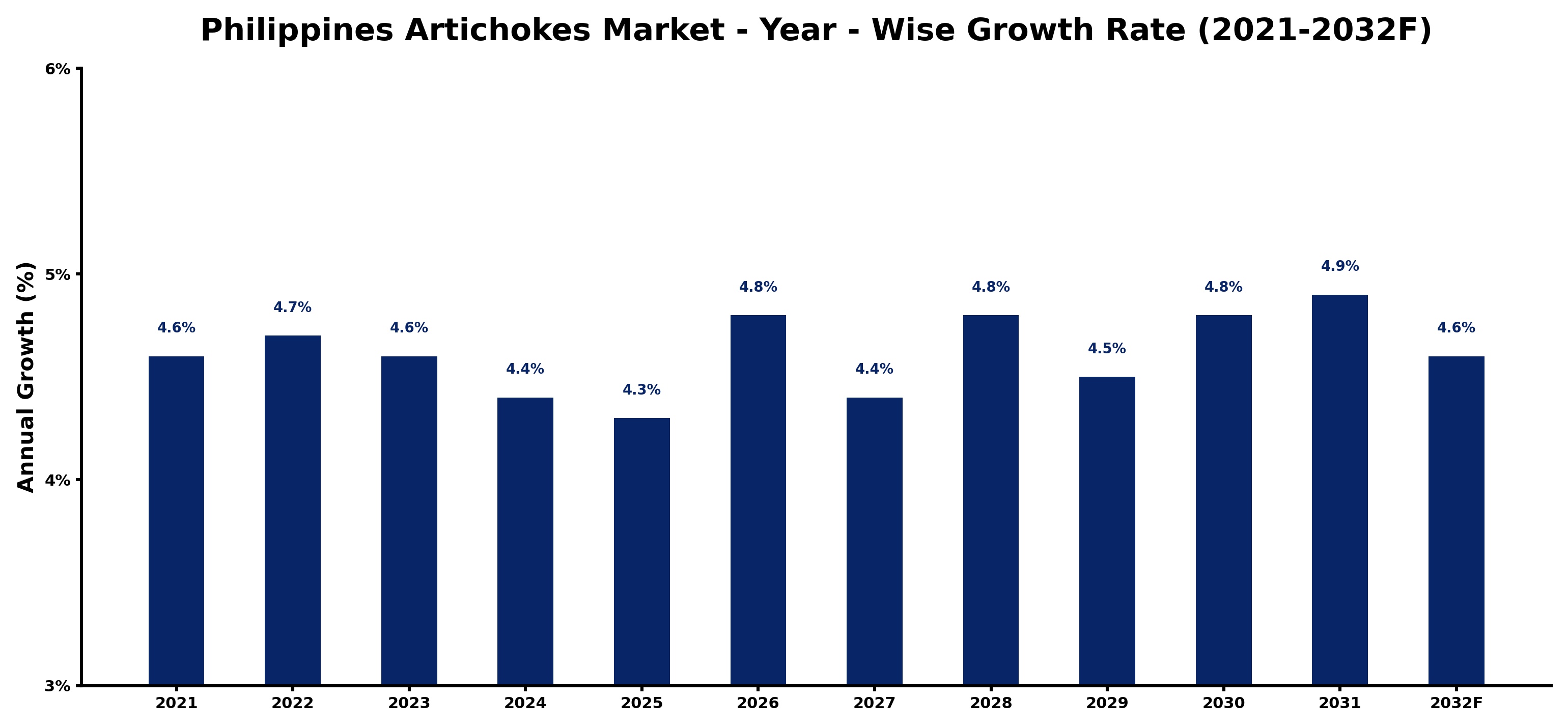
The table below presents the year‑wise growth rates along with the key drivers influencing the market
| Year | Growth Rate | Major Drivers |
| 2021 | 4.6% | Consumer health awareness increased demand |
| 2022 | 4.7% | Culinary trends embraced artichokes |
| 2023 | 4.6% | Local farming initiatives expanded supply |
| 2024 | 4.4% | Sustainable farming practices gained traction |
| 2025 | 4.3% | Artichoke-based products gained popularity |
| 2026 | 4.8% | Export opportunities enhanced market growth |
| 2027 | 4.4% | Culinary education promoted artichoke usage |
| 2028 | 4.8% | Food innovation introduced new recipes |
| 2029 | 4.5% | Social media influenced consumer choices |
| 2030 | 4.8% | Gastronomy events showcased artichokes |
| 2031 | 4.9% | Nutritional benefits highlighted in marketing |
| 2032 | 4.6% | Artichoke festivals attracted consumers |
Note - Market size estimations and growth projections presented in this report are based on 6Wresearch's advanced forecasting approach, validated with industry datasets as of June 2026.
Philippines Artichokes Market Synopsis
The artichokes market in the Philippines has experienced a steady rise, reflecting a growing consumer inclination towards healthier food choices. While the market has shown resilience in export volumes, recent challenges have tempered revenue growth due to fluctuating prices and supply chain disruptions.
Looking ahead, the market is poised for further expansion as the appreciation for diverse, health-conscious diets continues to grow. With strategic marketing efforts and educational initiatives to promote artichokes, there is potential to elevate consumer familiarity and, consequently, market demand.
Philippines Artichokes Market Key Takeaways
- Growing awareness of the health benefits of artichokes is driving demand.
- The influence of global culinary trends is shaping new consumption patterns.
- Supply chain management improvements are crucial for maintaining product quality.
- Education and marketing campaigns are necessary to enhance consumer familiarity.
- Fresh produce demand has surged in retail markets, influenced by home cooking trends.
Evaluation of Restraints in Philippines Artichokes Market
Despite the positive momentum, the Philippines artichokes market is not without its challenges. One significant restraint lies in the limited consumer knowledge about artichokes, which hampers broader adoption. Many potential buyers remain unaware of the vegetable's culinary versatility and health benefits, which necessitates targeted educational initiatives. Additionally, the vegetable's short shelf life complicates logistics and distribution, making it essential for stakeholders to develop innovative solutions to ensure product freshness during transport. Effective collaboration among farmers, distributors, and retailers is crucial to overcoming these hurdles and establishing a sustainable market.
Philippines Artichokes Market Trends
Current trends indicate a growing inclination toward healthy, plant-based diets, enhancing the appeal of artichokes. There is also an observable shift towards the incorporation of unique ingredients in culinary practices, driven by social media and food influencers showcasing innovative recipes. This trend not only promotes artichokes in the home kitchen but also encourages restaurants to feature them prominently on their menus. Moreover, the increase in local farming initiatives focused on organic practices reflects a broader consumer demand for sustainability and quality in food sourcing.
Philippines Artichokes Market Opportunities
The Philippines artichokes market presents numerous opportunities for growth and investment. As the health food movement gains traction, there is potential for artichokes to be marketed more aggressively as a superfood, particularly in wellness and health-oriented retail channels. Furthermore, developing partnerships with restaurants to incorporate artichokes into seasonal menus could significantly boost visibility and sales. The exploration of innovative processing techniques, such as dehydrated or frozen artichoke products, also opens doors for extending product reach and improving shelf life.
Government Initiatives in the Philippines Artichokes Market
The Philippine government has been increasingly supportive of agricultural initiatives aimed at improving local production capabilities. Various programs are focused on enhancing farm productivity and quality standards, which are essential for cultivating artichokes. Incentives for sustainable farming practices and investment in agricultural research are also being prioritized to promote the overall growth of niche markets, including artichokes. These efforts aim to foster a more resilient agricultural sector capable of meeting evolving consumer demands.
Future Insights of the Philippines Artichokes Market
The Philippines artichokes market is expected to evolve significantly between 2026 and 2032. As consumer preferences shift toward health-oriented food choices, the market will likely see a surge in demand. With continued emphasis on culinary innovation and the incorporation of artichokes into mainstream diets, the market is set for expansion. Additionally, ongoing improvements in agricultural practices and supply chain efficiencies will play a crucial role in supporting this growth, ensuring a consistent supply of quality artichokes for consumers.
Philippines Artichokes Market Latest Developments (May 2025 - June 2026)
Recent developments in the Philippines artichokes market reflect an adaptive response to changing consumer preferences. Market players have begun implementing more comprehensive marketing strategies aimed at educating consumers about the health benefits and culinary uses of artichokes. Additionally, initiatives focusing on improving logistics to enhance the freshness of products during transportation are being prioritized. As the demand from retail sectors remains strong, companies are exploring avenues for direct-to-consumer sales to capitalize on the growing interest in home cooking.
Philippines Artichokes Market - Key Attractiveness of the Report
- 10 Years of Market Numbers
- Historical Data Starting from 2022 to 2025
- Base Year: 2025
- Forecast Data until 2032
- Key Performance Indicators Impacting the Market
- Major Upcoming Developments and Projects
Key Highlights of the Report:
- Philippines Artichokes Market Outlook
- Market Size of Philippines Artichokes Market, 2025
- Forecast of Philippines Artichokes Market, 2032F
- Historical Data and Forecast of Philippines Artichokes Revenues & Volume for the Period 2022-2032F
- Philippines Artichokes Market Trend Evolution
- Philippines Artichokes Market Drivers and Challenges
- Philippines Artichokes Price Trends
- Philippines Artichokes Porter's Five Forces
- Philippines Artichokes Industry Life Cycle
- Historical Data and Forecast of Philippines Artichokes Market Revenues & Volume By Category for the Period 2022-2032F
- Historical Data and Forecast of Philippines Artichokes Market Revenues & Volume By Organic for the Period 2022-2032F
- Historical Data and Forecast of Philippines Artichokes Market Revenues & Volume By Conventional for the Period 2022-2032F
- Historical Data and Forecast of Philippines Artichokes Market Revenues & Volume By Product Type for the Period 2022-2032F
- Historical Data and Forecast of Philippines Artichokes Market Revenues & Volume By Globe Artichokes for the Period 2022-2032F
- Historical Data and Forecast of Philippines Artichokes Market Revenues & Volume By Elongated Artichokes for the Period 2022-2032F
- Historical Data and Forecast of Philippines Artichokes Market Revenues & Volume By End Use for the Period 2022-2032F
- Historical Data and Forecast of Philippines Artichokes Market Revenues & Volume By Direct Consumption for the Period 2022-2032F
- Historical Data and Forecast of Philippines Artichokes Market Revenues & Volume By Food Processing for the Period 2022-2032F
- Historical Data and Forecast of Philippines Artichokes Market Revenues & Volume By Beverage Processing for the Period 2022-2032F
- Historical Data and Forecast of Philippines Artichokes Market Revenues & Volume By Others for the Period 2022-2032F
- Philippines Artichokes Import Export Trade Statistics
- Market Opportunity Assessment By Category
- Market Opportunity Assessment By Product Type
- Market Opportunity Assessment By End Use
- Philippines Artichokes Top Companies Market Share
- Philippines Artichokes Competitive Benchmarking By Technical and Operational Parameters
- Philippines Artichokes Company Profiles
- Philippines Artichokes Key Strategic Recommendations






































