Philippines Banana Bread Market Top 5 Importing Countries and Market Competition (HHI) Analysis
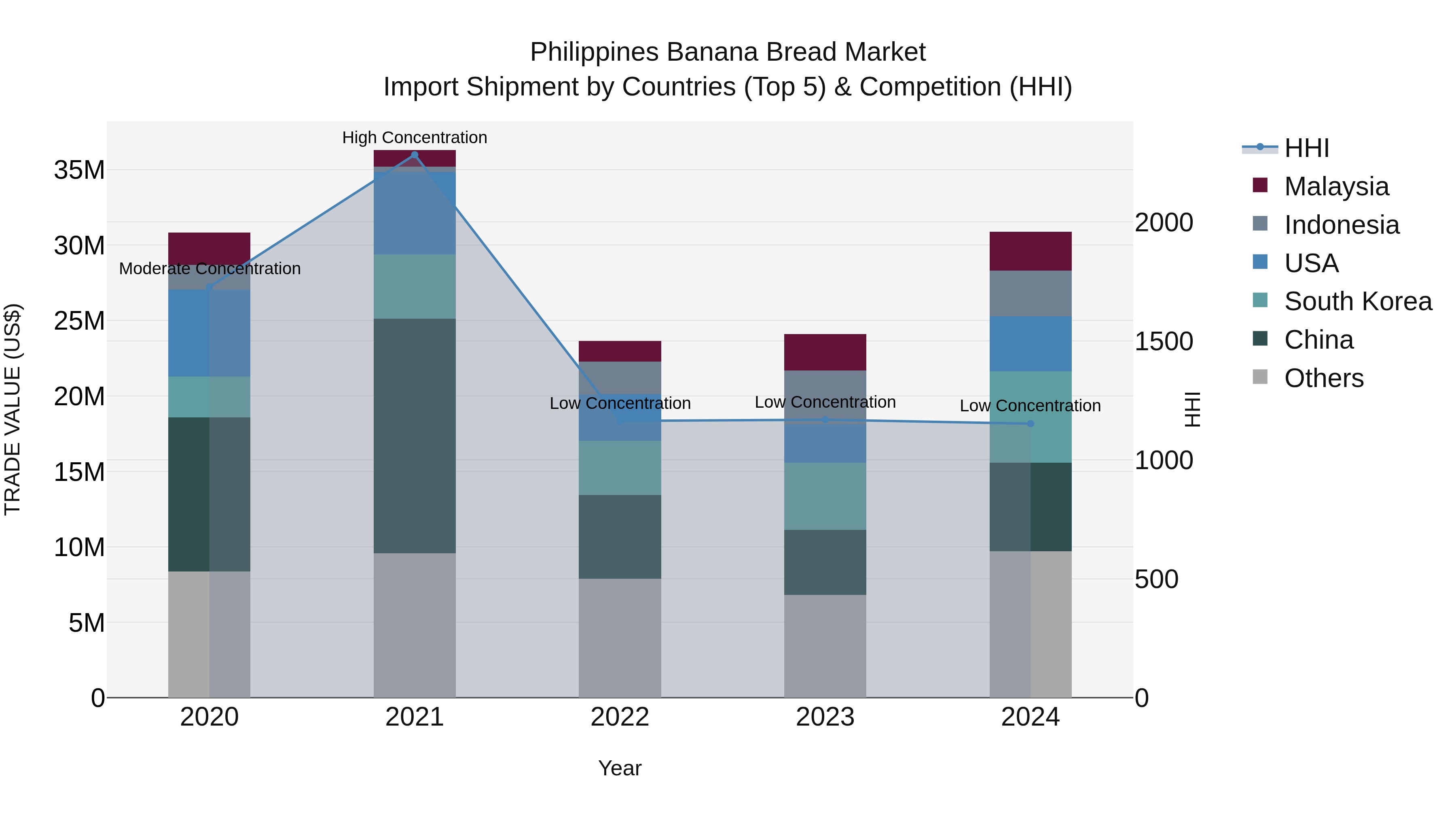
The Philippines saw increased banana bread import shipments in 2024, with top exporters being South Korea, China, USA, Indonesia, and Malaysia. Despite the diverse source countries, the market remains moderately concentrated with a low Herfindahl-Hirschman Index. The compound annual growth rate (CAGR) from 2020 to 2024 was stable at 0.04, but there was a notable surge in growth from 2023 to 2024, with a growth rate of 28.12%. This indicates a growing demand for banana bread imports in the Philippines, presenting opportunities for suppliers from various countries to capitalize on this trend.
Philippines Banana Bread Market Overview
Banana bread has become a popular baked good in the Philippines, particularly during the COVID-19 pandemic when home baking surged. The market includes small-scale bakeries, home-based businesses, and commercial manufacturers. Innovation in flavors and health-focused ingredients like whole wheat and low sugar variants are supporting its continued popularity.
Trends of the market
Banana bread has become increasingly popular in the Philippines, especially during periods of home confinement like the COVID-19 pandemic. The trend continues, fueled by home bakers, cafes, and commercial bakeries offering diverse variations including gluten-free and vegan options. Consumers interest in comfort foods and healthier baking alternatives supports ongoing market expansion.
Challenges of the market
The Banana Bread market in the Philippines faces challenges related to the rising costs of key ingredients, such as flour, sugar, and bananas, which can make it difficult for small-scale producers to maintain competitive pricing. Additionally, consumer preferences are shifting toward healthier snack options, and banana bread, often made with refined sugars and flours, may not align with current health trends. Another challenge is the intense competition in the baked goods market, where banana bread competes with other more popular or traditional bread and snack options. Lastly, inconsistent banana supply due to climate and pest-related challenges can affect production and availability.
Investment opportunities in the Market
The banana bread market in the Philippines offers substantial growth potential, fueled by increasing consumer interest in baked goods and healthier snack options. As the trend toward home baking and organic ingredients rises, businesses focusing on high-quality, nutritious banana bread products, including gluten-free and sugar-free options, will find a receptive market. Partnering with local bakeries and expanding online retail channels can further boost market penetration.
Government Policy of the market
Banana bread production benefits from food micro-enterprise development programs spearheaded by DTI and local government units. Initiatives such as shared service facilities and product packaging support help local bakeries scale operations. Food safety regulations and nutritional labeling requirements from the FDA ensure product compliance for both small- and large-scale producers, while government-backed food festivals and agri-tourism also support local banana bread sales.
Key Highlights of the Report:
- Philippines Banana Bread Market Outlook
- Market Size of Philippines Banana Bread Market, 2024
- Forecast of Philippines Banana Bread Market, 2031
- Historical Data and Forecast of Philippines Banana Bread Revenues & Volume for the Period 2021- 2031
- Philippines Banana Bread Market Trend Evolution
- Philippines Banana Bread Market Drivers and Challenges
- Philippines Banana Bread Price Trends
- Philippines Banana Bread Porter's Five Forces
- Philippines Banana Bread Industry Life Cycle
- Historical Data and Forecast of Philippines Banana Bread Market Revenues & Volume By Product for the Period 2021- 2031
- Historical Data and Forecast of Philippines Banana Bread Market Revenues & Volume By Unflavored for the Period 2021- 2031
- Historical Data and Forecast of Philippines Banana Bread Market Revenues & Volume By Flavored for the Period 2021- 2031
- Historical Data and Forecast of Philippines Banana Bread Market Revenues & Volume By Distribution Channel for the Period 2021- 2031
- Historical Data and Forecast of Philippines Banana Bread Market Revenues & Volume By Hypermarket & Supermarket for the Period 2021- 2031
- Historical Data and Forecast of Philippines Banana Bread Market Revenues & Volume By Convenience Stores for the Period 2021- 2031
- Historical Data and Forecast of Philippines Banana Bread Market Revenues & Volume By Online for the Period 2021- 2031
- Historical Data and Forecast of Philippines Banana Bread Market Revenues & Volume By Others for the Period 2021- 2031
- Philippines Banana Bread Import Export Trade Statistics
- Market Opportunity Assessment By Product
- Market Opportunity Assessment By Distribution Channel
- Philippines Banana Bread Top Companies Market Share
- Philippines Banana Bread Competitive Benchmarking By Technical and Operational Parameters
- Philippines Banana Bread Company Profiles
- Philippines Banana Bread Key Strategic Recommendations






































