Philippines Boiler Market Top 5 Importing Countries and Market Competition (HHI) Analysis
The Philippines` boiler import market in 2024 continued to be dominated by top exporters such as China, India, Taiwan, South Korea, and the USA. Despite high concentration with a high Herfindahl-Hirschman Index (HHI), the market experienced a significant CAGR of 26.82% from 2020 to 2024. However, there was a notable decline in growth rate from 2023 to 2024 at -23.94%, indicating a potential shift in market dynamics or challenges faced by the industry during that period.
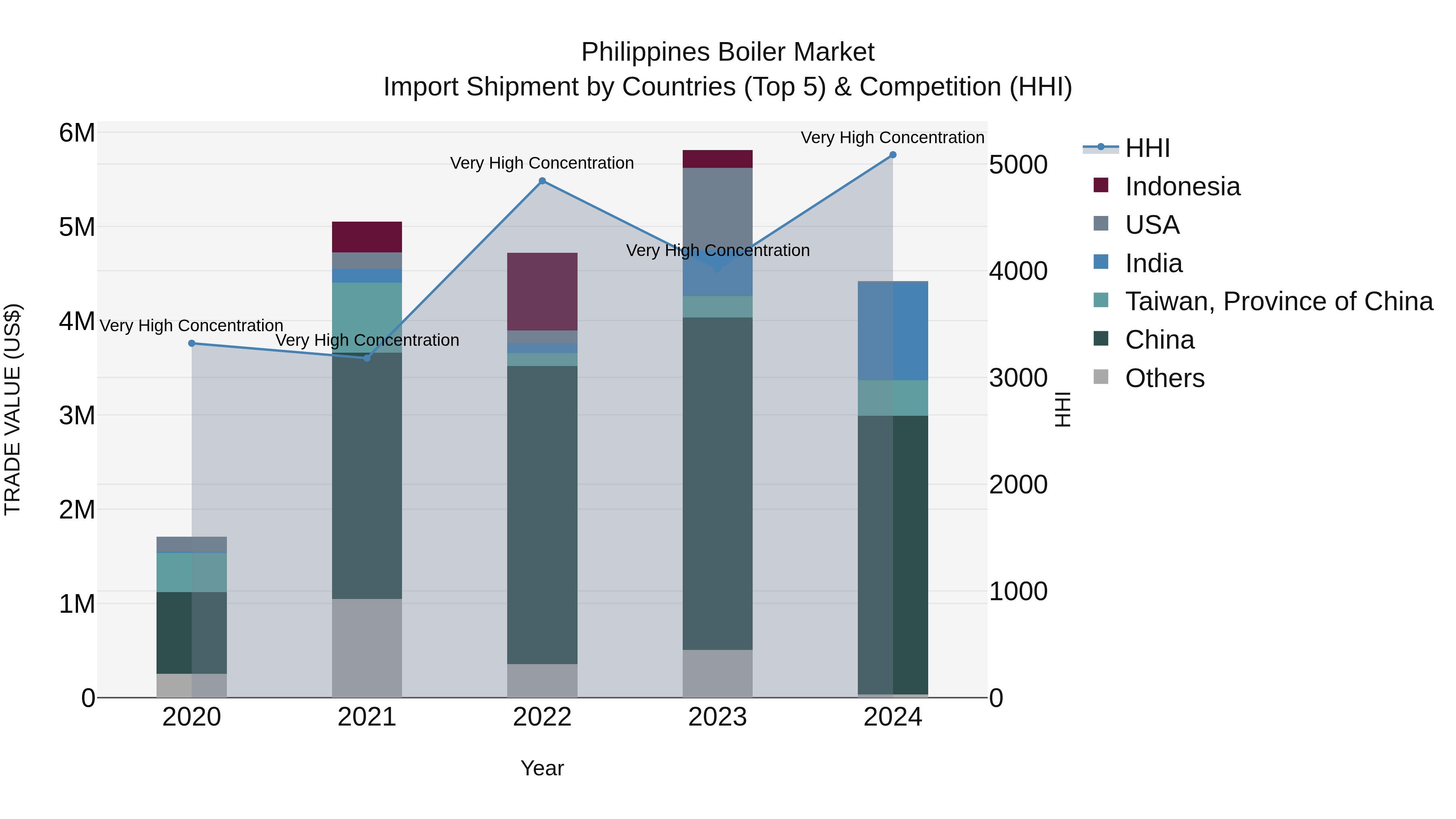
Philippines Boiler Market Overview
The boiler market in the Philippines is experiencing steady growth, driven by industrialization, power generation, and the need for efficient heating systems in commercial facilities. Energy efficiency and environmental compliance are key concerns.
Trends of the market
The boiler market in the Philippines is expanding alongside the countrys industrial and infrastructure development. Energy-efficient and environmentally friendly boiler systems are increasingly favored in manufacturing, power generation, and commercial applications.
Challenges of the market
The boiler market faces challenges such as rising fuel and operational costs, as well as regulatory pressures to meet environmental standards. The need for efficient and cost-effective solutions, especially in industrial and commercial applications, drives innovation but also increases competition. Furthermore, the high initial capital investment required for boiler systems can deter potential buyers.
Investment opportunities in the Market
The boiler market in the Philippines is growing due to increasing demand for energy-efficient heating solutions in industries such as manufacturing, power generation, and commercial establishments. Boilers are essential for steam production and heating applications, and with a focus on sustainability, more businesses are seeking efficient, eco-friendly boiler systems. Investors can explore opportunities in the development and supply of advanced boilers, particularly in the industrial and commercial sectors that require consistent heating and power generation solutions.
Government Policy of the market
The Boiler Market is overseen by the Department of Labor and Employment (DOLE) and the Bureau of Fire Protection (BFP) for workplace safety and operational compliance. The government enforces strict standards on boiler design, installation, inspection, and maintenance, along with operator licensing requirements to prevent accidents.
Key Highlights of the Report:
- Philippines Boiler Market Outlook
- Market Size of Philippines Boiler Market, 2024
- Forecast of Philippines Boiler Market, 2031
- Historical Data and Forecast of Philippines Boiler Revenues & Volume for the Period 2021- 2031
- Philippines Boiler Market Trend Evolution
- Philippines Boiler Market Drivers and Challenges
- Philippines Boiler Price Trends
- Philippines Boiler Porter's Five Forces
- Philippines Boiler Industry Life Cycle
- Historical Data and Forecast of Philippines Boiler Market Revenues & Volume By Fuel Type for the Period 2021- 2031
- Historical Data and Forecast of Philippines Boiler Market Revenues & Volume By Natural Gas & Biomass for the Period 2021- 2031
- Historical Data and Forecast of Philippines Boiler Market Revenues & Volume By Coal for the Period 2021- 2031
- Historical Data and Forecast of Philippines Boiler Market Revenues & Volume By Oil for the Period 2021- 2031
- Historical Data and Forecast of Philippines Boiler Market Revenues & Volume By Others for the Period 2021- 2031
- Historical Data and Forecast of Philippines Boiler Market Revenues & Volume By Boiler Type for the Period 2021- 2031
- Historical Data and Forecast of Philippines Boiler Market Revenues & Volume By Fire-Tube for the Period 2021- 2031
- Historical Data and Forecast of Philippines Boiler Market Revenues & Volume By Water-Tube for the Period 2021- 2031
- Historical Data and Forecast of Philippines Boiler Market Revenues & Volume By Boiler Horsepower for the Period 2021- 2031
- Historical Data and Forecast of Philippines Boiler Market Revenues & Volume By 10-150 BHP for the Period 2021- 2031
- Historical Data and Forecast of Philippines Boiler Market Revenues & Volume By 151-300 BHP for the Period 2021- 2031
- Historical Data and Forecast of Philippines Boiler Market Revenues & Volume By 301-600 BHP for the Period 2021- 2031
- Historical Data and Forecast of Philippines Boiler Market Revenues & Volume By End-Use Industry for the Period 2021- 2031
- Historical Data and Forecast of Philippines Boiler Market Revenues & Volume By Chemical for the Period 2021- 2031
- Historical Data and Forecast of Philippines Boiler Market Revenues & Volume By Food for the Period 2021- 2031
- Historical Data and Forecast of Philippines Boiler Market Revenues & Volume By Refineries for the Period 2021- 2031
- Historical Data and Forecast of Philippines Boiler Market Revenues & Volume By Metals & Mining for the Period 2021- 2031
- Historical Data and Forecast of Philippines Boiler Market Revenues & Volume By Others for the Period 2021- 2031
- Philippines Boiler Import Export Trade Statistics
- Market Opportunity Assessment By Fuel Type
- Market Opportunity Assessment By Boiler Type
- Market Opportunity Assessment By Boiler Horsepower
- Market Opportunity Assessment By End-Use Industry
- Philippines Boiler Top Companies Market Share
- Philippines Boiler Competitive Benchmarking By Technical and Operational Parameters
- Philippines Boiler Company Profiles
- Philippines Boiler Key Strategic Recommendations






































