Philippines Botanical Supplements Market Top 5 Importing Countries and Market Competition (HHI) Analysis
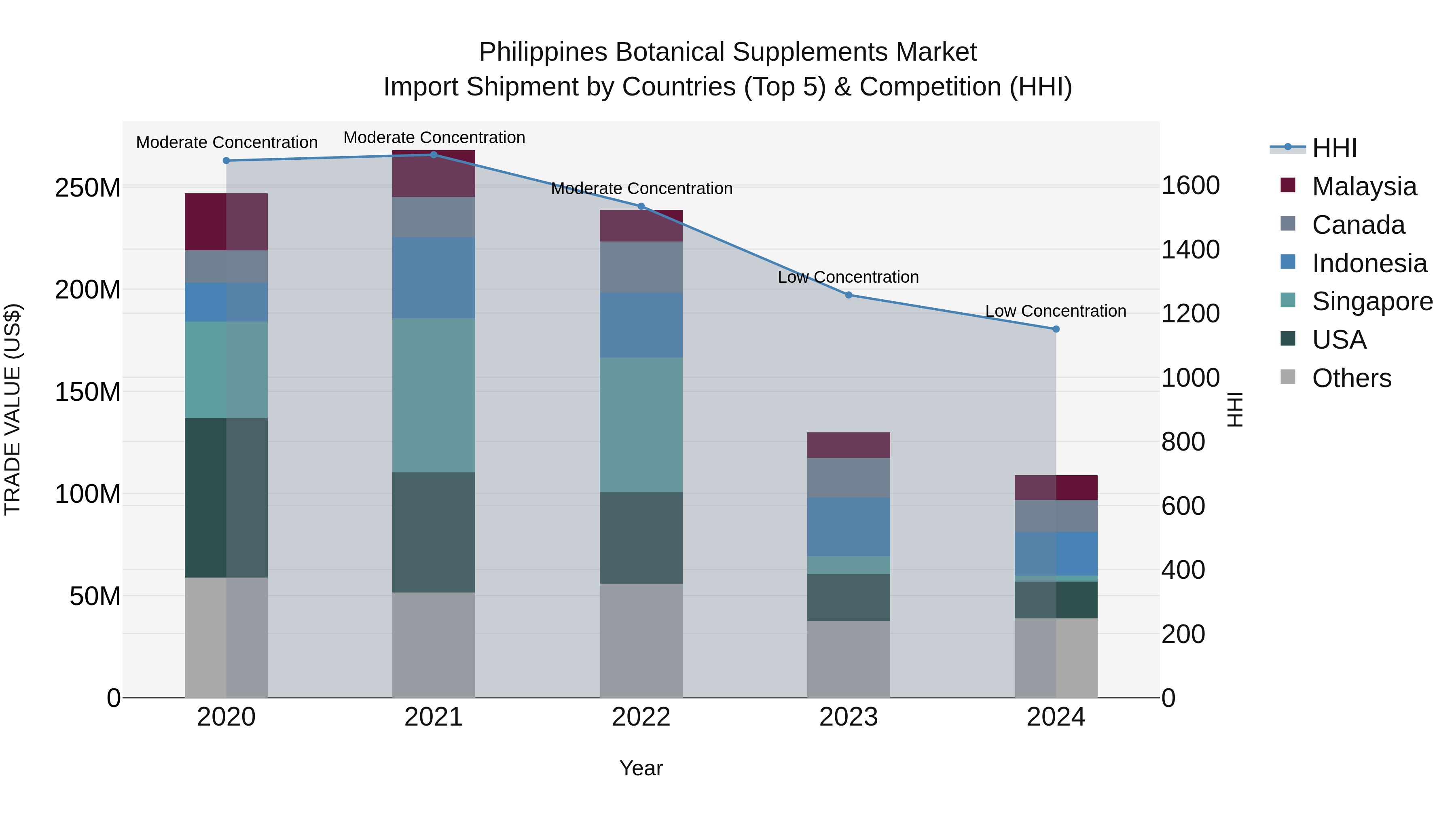
Despite a declining CAGR and negative growth rate in 2024, the Philippines botanical supplements import market continues to be diversified with top exporters like Indonesia, USA, Canada, Malaysia, and India. The low Herfindahl-Hirschman Index (HHI) indicates low market concentration, offering opportunities for various players to enter the market. The presence of multiple exporting countries suggests a competitive landscape, potentially driving innovation and product diversity in the industry. Monitoring emerging trends and consumer preferences can help stakeholders navigate the market dynamics and capitalize on growth opportunities in the botanical supplements sector.
Botanical Supplements Market: Philippines vs Top 5 Major Economies in 2027 (Asia)
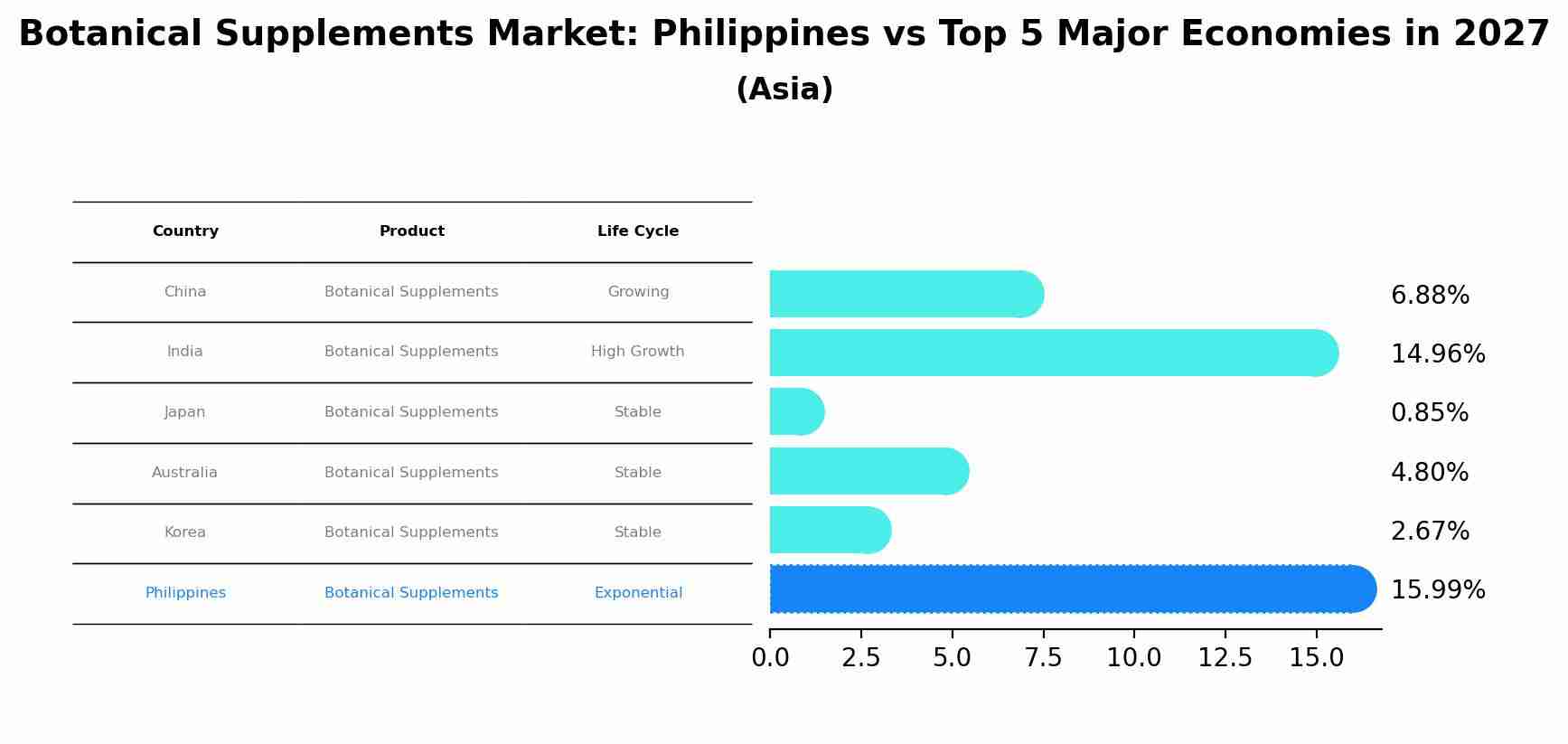
The Botanical Supplements market in Philippines is projected to grow at a exponential growth rate of 15.99% by 2027, within the Asia region led by China, along with other countries like India, Japan, Australia and South Korea, collectively shaping a dynamic and evolving market environment driven by innovation and increasing adoption of emerging technologies.
philippines botanical supplements market Synopsis
In the realm of botanical supplements, the Philippines market showcases a rising trend in health and wellness awareness. Consumers are increasingly seeking natural and plant-derived supplements to support their overall well-being. This has led to a growing market for botanical supplements sourced from a variety of herbs, roots, and other plant materials, as they are perceived as safer alternatives to synthetic supplements.
Drivers of the Market
The botanical supplements market in the Philippines is primarily driven by the rising consumer interest in natural and herbal remedies. Increased awareness of the potential health benefits of botanical supplements, including traditional remedies used in Filipino culture, drives market growth. Additionally, the perception of botanical supplements as a safer alternative to synthetic supplements contributes to their popularity.
Challenges of the Market
The Philippines botanical supplements market encounters challenges related to quality control, regulatory compliance, and consumer education. Ensuring the purity, potency, and safety of botanical supplements is vital. The market`s growth is influenced by regulations governing supplement manufacturing, labeling, and claims. Additionally, educating consumers about the benefits and potential risks of botanical supplements is an ongoing challenge.
COVID-19 Impact on the Market
The Philippines botanical supplements market experienced shifts in consumer behavior during the COVID-19 pandemic. Increased focus on health and wellness prompted greater interest in supplements, including botanicals known for their potential immune-boosting and health-promoting properties. However, disruptions in the supply chain and manufacturing processes impacted the availability of some supplements. The market`s growth was also influenced by changes in consumer disposable income and priorities. The recovery of the market hinged on the sustained interest in health products and the ability of the industry to adapt to supply chain challenges.
Key Players in the Market
The botanical supplements market in the Philippines is a segment of the broader dietary supplements industry. Key players could include health and wellness companies like ATC Healthcare, Sant? Barley, and Herbalife Philippines.
Key Highlights of the Report:
- Philippines Botanical Supplements Market Outlook
- Market Size of Philippines Botanical Supplements Market, 2024
- Forecast of Philippines Botanical Supplements Market, 2031
- Historical Data and Forecast of Philippines Botanical Supplements Revenues & Volume for the Period 2021-2031
- Philippines Botanical Supplements Market Trend Evolution
- Philippines Botanical Supplements Market Drivers and Challenges
- Philippines Botanical Supplements Price Trends
- Philippines Botanical Supplements Porter's Five Forces
- Philippines Botanical Supplements Industry Life Cycle
- Historical Data and Forecast of Philippines Botanical Supplements Market Revenues & Volume By Source for the Period 2021-2031
- Historical Data and Forecast of Philippines Botanical Supplements Market Revenues & Volume By Herbs for the Period 2021-2031
- Historical Data and Forecast of Philippines Botanical Supplements Market Revenues & Volume By Leaves for the Period 2021-2031
- Historical Data and Forecast of Philippines Botanical Supplements Market Revenues & Volume By Spices for the Period 2021-2031
- Historical Data and Forecast of Philippines Botanical Supplements Market Revenues & Volume By Flowers for the Period 2021-2031
- Historical Data and Forecast of Philippines Botanical Supplements Market Revenues & Volume By Others for the Period 2021-2031
- Historical Data and Forecast of Philippines Botanical Supplements Market Revenues & Volume By Form for the Period 2021-2031
- Historical Data and Forecast of Philippines Botanical Supplements Market Revenues & Volume By Powder for the Period 2021-2031
- Historical Data and Forecast of Philippines Botanical Supplements Market Revenues & Volume By Liquid for the Period 2021-2031
- Historical Data and Forecast of Philippines Botanical Supplements Market Revenues & Volume By Tablets for the Period 2021-2031
- Historical Data and Forecast of Philippines Botanical Supplements Market Revenues & Volume By Capsules for the Period 2021-2031
- Historical Data and Forecast of Philippines Botanical Supplements Market Revenues & Volume By Gummies for the Period 2021-2031
- Historical Data and Forecast of Philippines Botanical Supplements Market Revenues & Volume By Others for the Period 2021-2031
- Historical Data and Forecast of Philippines Botanical Supplements Market Revenues & Volume By Application for the Period 2021-2031
- Historical Data and Forecast of Philippines Botanical Supplements Market Revenues & Volume By Energy & Weight Management for the Period 2021-2031
- Historical Data and Forecast of Philippines Botanical Supplements Market Revenues & Volume By General Health for the Period 2021-2031
- Historical Data and Forecast of Philippines Botanical Supplements Market Revenues & Volume By Bone & Joint Health for the Period 2021-2031
- Historical Data and Forecast of Philippines Botanical Supplements Market Revenues & Volume By Gastrointestinal Health for the Period 2021-2031
- Historical Data and Forecast of Philippines Botanical Supplements Market Revenues & Volume By Immunity for the Period 2021-2031
- Historical Data and Forecast of Philippines Botanical Supplements Market Revenues & Volume By Cardiac Health for the Period 2021-2031
- Historical Data and Forecast of Philippines Botanical Supplements Market Revenues & Volume By Diabetes for the Period 2021-2031
- Historical Data and Forecast of Philippines Botanical Supplements Market Revenues & Volume By Anti-cancer for the Period 2021-2031
- Historical Data and Forecast of Philippines Botanical Supplements Market Revenues & Volume By Distribution Channel for the Period 2021-2031
- Historical Data and Forecast of Philippines Botanical Supplements Market Revenues & Volume By Offline for the Period 2021-2031
- Historical Data and Forecast of Philippines Botanical Supplements Market Revenues & Volume By Online for the Period 2021-2031
- Philippines Botanical Supplements Import Export Trade Statistics
- Market Opportunity Assessment By Source
- Market Opportunity Assessment By Form
- Market Opportunity Assessment By Application
- Market Opportunity Assessment By Distribution Channel
- Philippines Botanical Supplements Top Companies Market Share
- Philippines Botanical Supplements Competitive Benchmarking By Technical and Operational Parameters
- Philippines Botanical Supplements Company Profiles
- Philippines Botanical Supplements Key Strategic Recommendations






































