Philippines Caps & Closure Market Top 5 Importing Countries and Market Competition (HHI) Analysis
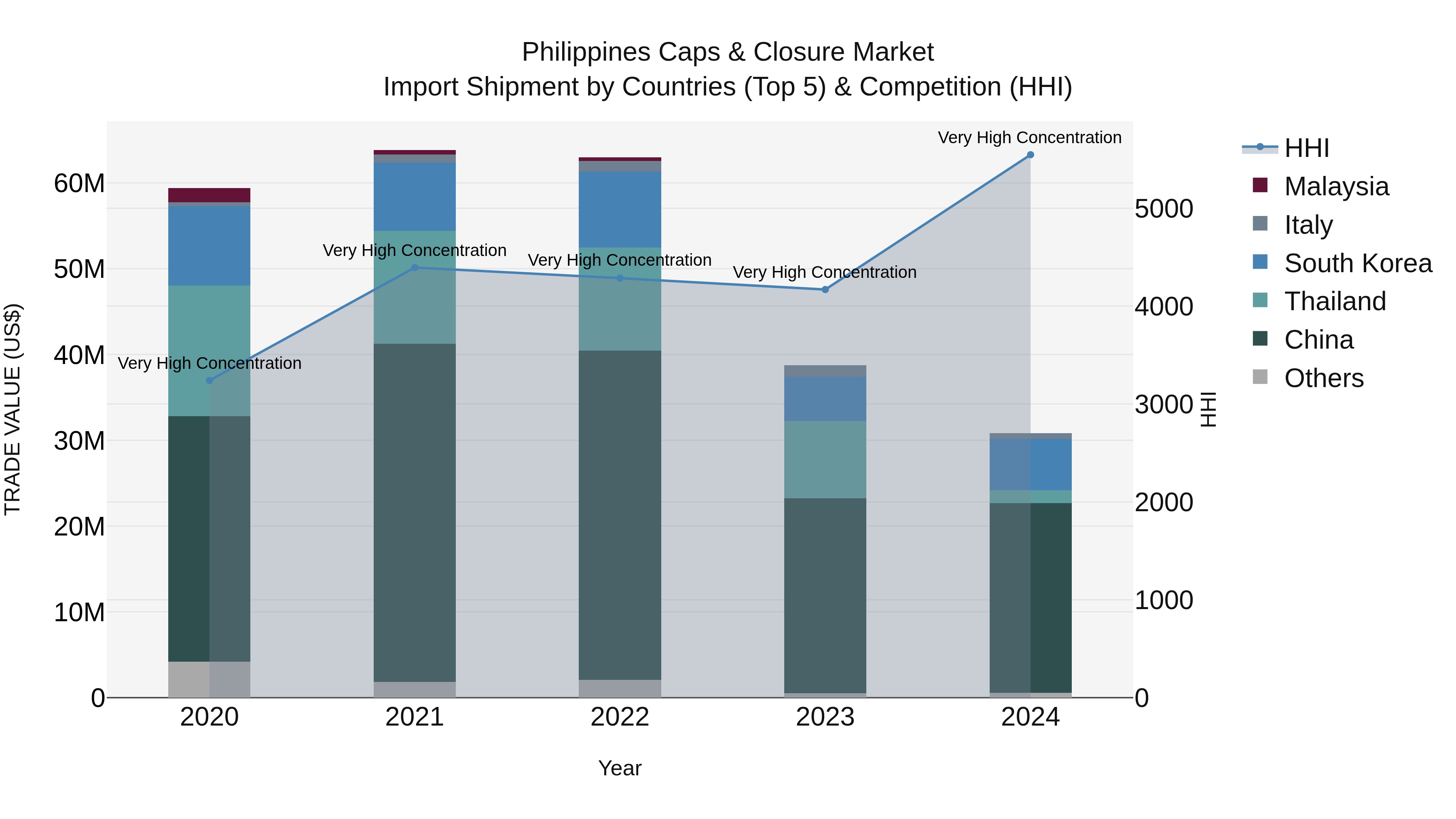
Despite the negative CAGR and growth rate in caps & closure imports to the Philippines, the market continues to be dominated by top exporting countries such as China, South Korea, Thailand, Italy, and India. The high Herfindahl-Hirschman Index (HHI) concentration in 2024 indicates a competitive landscape with limited market diversification. It will be crucial for market players to strategize effectively to navigate the challenging environment and potentially explore opportunities for growth and innovation in the coming years.
Philippines Caps & Closure Market Overview
The caps and closure market serves the food, beverage, pharmaceuticals, and cosmetics industries. Demand is fueled by rising packaged goods consumption, innovation in materials, and sustainability concerns.
Trends of the market
The Caps & Closure Market in the Philippines is expanding as demand for packaging solutions grows across various industries such as food, beverages, pharmaceuticals, and cosmetics. Caps and closures are critical for ensuring product safety, freshness, and convenience for consumers. With increasing focus on sustainability, the market is also witnessing a rise in eco-friendly and recyclable closures. The growth of e-commerce and the rise of ready-to-drink beverages are also contributing to the demand for innovative and secure closure systems.
Challenges of the market
The market faces challenges with rising material costs, regulatory pressures regarding the use of certain plastics, the need for more sustainable packaging solutions, and the increasing competition from innovative closures and packaging solutions.
Investment opportunities in the Market
The caps and closure market in the Philippines is experiencing growth driven by the expanding beverage, food packaging, and pharmaceutical industries. With the rise in consumer demand for convenience and hygiene, the demand for secure and efficient packaging solutions such as caps and closures is increasing. Companies investing in the development and production of advanced caps and closure designs, especially those focusing on sustainability and ease of use, will be well-positioned to capitalize on the growing demand in the Philippines market.
Government Policy of the market
The caps and closure market in the Philippines is subject to regulations that ensure the safety and quality of these products, which are essential for packaging food, beverages, and pharmaceuticals. The government, through the Department of Trade and Industry (DTI) and the FDA, sets standards for the materials used in caps and closures, ensuring they do not pose health risks to consumers. These policies also regulate the proper labeling and recycling of packaging materials, promoting environmental sustainability.
Key Highlights of the Report:
- Philippines Caps & Closure Market Outlook
- Market Size of Philippines Caps & Closure Market, 2024
- Forecast of Philippines Caps & Closure Market, 2031
- Historical Data and Forecast of Philippines Caps & Closure Revenues & Volume for the Period 2021- 2031
- Philippines Caps & Closure Market Trend Evolution
- Philippines Caps & Closure Market Drivers and Challenges
- Philippines Caps & Closure Price Trends
- Philippines Caps & Closure Porter's Five Forces
- Philippines Caps & Closure Industry Life Cycle
- Historical Data and Forecast of Philippines Caps & Closure Market Revenues & Volume By Material Type for the Period 2021- 2031
- Historical Data and Forecast of Philippines Caps & Closure Market Revenues & Volume By PET for the Period 2021- 2031
- Historical Data and Forecast of Philippines Caps & Closure Market Revenues & Volume By PP for the Period 2021- 2031
- Historical Data and Forecast of Philippines Caps & Closure Market Revenues & Volume By HDPE for the Period 2021- 2031
- Historical Data and Forecast of Philippines Caps & Closure Market Revenues & Volume By LDPE for the Period 2021- 2031
- Historical Data and Forecast of Philippines Caps & Closure Market Revenues & Volume By End User Industry for the Period 2021- 2031
- Historical Data and Forecast of Philippines Caps & Closure Market Revenues & Volume By Beverage (Bottled Water, Beer, Dairy, RTD, Wine, Spirits, etc.) for the Period 2021- 2031
- Historical Data and Forecast of Philippines Caps & Closure Market Revenues & Volume By Food for the Period 2021- 2031
- Historical Data and Forecast of Philippines Caps & Closure Market Revenues & Volume By Pharmaceutical and Healthcare for the Period 2021- 2031
- Historical Data and Forecast of Philippines Caps & Closure Market Revenues & Volume By Cosmetics and Toiletries for the Period 2021- 2031
- Philippines Caps & Closure Import Export Trade Statistics
- Market Opportunity Assessment By Material Type
- Market Opportunity Assessment By End User Industry
- Philippines Caps & Closure Top Companies Market Share
- Philippines Caps & Closure Competitive Benchmarking By Technical and Operational Parameters
- Philippines Caps & Closure Company Profiles
- Philippines Caps & Closure Key Strategic Recommendations






































