Philippines Ceramic Tiles & Sanitary Ware Market Top 5 Importing Countries and Market Competition (HHI) Analysis
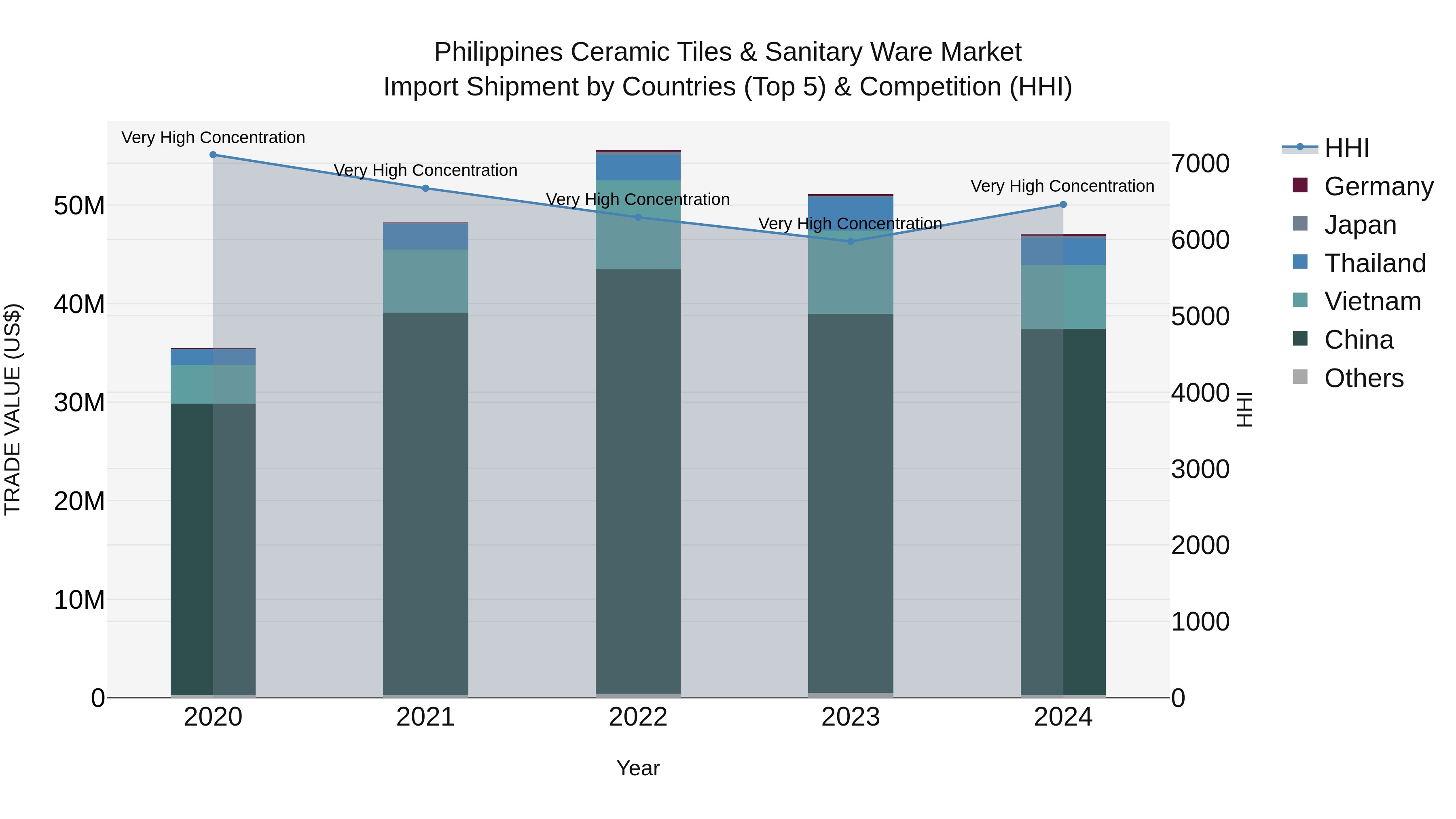
In 2024, the Philippines continued to witness a high concentration of ceramic tiles and sanitary ware imports, with top exporters being China, Vietnam, Thailand, Japan, and Germany. Despite a slight decline in growth rate from 2023 to 2024, the industry maintained a healthy Compound Annual Growth Rate (CAGR) of 7.36% over the period of 2020-2024. The market dynamics suggest strong competition among key exporting countries, indicating a competitive landscape and potential opportunities for market players to differentiate and innovate in order to capture a larger share of the market in the Philippines.
Philippines Ceramic Tiles & Sanitary Ware Market Overview
The combined ceramic tiles and sanitary ware market in the Philippines is thriving due to rapid urbanization and commercial construction. Developers and homeowners are increasingly looking for stylish, durable, and water-efficient products. Competition among local players and imported brands is intense, spurring innovation in design, materials, and sustainability.
Trends of the market
The combined ceramic tiles and sanitary ware market is expanding as urbanization and infrastructure development fuel demand. Integrated solutions that emphasize coordinated design themes and sustainability, including water-saving fixtures and eco-friendly tiles, are gaining traction among builders and homeowners.
Challenges of the market
The combined Ceramic Tiles & Sanitary Ware Market in the Philippines faces challenges from fluctuating raw material prices and increasing competition from imported products, particularly those from countries with lower production costs. Local manufacturers are also faced with a shift in consumer preferences toward sustainable, water-efficient products. Additionally, there are regulatory hurdles related to environmental standards that manufacturers must adhere to, adding further complexity to operations.
Investment opportunities in the Market
The combined ceramic tiles and sanitary ware market in the Philippines presents a unique opportunity for investors to tap into two complementary sectors that cater to the growing demand for modern, aesthetically appealing, and durable materials for homes and businesses. As construction projects proliferate and the demand for home improvement products rises, both ceramic tiles and sanitary ware are essential components in the design and functionality of residential and commercial spaces. By investing in both segments, companies can establish a strong foothold in the expanding construction and renovation industries.
Government Policy of the market
The Philippine government adopts an integrated approach to regulate and promote the ceramic tiles and sanitary ware markets, focusing on both local production and environmental sustainability. Policies encourage the use of eco-friendly materials and technologies in the manufacturing of both tiles and sanitary ware. The government also provides financial incentives for companies that implement green practices and support local industries through favorable import regulations and export opportunities.
Key Highlights of the Report:
- Philippines Ceramic Tiles & Sanitary Ware Market Outlook
- Market Size of Philippines Ceramic Tiles & Sanitary Ware Market, 2024
- Forecast of Philippines Ceramic Tiles & Sanitary Ware Market, 2031
- Historical Data and Forecast of Philippines Ceramic Tiles & Sanitary Ware Revenues & Volume for the Period 2021- 2031
- Philippines Ceramic Tiles & Sanitary Ware Market Trend Evolution
- Philippines Ceramic Tiles & Sanitary Ware Market Drivers and Challenges
- Philippines Ceramic Tiles & Sanitary Ware Price Trends
- Philippines Ceramic Tiles & Sanitary Ware Porter's Five Forces
- Philippines Ceramic Tiles & Sanitary Ware Industry Life Cycle
- Historical Data and Forecast of Philippines Ceramic Tiles & Sanitary Ware Market Revenues & Volume By Product for the Period 2021- 2031
- Historical Data and Forecast of Philippines Ceramic Tiles & Sanitary Ware Market Revenues & Volume By Tiles for the Period 2021- 2031
- Historical Data and Forecast of Philippines Ceramic Tiles & Sanitary Ware Market Revenues & Volume By Sanitary ware for the Period 2021- 2031
- Historical Data and Forecast of Philippines Ceramic Tiles & Sanitary Ware Market Revenues & Volume By End-User for the Period 2021- 2031
- Historical Data and Forecast of Philippines Ceramic Tiles & Sanitary Ware Market Revenues & Volume By Residential for the Period 2021- 2031
- Historical Data and Forecast of Philippines Ceramic Tiles & Sanitary Ware Market Revenues & Volume By Commercial for the Period 2021- 2031
- Philippines Ceramic Tiles & Sanitary Ware Import Export Trade Statistics
- Market Opportunity Assessment By Product
- Market Opportunity Assessment By End-User
- Philippines Ceramic Tiles & Sanitary Ware Top Companies Market Share
- Philippines Ceramic Tiles & Sanitary Ware Competitive Benchmarking By Technical and Operational Parameters
- Philippines Ceramic Tiles & Sanitary Ware Company Profiles
- Philippines Ceramic Tiles & Sanitary Ware Key Strategic Recommendations






































