Philippines Coil Coating Market Top 5 Importing Countries and Market Competition (HHI) Analysis
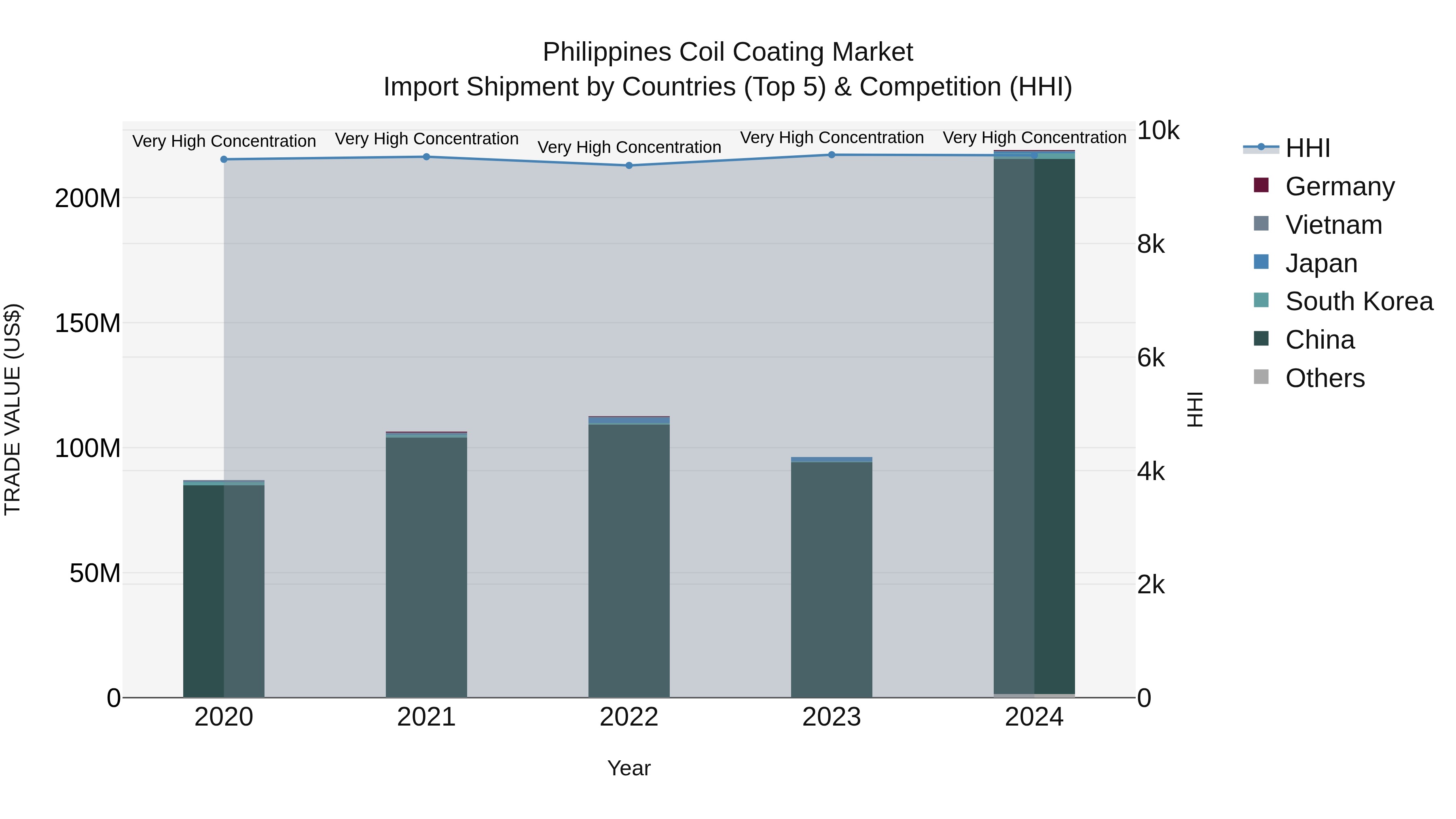
Philippines` coil coating import market in 2024 continued to be dominated by key players such as China, South Korea, Japan, Thailand, and Malaysia. The high Herfindahl-Hirschman Index (HHI) indicates a concentrated market. With a remarkable compound annual growth rate (CAGR) of 25.94% from 2020 to 2024, the industry witnessed significant expansion. The exceptional growth rate of 127.61% from 2023 to 2024 showcases the dynamic nature of the market and the opportunities it presents for stakeholders in the coil coating sector.
Philippines Coil Coating Market Overview
The coil coating market in the Philippines is showing strong potential due to the rising demand for pre-painted metal used in construction, appliances, and transportation. Coil coating involves the continuous application of organic coatings on rolled metal coils, offering superior surface protection and aesthetic appeal. With the boom in infrastructure projects and real estate development, coated steel and aluminum materials are in high demand. The market is also supported by growing awareness of energy-efficient and corrosion-resistant materials, along with an increasing preference for environmentally friendly coatings.
Trends of the market
The Philippines coil coating market is expanding as industries such as construction and automotive increasingly use coil-coated metals for durability, aesthetics, and performance. Coil coating is a process where metal coils are coated with protective and decorative layers of paint, which are then hardened. This coating process enhances the lifespan of metals and improves their resistance to corrosion and wear. With the growth of infrastructure and automotive sectors in the Philippines, the demand for coil coatings is expected to rise, driven by the need for high-performance, long-lasting materials.
Challenges of the market
The coil coating market in the Philippines struggles with issues related to cost and availability of raw materials. The production of high-quality coatings requires specialized chemicals and materials, which are often imported, adding to the overall cost. The market also faces competition from alternative coating methods that are cheaper and easier to implement. Additionally, there is a lack of skilled labor to effectively apply coil coatings, leading to inconsistent quality and lower demand for premium products.
Investment opportunities in the Market
The coil coating market in the Philippines is growing due to increasing demand for durable, corrosion-resistant materials used in various industries, including automotive, construction, and manufacturing. Coil coatings are applied to metal sheets used in the production of vehicle parts, building materials, and appliances, providing a protective finish that enhances their durability and appearance. Investment opportunities lie in the development of eco-friendly, high-performance coatings that offer better protection against harsh weather conditions, scratches, and corrosion. As the Philippines` manufacturing sector continues to grow, particularly in automotive and construction, the demand for coil-coated materials will also increase, providing investors with long-term opportunities for growth.
Government Policy of the market
The coil coating industry is supported through policies encouraging local manufacturing and infrastructure development. The Board of Investments (BOI) offers incentives under the Investment Priorities Plan (IPP) for industries using coated steel in appliances, buildings, and transport. Environmental regulations enforced by the Department of Environment and Natural Resources (DENR) ensure that coating processes comply with volatile organic compound (VOC) and hazardous substance guidelines.
Key Highlights of the Report:
- Philippines Coil Coating Market Outlook
- Market Size of Philippines Coil Coating Market, 2024
- Forecast of Philippines Coil Coating Market, 2031
- Historical Data and Forecast of Philippines Coil Coating Revenues & Volume for the Period 2021- 2031
- Philippines Coil Coating Market Trend Evolution
- Philippines Coil Coating Market Drivers and Challenges
- Philippines Coil Coating Price Trends
- Philippines Coil Coating Porter's Five Forces
- Philippines Coil Coating Industry Life Cycle
- Historical Data and Forecast of Philippines Coil Coating Market Revenues & Volume By Type for the Period 2021- 2031
- Historical Data and Forecast of Philippines Coil Coating Market Revenues & Volume By Polyester Coil Coatings for the Period 2021- 2031
- Historical Data and Forecast of Philippines Coil Coating Market Revenues & Volume By Polyvinylidene Fluoride Coil Coatings for the Period 2021- 2031
- Historical Data and Forecast of Philippines Coil Coating Market Revenues & Volume By Polyurethane Coil Coatings for the Period 2021- 2031
- Historical Data and Forecast of Philippines Coil Coating Market Revenues & Volume By Plastisol Coil Coatings for the Period 2021- 2031
- Historical Data and Forecast of Philippines Coil Coating Market Revenues & Volume By Application for the Period 2021- 2031
- Historical Data and Forecast of Philippines Coil Coating Market Revenues & Volume By Roofing for the Period 2021- 2031
- Historical Data and Forecast of Philippines Coil Coating Market Revenues & Volume By Wall Cladding for the Period 2021- 2031
- Historical Data and Forecast of Philippines Coil Coating Market Revenues & Volume By Composite Panels for the Period 2021- 2031
- Historical Data and Forecast of Philippines Coil Coating Market Revenues & Volume By Doors and Windows for the Period 2021- 2031
- Historical Data and Forecast of Philippines Coil Coating Market Revenues & Volume By Others for the Period 2021- 2031
- Historical Data and Forecast of Philippines Coil Coating Market Revenues & Volume By End-use for the Period 2021- 2031
- Historical Data and Forecast of Philippines Coil Coating Market Revenues & Volume By Construction for the Period 2021- 2031
- Historical Data and Forecast of Philippines Coil Coating Market Revenues & Volume By Automotive for the Period 2021- 2031
- Historical Data and Forecast of Philippines Coil Coating Market Revenues & Volume By Furniture for the Period 2021- 2031
- Historical Data and Forecast of Philippines Coil Coating Market Revenues & Volume By HVAC Systems for the Period 2021- 2031
- Philippines Coil Coating Import Export Trade Statistics
- Market Opportunity Assessment By Type
- Market Opportunity Assessment By Application
- Market Opportunity Assessment By End-use
- Philippines Coil Coating Top Companies Market Share
- Philippines Coil Coating Competitive Benchmarking By Technical and Operational Parameters
- Philippines Coil Coating Company Profiles
- Philippines Coil Coating Key Strategic Recommendations






































