Philippines Construction Drone Market Top 5 Importing Countries and Market Competition (HHI) Analysis
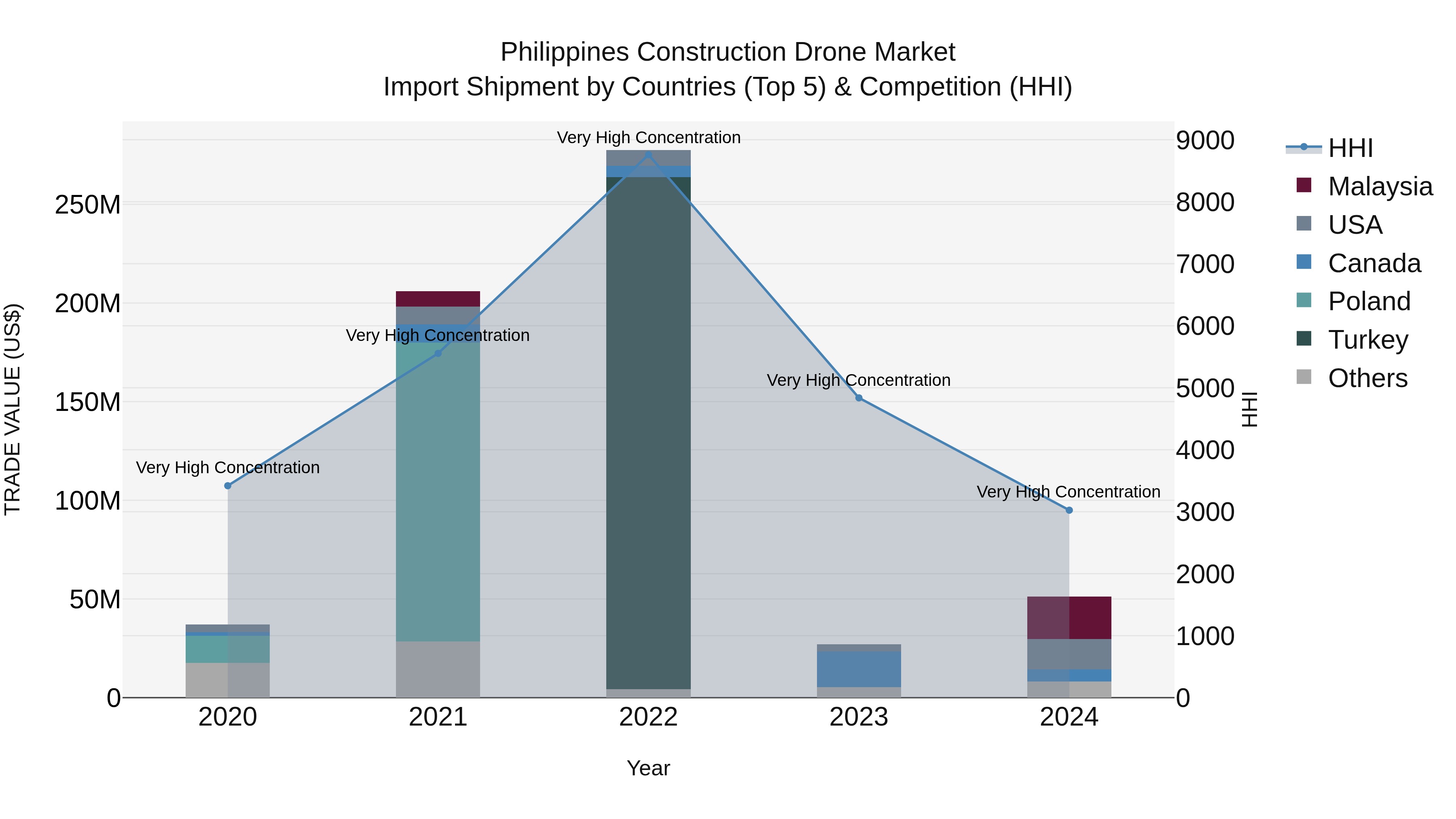
The Philippines` construction drone import market witnessed significant growth in 2024, with top exporting countries including Malaysia, USA, Metropolitan France, Canada, and the UK. The high Herfindahl-Hirschman Index (HHI) indicates a concentrated market, reflecting the dominance of these key players. The compound annual growth rate (CAGR) from 2020 to 2024 stood at a promising 8.44%, showcasing sustained market expansion. Moreover, the impressive growth rate of 89.92% from 2023 to 2024 underscores the increasing demand for construction drones in the Philippines.
Philippines Construction Drone Market Overview
Drones are becoming essential in the Philippine construction sector for site surveys, progress monitoring, and safety inspections. Their ability to cover large areas quickly and deliver high-resolution images helps reduce delays and improve decision-making. Regulatory hurdles and skill gaps in drone operation remain challenges, but adoption is steadily increasing.
Trends of the market
The construction drone market is expanding as drones are increasingly used for site surveys, progress monitoring, and safety inspections. Their ability to capture high-resolution aerial data saves time and reduces risks, making them valuable assets in Philippine construction projects.
Challenges of the market
Despite its technological promise, the construction drone market in the Philippines is constrained by regulatory barriers, including complex licensing processes from the Civil Aviation Authority of the Philippines (CAAP). Concerns over airspace safety and data privacy have slowed government support for commercial drone applications. Additionally, the upfront cost of drones and training personnel limits adoption among small- and medium-sized contractors. Technical issues such as battery life, accuracy in surveying rugged terrain, and connectivity problems also hamper field utility.
Investment opportunities in the Market
Construction drones are revolutionizing site surveying, progress monitoring, and safety inspections. The Philippines construction sector is ripe for drone adoption, creating opportunities for companies specializing in drone hardware, software, and data analytics services. Investments focused on regulatory compliance, operator training, and customized drone solutions will enhance market penetration.
Government Policy of the market
The use of drones in construction is regulated by the Civil Aviation Authority of the Philippines (CAAP), which mandates registration, licensing, and operational limits for drones. Policies support the integration of drone technology for surveying, inspection, and monitoring to improve project efficiency and safety. Privacy laws and airspace regulations ensure responsible drone use in construction zones.
Key Highlights of the Report:
- Philippines Construction Drone Market Outlook
- Market Size of Philippines Construction Drone Market, 2024
- Forecast of Philippines Construction Drone Market, 2031
- Historical Data and Forecast of Philippines Construction Drone Revenues & Volume for the Period 2021- 2031
- Philippines Construction Drone Market Trend Evolution
- Philippines Construction Drone Market Drivers and Challenges
- Philippines Construction Drone Price Trends
- Philippines Construction Drone Porter's Five Forces
- Philippines Construction Drone Industry Life Cycle
- Historical Data and Forecast of Philippines Construction Drone Market Revenues & Volume By Type for the Period 2021- 2031
- Historical Data and Forecast of Philippines Construction Drone Market Revenues & Volume By Fixed Wing Drone for the Period 2021- 2031
- Historical Data and Forecast of Philippines Construction Drone Market Revenues & Volume By Rotary Wing Drone for the Period 2021- 2031
- Historical Data and Forecast of Philippines Construction Drone Market Revenues & Volume By Application for the Period 2021- 2031
- Historical Data and Forecast of Philippines Construction Drone Market Revenues & Volume By Surveying Land for the Period 2021- 2031
- Historical Data and Forecast of Philippines Construction Drone Market Revenues & Volume By Infrastructure Inspection for the Period 2021- 2031
- Historical Data and Forecast of Philippines Construction Drone Market Revenues & Volume By Security and Surveillance for the Period 2021- 2031
- Historical Data and Forecast of Philippines Construction Drone Market Revenues & Volume By Others for the Period 2021- 2031
- Historical Data and Forecast of Philippines Construction Drone Market Revenues & Volume By End User for the Period 2021- 2031
- Historical Data and Forecast of Philippines Construction Drone Market Revenues & Volume By Residential for the Period 2021- 2031
- Historical Data and Forecast of Philippines Construction Drone Market Revenues & Volume By Commercial for the Period 2021- 2031
- Historical Data and Forecast of Philippines Construction Drone Market Revenues & Volume By Industrial for the Period 2021- 2031
- Philippines Construction Drone Import Export Trade Statistics
- Market Opportunity Assessment By Type
- Market Opportunity Assessment By Application
- Market Opportunity Assessment By End User
- Philippines Construction Drone Top Companies Market Share
- Philippines Construction Drone Competitive Benchmarking By Technical and Operational Parameters
- Philippines Construction Drone Company Profiles
- Philippines Construction Drone Key Strategic Recommendations






































