Philippines Digital Education Market Size & Growth Rate (2026-2032)
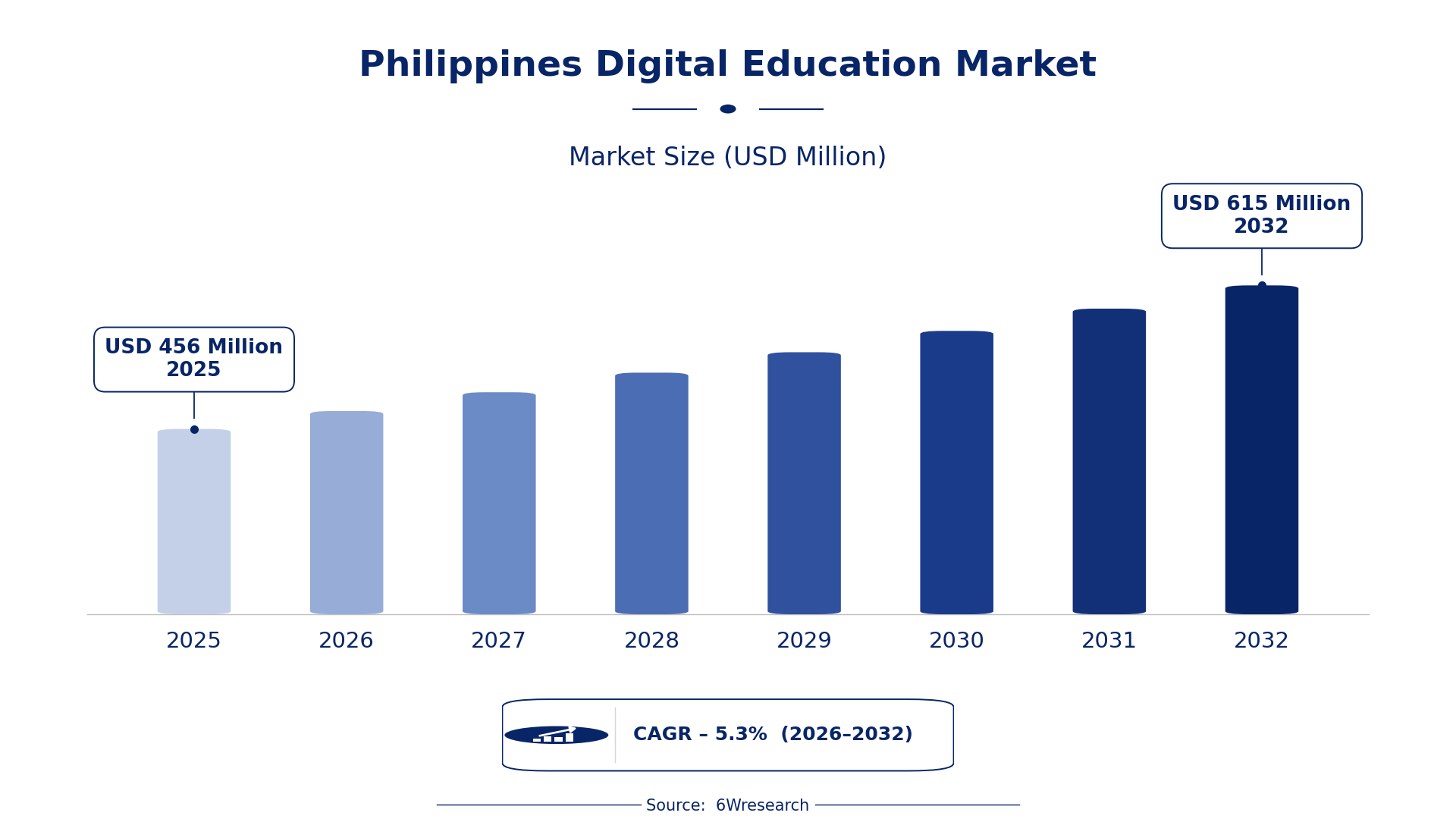
The Philippines Digital Education Market was estimated at USD 456 Million in 2025 and is projected to reach USD 615 Million by 2032, growing at a CAGR of 5.3% from 2026 to 2032.
Philippines Digital Education Market Synopsis
The Philippines Digital Education Market has witnessed remarkable momentum in recent years, largely driven by a surge in online learning demand. With a youthful demographic eager to embrace technology, educational institutions are increasingly adopting digital platforms to enhance learning experiences.
Looking ahead, the market is set to evolve significantly as more players enter the space, diversifying the offerings available to learners. The emphasis on improving educational outcomes through digital means is likely to intensify, ultimately reshaping traditional learning paradigms.
Philippines Digital Education Market Year-wise Growth Rate and Key Drivers
This graph illustrates the annual growth rates of the Philippines Digital Education Market from 2021 to 2032, highlighting a steady upward trajectory and projected expansion over the forecast period.
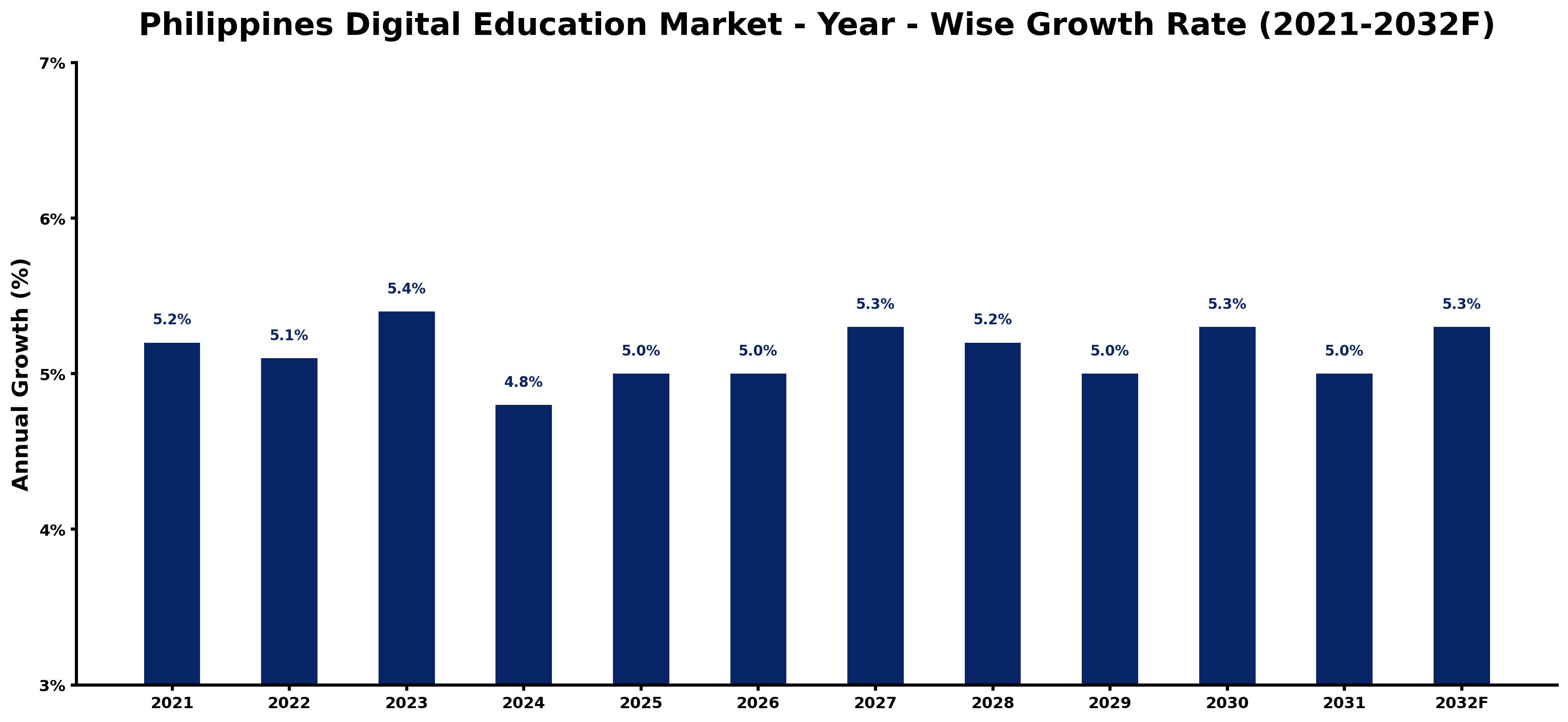
The table below presents the year‑wise growth rates along with the key drivers influencing the market
| Year | Growth Rate | Major Drivers |
| 2021 | 5.2% | Department of Education’s online learning transition program |
| 2022 | 5.1% | Rising smartphone penetration enhancing accessibility to education |
| 2023 | 5.4% | Increased investment in digital infrastructure by local universities |
| 2024 | 4.8% | Government's push for inclusive education through technology |
| 2025 | 5.0% | Growing interest in STEM education among Filipino youth |
| 2026 | 5.0% | Surge in educational content creators and local platforms |
| 2027 | 5.3% | Partnerships with NGOs for digital literacy programs |
| 2028 | 5.2% | Adoption of gamified learning to engage students |
| 2029 | 5.0% | Rising collaboration between tech firms and schools |
| 2030 | 5.3% | Increased use of AI for personalized learning experiences |
| 2031 | 5.0% | Enhanced internet connectivity in rural education facilities |
| 2032 | 5.3% | Support from educational grants facilitating digital tools |
Note: Market size estimations and growth projections presented in this report are based on 6Wresearch's proprietary forecasting methodology, utilizing the latest available industry data, government publications, and primary research inputs.
Philippines Digital Education Market Key Takeaways
Below are some of the specific key takeaways from the market, including:
- The increasing penetration of internet access is facilitating the growth of online education.
- Government initiatives aimed at enhancing digital infrastructure are expected to further support market expansion.
- The rise of mobile learning applications is transforming how education is delivered and accessed.
- Partnerships between educational institutions and technology providers are becoming more prevalent.
- There is a growing focus on personalized learning experiences powered by data analytics.
Evaluation of Restraints in Philippines Digital Education Market
Despite the positive growth trajectory, the Philippines Digital Education Market faces a notable digital divide. Many students in rural areas lack access to reliable internet and necessary technological devices, which hinders equitable educational opportunities. on top of that, the varying levels of digital literacy among educators and students present additional barriers to effective implementation of digital education solutions.
Philippines Digital Education Market Trends
Key trends shaping the Philippines Digital Education Market include an increasing reliance on hybrid learning models, which combine traditional and online education. Gamification of learning is gaining traction, making education more engaging for younger audiences. Additionally, artificial intelligence is being integrated into educational tools, enabling personalized learning experiences tailored to individual student needs.
Philippines Digital Education Market Opportunities
Growth opportunities in the Philippines Digital Education Market lie in the expansion of mobile learning platforms and localized content development. There is a significant demand for vocational training programs that cater to the evolving job market. on top of that, investment in teacher training programs focused on digital education technologies can enhance teaching effectiveness and student outcomes.
Government Initiatives in the Philippines Digital Education Market
Government support plays a crucial role in shaping the Philippines Digital Education Market. With a commitment to improving educational access and quality, public policy initiatives are increasingly focused on enhancing digital infrastructure and promoting online learning solutions. This regulatory posture aims to address existing gaps and ensure that all students can benefit from digital education.
- A recent initiative launched in early 2023 focuses on upgrading internet connectivity in underserved regions, aimed at ensuring equitable access to digital education.
- Current efforts include a nationwide program that provides training for teachers in digital pedagogy, which is essential for effective online instruction.
- Planned initiatives for 2026 include the establishment of public-private partnerships to develop and disseminate localized educational content tailored to Filipino learners.
- A regulatory framework introduced in 2024 mandates the integration of technology in public school curriculums, emphasizing digital literacy.
- A multi-year program focused on enhancing cybersecurity measures in educational institutions is currently underway to protect student data and privacy.
Future Insights of the Philippines Digital Education Market
From 2026 to 2032, the Philippines Digital Education Market is expected to witness substantial advancements. Increased investment in digital infrastructure will likely drive up internet penetration rates, further facilitating online learning. As technology continues to integrate into education, there will be a shift toward more interactive and personalized learning experiences, making education more accessible and engaging for students across the country.
Philippines Digital Education Market Latest Developments
Recent activity in the Philippines Digital Education Market reflects a dynamic environment responding to both technological advancements and educational needs. Over the past year, stakeholders have intensified their focus on enhancing digital learning platforms and tools.
- A leading technology provider announced a partnership in Q1 2025 to launch a new e-learning platform that incorporates gamified learning experiences.
- In mid-2025, a major educational institution completed a successful pilot program for a virtual classroom initiative, demonstrating increased student engagement and learning outcomes.
- A government-backed digital literacy initiative began in early 2025, aiming to train over 100,000 teachers in the next two years.
- By late 2025, a new mobile learning application designed for vocational training is expected to be released, targeting students seeking skills for in-demand jobs.
- Upcoming in 2026, a consortium of educational institutions plans to introduce a shared digital library resource to enhance access to educational materials.
Philippines Digital Education Market - Key Attractiveness of the Report
- 10 Years of Market Numbers
- Historical Data Starting from 2022 to 2025
- Base Year: 2025
- Forecast Data until 2032
- Key Performance Indicators Impacting the Market
- Major Upcoming Developments and Projects
Key Highlights of the Report:
- Philippines Digital Education Market Outlook
- Market Size of Philippines Digital Education Market, 2025
- Forecast of Philippines Digital Education Market, 2032
- Historical Data and Forecast of Philippines Digital Education Revenues & Volume for the Period 2022-2032F
- Philippines Digital Education Market Trend Evolution
- Philippines Digital Education Market Drivers and Challenges
- Philippines Digital Education Price Trends
- Philippines Digital Education Porter's Five Forces
- Philippines Digital Education Industry Life Cycle
- Historical Data and Forecast of Philippines Digital Education Market Revenues & Volume By End User for the Period 2022-2032F
- Historical Data and Forecast of Philippines Digital Education Market Revenues & Volume By Academic Institutions for the Period 2022-2032F
- Historical Data and Forecast of Philippines Digital Education Market Revenues & Volume By Enterprises and Public Sector for the Period 2022-2032F
- Historical Data and Forecast of Philippines Digital Education Market Revenues & Volume By Learning Type for the Period 2022-2032F
- Historical Data and Forecast of Philippines Digital Education Market Revenues & Volume By Self-paced Online Education for the Period 2022-2032F
- Historical Data and Forecast of Philippines Digital Education Market Revenues & Volume By Instructor-led Online Education for the Period 2022-2032F
- Historical Data and Forecast of Philippines Digital Education Market Revenues & Volume By Course Type for the Period 2022-2032F
- Historical Data and Forecast of Philippines Digital Education Market Revenues & Volume By Science and Technology Courses for the Period 2022-2032F
- Historical Data and Forecast of Philippines Digital Education Market Revenues & Volume By Entrepreneurship and Business Management Courses for the Period 2022-2032F
- Historical Data and Forecast of Philippines Digital Education Market Revenues & Volume By Other Courses for the Period 2022-2032F
- Philippines Digital Education Import Export Trade Statistics
- Market Opportunity Assessment By End User
- Market Opportunity Assessment By Learning Type
- Market Opportunity Assessment By Course Type
- Philippines Digital Education Top Companies Market Share
- Philippines Digital Education Competitive Benchmarking By Technical and Operational Parameters
- Philippines Digital Education Company Profiles
- Philippines Digital Education Key Strategic Recommendations






































