Philippines E-wallet Market Size, Share & Growth Rate
The Philippines E-wallet Market was estimated at USD 1400 Million in 2025 and is projected to reach USD 2029 Million by 2032, growing at a CAGR of 5.4% from 2026 to 2032. This remarkable trajectory is primarily fueled by the surge in digital payment adoption, driven by both consumer preferences and technological advancements in financial technology. The growing influence of e-commerce and the increasing smartphone penetration across the nation are accelerating this growth, making cashless transactions more convenient and accessible for a broader population.
Philippines E-wallet Market Year-wise Growth Rate and Key Drivers
This graph highlights how the Philippines E-wallet Market has steadily grown over the years, supported by major growth factors.
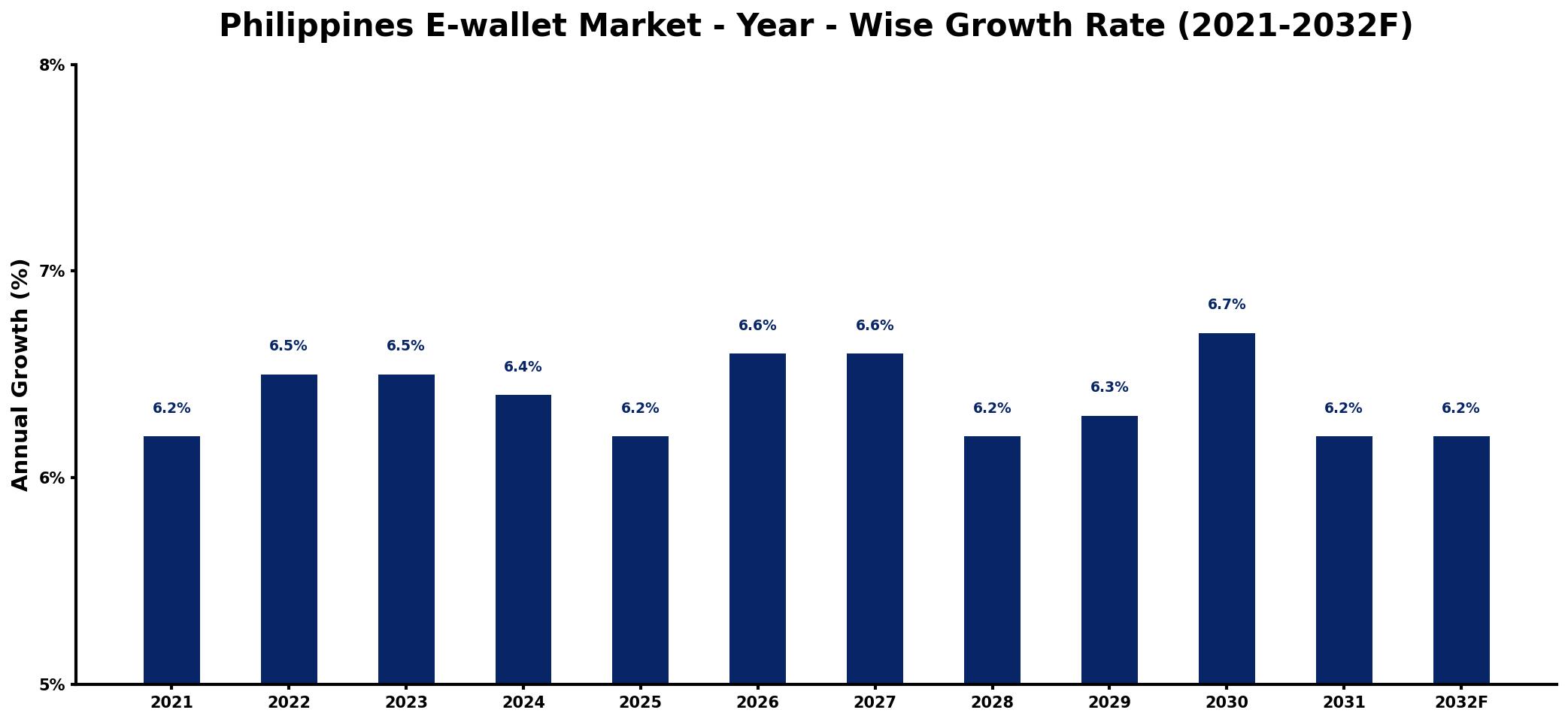
The table below presents the year‑wise growth rates along with the key drivers influencing the market
| Year | Growth Rate | Major Drivers |
| 2021 | 6.2% | Rising digital payment adoption |
| 2022 | 6.5% | Increased smartphone penetration rates |
| 2023 | 6.5% | Expansion of online retail platforms |
| 2024 | 6.4% | Growing interest in fintech solutions |
| 2025 | 6.2% | Higher consumer trust in e-commerce |
| 2026 | 6.6% | Increased investment in digital infrastructure |
| 2027 | 6.6% | Emergence of innovative payment solutions |
| 2028 | 6.2% | strengthening international trade flows |
| 2029 | 6.3% | Growth in remittance service usage |
| 2030 | 6.7% | Adoption of contactless payment methods |
| 2031 | 6.2% | Increased partnerships with merchants |
| 2032 | 6.2% | Rise in mobile app usage |
Note: Market size estimations and growth projections presented in this report are based on 6Wresearch's proprietary forecasting methodology, utilizing the latest available industry data, government publications, and primary research inputs.
Philippines E-wallet Market Synopsis
The demand for e-wallet services in the Philippines is rapidly increasing, influenced by the convenience they offer for everyday transactions, including retail shopping and bill payments. This trend is further reinforced by the government's robust initiatives aimed at promoting financial inclusion, empowering unbanked populations to engage in digital finance.
Moreover, the competitive landscape is characterized by a burgeoning fintech sector that continually innovates to provide user-friendly interfaces and enhanced security features. The partnership dynamics between e-wallet providers and traditional banking institutions are also shaping market developments, establishing a more integrated ecosystem for consumers.
Philippines E-wallet Market Key Takeaways
- The e-wallet market is projected to grow significantly, reflecting a shift towards digital payment solutions.
- Key driving forces include increased smartphone usage and government endorsement of cashless transactions.
- Partnerships between e-wallet providers and financial institutions are pivotal in enhancing service offerings.
- Consumer trust remains vital, necessitating user-friendly and secure transaction environments.
- Financial inclusion initiatives are set to expand the user base for e-wallet services across the archipelago.
Evaluation of Restraints in Philippines E-wallet Market
Despite the promising growth in the Philippines E-wallet Market, certain factors pose limitations to its full potential. The landscape is increasingly competitive, with established players dominating the space. For new entrants and smaller firms, building consumer trust and brand loyalty is a significant hurdle. Additionally, education around digital financial services remains crucial, as some segments of the population may still favor traditional cash-based transactions due to concerns about security and privacy.
Philippines E-wallet Market Trends
The Philippines E-wallet Market is witnessing transformative trends driven by technological advancements. Innovations in biometric authentication and machine learning are enhancing security features and user experiences, making transactions faster and more secure. Furthermore, the rise of social commerce is prompting e-wallet platforms to integrate seamlessly with social media channels, allowing users to transact in real-time. This trend is reshaping consumer behavior, where the lines between social interaction and commerce continue to blur.
Philippines E-wallet Market Opportunities
Investors and market participants are presented with substantial growth opportunities as the e-wallet landscape evolves. Expanding partnerships with local merchants and retailers can drive adoption, particularly in underserved regions. Additionally, innovations in customer engagement, such as personalized promotions and rewards programs, can attract new users. The emergence of cross-border payments also represents a frontier for growth, catering to the increasing number of Filipinos engaged in overseas transactions.
Government Initiatives in the Philippines E-wallet Market
The Philippine government is actively promoting the shift towards a cashless economy through various initiatives, including regulatory frameworks that support fintech innovation. Programs aimed at enhancing financial literacy and digital skills among the population are in place, ensuring that consumers are equipped to use e-wallet services. Furthermore, the government has also encouraged banks and financial institutions to collaborate with e-wallet providers, fostering an inclusive financial ecosystem that serves the diverse needs of its citizens.
Future Insights of the Philippines E-wallet Market
Looking ahead to the period of 2026-2032, the Philippines E-wallet Market is set for robust growth, driven by continuous technological advancements and increased financial inclusion efforts. As digital payment habits solidify among the population, the market is expected to adapt, incorporating newer technologies such as blockchain for enhanced security. The expanding e-commerce ecosystem will also present new avenues for e-wallet integration, facilitating seamless transactions for both businesses and consumers alike.
Philippines E-wallet Market Latest Developments (2025 - 2026)
Recent developments in the Philippines E-wallet Market have centered around enhancing user security and expanding service offerings. Companies are increasingly focusing on integrating artificial intelligence to improve fraud detection systems, assuring consumers of transaction safety. New collaborations are emerging, aimed at facilitating wider acceptance of e-wallet services at retail outlets, thus enhancing convenience for users. Additionally, promotional campaigns to foster user adoption are being rolled out, particularly targeting the younger demographic, who are more inclined towards digital solutions.
Philippines E-wallet Market - Key Attractiveness of the Report
- 10 Years of Market Numbers
- Historical Data Starting from 2022 to 2025
- Base Year: 2025
- Forecast Data until 2032
- Key Performance Indicators Impacting the Market
- Major Upcoming Developments and Projects
Key Highlights of the Report:
- Philippines E-wallet Market Outlook
- Market Size of Philippines E-wallet Market, 2025
- Forecast of Philippines E-wallet Market, 2032
- Historical Data and Forecast of Philippines E-wallet Revenues & Volume for the Period 2022-2032F
- Philippines E-wallet Market Trend Evolution
- Philippines E-wallet Market Drivers and Challenges
- Philippines E-wallet Price Trends
- Philippines E-wallet Porter's Five Forces
- Philippines E-wallet Industry Life Cycle
- Historical Data and Forecast of Philippines E-wallet Market Revenues & Volume By Application for the Period 2022-2032F
- Historical Data and Forecast of Philippines E-wallet Market Revenues & Volume By Restaurants for the Period 2022-2032F
- Historical Data and Forecast of Philippines E-wallet Market Revenues & Volume By Transportation for the Period 2022-2032F
- Historical Data and Forecast of Philippines E-wallet Market Revenues & Volume By Banking for the Period 2022-2032F
- Historical Data and Forecast of Philippines E-wallet Market Revenues & Volume By Retail for the Period 2022-2032F
- Historical Data and Forecast of Philippines E-wallet Market Revenues & Volume By Type for the Period 2022-2032F
- Historical Data and Forecast of Philippines E-wallet Market Revenues & Volume By Closed E Wallets for the Period 2022-2032F
- Historical Data and Forecast of Philippines E-wallet Market Revenues & Volume By Semi Closed E Wallets for the Period 2022-2032F
- Historical Data and Forecast of Philippines E-wallet Market Revenues & Volume By Open E Wallets for the Period 2022-2032F
- Historical Data and Forecast of Philippines E-wallet Market Revenues & Volume By Mode for the Period 2022-2032F
- Historical Data and Forecast of Philippines E-wallet Market Revenues & Volume By Online for the Period 2022-2032F
- Historical Data and Forecast of Philippines E-wallet Market Revenues & Volume By M Wallet for the Period 2022-2032F
- Historical Data and Forecast of Philippines E-wallet Market Revenues & Volume By Mode for the Period 2022-2032F
- Historical Data and Forecast of Philippines E-wallet Market Revenues & Volume By Online for the Period 2022-2032F
- Historical Data and Forecast of Philippines E-wallet Market Revenues & Volume By M Wallet for the Period 2022-2032F
- Philippines E-wallet Import Export Trade Statistics
- Market Opportunity Assessment By Application
- Market Opportunity Assessment By Type
- Market Opportunity Assessment By Mode
- Philippines E-wallet Top Companies Market Share
- Philippines E-wallet Competitive Benchmarking By Technical and Operational Parameters
- Philippines E-wallet Company Profiles
- Philippines E-wallet Key Strategic Recommendations






































