Philippines Emollient Market Top 5 Importing Countries and Market Competition (HHI) Analysis
The Philippines saw a significant shift in its emollient import market in 2024, with top exporting countries including China, USA, Singapore, Germany, and South Korea. The market experienced a decrease in concentration from 2023 to 2024, indicating a more diverse range of sources for emollients. Despite a negative growth rate from 2023 to 2024, the compound annual growth rate (CAGR) for the period of 2020-2024 stood at a healthy 10.28%. This suggests a strong overall growth trend in the emollient import market in the Philippines over the past few years.
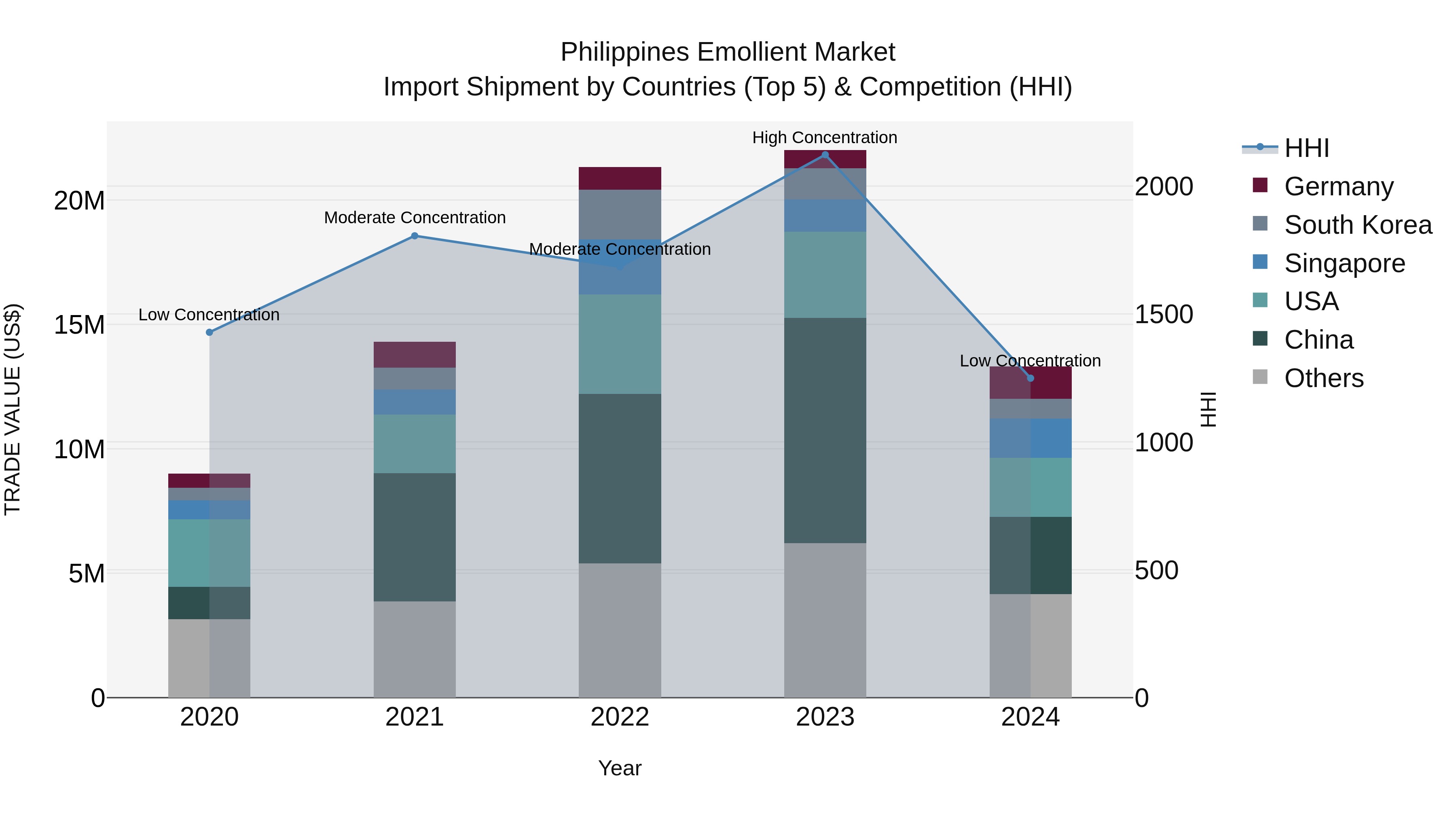
Philippines Emollient Market Overview
The Philippines emollient market is witnessing steady growth driven by the increasing demand for skincare and cosmetic products. Emollients are essential ingredients in various personal care products due to their ability to soften and soothe the skin. The market is characterized by a wide range of emollient products such as creams, lotions, and oils, catering to diverse consumer preferences. Key drivers of market growth include rising disposable incomes, changing lifestyles, and a growing awareness of skincare routines among the Filipino population. Manufacturers are focusing on product innovation, incorporating natural and organic ingredients to meet the rising demand for clean beauty products. The market is also influenced by the increasing trend towards sustainable and eco-friendly formulations, leading to a shift towards plant-based emollients.
Philippines Emollient Market Trends and Opportunities
The Philippines Emollient Market is witnessing significant growth due to the rising demand for skincare and personal care products. Consumers are increasingly seeking products with moisturizing and hydrating properties, driving the demand for emollients in creams, lotions, and other cosmetic formulations. Natural and organic emollients are gaining popularity as consumers become more conscious of clean and sustainable beauty trends. The market offers opportunities for manufacturers to innovate and introduce new emollient ingredients derived from plant sources, such as coconut oil, shea butter, and argan oil, to cater to the growing demand for natural skincare products. Additionally, the increasing focus on anti-aging and sun protection products presents avenues for the development of emollients that offer enhanced skin benefits and UV protection.
Philippines Emollient Market Challenges
In the Philippines Emollient Market, some challenges include the presence of counterfeit products that can impact brand credibility and consumer trust. Additionally, the market is highly competitive with various international and local players offering a wide range of emollient products, making it challenging for companies to differentiate their offerings. Regulatory hurdles and compliance requirements also pose challenges for manufacturers in ensuring that their products meet safety and quality standards set by government agencies. Furthermore, fluctuating raw material prices and supply chain disruptions can affect production costs and lead to pricing uncertainties. Overall, navigating these challenges requires companies in the Philippines Emollient Market to stay innovative, maintain quality standards, and build strong distribution networks to remain competitive and sustain growth.
Philippines Emollient Market Drivers
The drivers fueling the growth of the Philippines Emollient Market include increasing consumer awareness about skincare and personal grooming, rising disposable incomes leading to higher spending on beauty products, and a growing preference for natural and organic ingredients in skincare products. The market is also benefiting from the expanding retail sector, with more beauty and personal care brands entering the market and offering a variety of emollient products to cater to diverse consumer needs. Additionally, the influence of social media and beauty influencers promoting skincare routines and product recommendations is driving demand for emollients in the Philippines. Overall, these factors are contributing to the steady expansion of the emollient market in the country.
Philippines Emollient Market Government Policy
In the Philippines, government policies related to the emollient market primarily focus on ensuring product safety, quality, and compliance with regulations. The Food and Drug Administration (FDA) regulates the sale and distribution of emollients, requiring manufacturers to obtain proper licenses and adhere to labeling requirements to protect consumers from potential health risks. Additionally, the Department of Trade and Industry (DTI) oversees fair trade practices and market competition, promoting a level playing field for businesses in the emollient sector. These policies aim to safeguard public health, maintain industry standards, and foster a transparent and competitive market environment for emollient products in the Philippines.
Philippines Emollient Market Future Outlook
The Philippines emollient market is poised for steady growth in the coming years due to increasing consumer awareness about skincare products and a growing demand for natural and organic ingredients. The market is expected to be driven by factors such as a rising disposable income, changing lifestyles, and the influence of social media on beauty trends. With a growing preference for products that offer moisturizing and healing properties, there is a significant opportunity for manufacturers to innovate and introduce new emollient formulations to cater to evolving consumer preferences. The market is also likely to benefit from the expanding distribution channels and the increasing availability of a wide range of emollient products across various retail outlets, further fueling market growth in the foreseeable future.
Key Highlights of the Report:
- Philippines Emollient Market Outlook
- Market Size of Philippines Emollient Market, 2024
- Forecast of Philippines Emollient Market, 2031
- Historical Data and Forecast of Philippines Emollient Revenues & Volume for the Period 2021- 2031
- Philippines Emollient Market Trend Evolution
- Philippines Emollient Market Drivers and Challenges
- Philippines Emollient Price Trends
- Philippines Emollient Porter's Five Forces
- Philippines Emollient Industry Life Cycle
- Historical Data and Forecast of Philippines Emollient Market Revenues & Volume By Type for the Period 2021- 2031
- Historical Data and Forecast of Philippines Emollient Market Revenues & Volume By Esters for the Period 2021- 2031
- Historical Data and Forecast of Philippines Emollient Market Revenues & Volume By Fatty Alcohols for the Period 2021- 2031
- Historical Data and Forecast of Philippines Emollient Market Revenues & Volume By Fatty Acids for the Period 2021- 2031
- Historical Data and Forecast of Philippines Emollient Market Revenues & Volume By Ethers for the Period 2021- 2031
- Historical Data and Forecast of Philippines Emollient Market Revenues & Volume By Silicones for the Period 2021- 2031
- Historical Data and Forecast of Philippines Emollient Market Revenues & Volume By Others for the Period 2021- 2031
- Historical Data and Forecast of Philippines Emollient Market Revenues & Volume By Form for the Period 2021- 2031
- Historical Data and Forecast of Philippines Emollient Market Revenues & Volume By Solid for the Period 2021- 2031
- Historical Data and Forecast of Philippines Emollient Market Revenues & Volume By Liquid for the Period 2021- 2031
- Historical Data and Forecast of Philippines Emollient Market Revenues & Volume By Application for the Period 2021- 2031
- Historical Data and Forecast of Philippines Emollient Market Revenues & Volume By Skin Care for the Period 2021- 2031
- Historical Data and Forecast of Philippines Emollient Market Revenues & Volume By Hair Care for the Period 2021- 2031
- Historical Data and Forecast of Philippines Emollient Market Revenues & Volume By Deodorants for the Period 2021- 2031
- Historical Data and Forecast of Philippines Emollient Market Revenues & Volume By Oral Care for the Period 2021- 2031
- Historical Data and Forecast of Philippines Emollient Market Revenues & Volume By Others for the Period 2021- 2031
- Philippines Emollient Import Export Trade Statistics
- Market Opportunity Assessment By Type
- Market Opportunity Assessment By Form
- Market Opportunity Assessment By Application
- Philippines Emollient Top Companies Market Share
- Philippines Emollient Competitive Benchmarking By Technical and Operational Parameters
- Philippines Emollient Company Profiles
- Philippines Emollient Key Strategic Recommendations






































