Philippines Energy Security Market Size & Growth Rate (2026-2032)
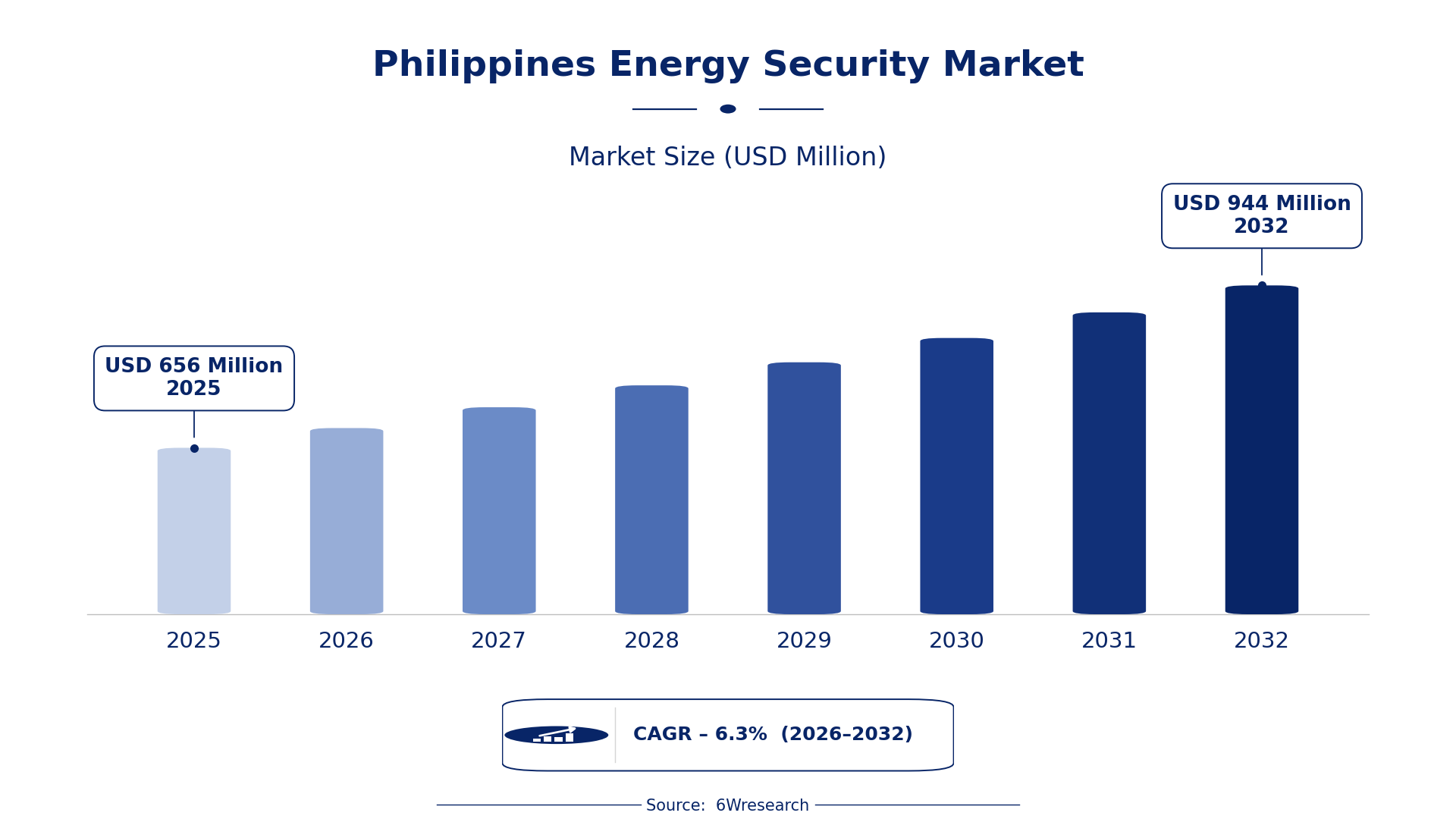
The Philippines Energy Security Market was estimated at USD 656 Million in 2025 and is projected to reach USD 944 Million by 2032, growing at a CAGR of 6.3% from 2026 to 2032.
Philippines Energy Security Market Synopsis
The urgent need for reliable energy sources is driving the Philippines Energy Security Market. As demand rises amid a burgeoning population, ensuring a stable supply while reducing reliance on fossil fuels has become paramount.
Government initiatives focusing on renewable energy integration, coupled with private sector innovations, are reshaping the energy security strategies. This transformation is critical to address the vulnerabilities in the nation’s energy infrastructure.
Philippines Energy Security Market Year-wise Growth Rate and Key Drivers
This graph illustrates the annual growth rates of the Philippines Energy Security Market from 2021 to 2032, highlighting a steady upward trajectory and projected expansion over the forecast period.
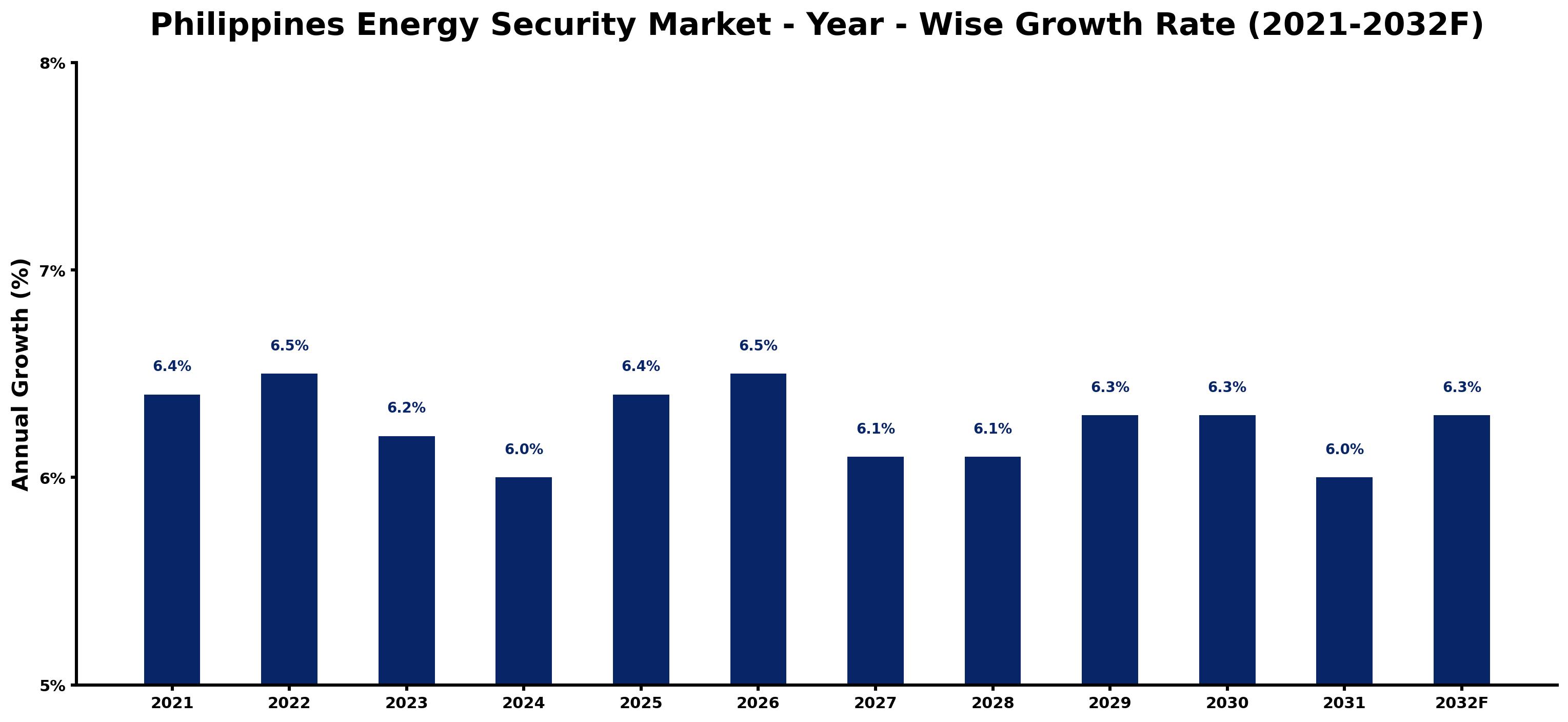
The table below presents the year‑wise growth rates along with the key drivers influencing the market
| Year | Growth Rate | Major Drivers |
| 2021 | 6.4% | Philippines' Renewable Energy Act promoting sustainable solutions |
| 2022 | 6.5% | Increased funding for energy resilience programs by DOE |
| 2023 | 6.2% | Demand for off-grid energy solutions surging in rural areas |
| 2024 | 6.0% | Implementation of Energy Virtual One-Stop Shop by government |
| 2025 | 6.4% | Local demand for solar power driven by subsidy initiatives |
| 2026 | 6.5% | Emerging interest in geothermal energy development projects |
| 2027 | 6.1% | Government enhancing investment incentives for energy technologies |
| 2028 | 6.1% | Focus on disaster preparedness boosting energy infrastructure improvements |
| 2029 | 6.3% | Rising urban population driving energy consumption patterns |
| 2030 | 6.3% | Public-private partnerships enabling energy efficiency upgrades |
| 2031 | 6.0% | Increasing foreign investments in Philippine energy sector |
| 2032 | 6.3% | Growth in energy storage solutions addressing grid reliability |
Note: Market size estimations and growth projections presented in this report are based on 6Wresearch's proprietary forecasting methodology, utilizing the latest available industry data, government publications, and primary research inputs.
Philippines Energy Security Market Key Takeaways
Below are some of the specific key takeaways from the market, including:
- The market emphasizes the transition from fossil fuels to renewable energy sources to enhance sustainability.
- Government policies are increasingly prioritizing energy diversification and reliability.
- Technological advancements are leading to improved energy infrastructure resilience.
- Public-private partnerships are becoming crucial in funding new energy projects.
- Investment in energy security is deemed essential for the country's economic growth.
Evaluation of Restraints in Philippines Energy Security Market
Several key restraints are impacting the Philippines Energy Security Market. High dependence on imported fossil fuels remains a substantial hurdle, limiting the country’s energy independence. on top of that, infrastructure challenges, including aging power grids and inadequate storage facilities, impede efforts to ensure a consistent energy supply. Bureaucratic inefficiencies also delay project approvals, stalling potential advancements in energy security.
Philippines Energy Security Market Trends
An increasing trend towards renewable energy integration is evident, with solar and wind energy gaining traction across the archipelago. Investments in smart grid technologies are also on the rise, allowing for better energy management and efficiency. Additionally, energy storage solutions are being explored to address intermittency issues associated with renewable sources. As public awareness of energy issues grows, there is a stronger push for sustainable energy practices within communities.
Philippines Energy Security Market Opportunities
Significant growth opportunities lie in the development of offshore wind farms and solar energy installations. The government is advocating for investments in these areas, particularly in regions with abundant natural resources. on top of that, the emerging market for energy storage solutions offers a promising avenue for innovation and investment, addressing key challenges in renewable energy adoption.
Government Initiatives in the Philippines Energy Security Market
Government policy is actively shaping the Philippines Energy Security Market. The Department of Energy is spearheading various initiatives to enhance energy reliability and promote sustainability. There is a clear focus on reducing fossil fuel dependence while advancing renewable energy projects that align with national development goals.
- A regulatory framework established in 2023 mandates the integration of renewable energy sources into the national grid.
- Currently ongoing is a nationwide initiative to upgrade existing power infrastructure, aimed at improving resilience against natural disasters.
- Future plans include a public-private partnership program designed to accelerate the development of renewable energy facilities by 2028.
- A recently completed program focused on energy efficiency standards for new construction has been successfully implemented across major urban areas.
- Another ongoing initiative involves expanding research and development grants for innovations in energy storage technologies.
Future Insights of the Philippines Energy Security Market
Between 2026 and 2032, the Philippines Energy Security Market is expected to transform significantly. As the country pushes for energy self-sufficiency, investments in renewable sources will intensify. Regulatory support will likely remain strong, encouraging both domestic and foreign investments in energy projects. Additionally, technological advancements are anticipated to address existing infrastructure challenges, ultimately leading to a more reliable and secure energy framework.
Philippines Energy Security Market Latest Developments
Recent activity in the Philippines Energy Security Market highlights a concerted push towards enhancing energy resilience and diversifying energy sources. Various projects and initiatives have been announced or are currently underway, reflecting a commitment to tackling energy security challenges head-on.
- A major technology vendor launched an innovative energy management system in early 2025, aimed at optimizing energy use in urban centers.
- Current upgrades to the national grid, which began in mid-2025, are expected to improve connectivity and reliability across remote areas.
- A new partnership between government agencies and a private firm to deploy solar panels in schools is ongoing, fostering education about renewable energy.
- A rollout planned for Q1 2026 will see the introduction of smart metering across the country to enhance energy consumption tracking.
- A comprehensive review of energy regulations, which began in late 2025, is aimed at streamlining processes and enhancing transparency for new projects.
Philippines Energy Security Market - Key Attractiveness of the Report
- 10 Years of Market Numbers
- Historical Data Starting from 2022 to 2025
- Base Year: 2025
- Forecast Data until 2032
- Key Performance Indicators Impacting the Market
- Major Upcoming Developments and Projects
Key Highlights of the Report:
- Philippines Energy Security Market Outlook
- Market Size of Philippines Energy Security Market, 2025
- Forecast of Philippines Energy Security Market, 2032
- Historical Data and Forecast of Philippines Energy Security Revenues & Volume for the Period 2022-2032F
- Philippines Energy Security Market Trend Evolution
- Philippines Energy Security Market Drivers and Challenges
- Philippines Energy Security Price Trends
- Philippines Energy Security Porter's Five Forces
- Philippines Energy Security Industry Life Cycle
- Historical Data and Forecast of Philippines Energy Security Market Revenues & Volume By Power Plants for the Period 2022-2032F
- Historical Data and Forecast of Philippines Energy Security Market Revenues & Volume By Nuclear for the Period 2022-2032F
- Historical Data and Forecast of Philippines Energy Security Market Revenues & Volume By Thermal for the Period 2022-2032F
- Historical Data and Forecast of Philippines Energy Security Market Revenues & Volume By Hydro for the Period 2022-2032F
- Historical Data and Forecast of Philippines Energy Security Market Revenues & Volume By Oil for the Period 2022-2032F
- Historical Data and Forecast of Philippines Energy Security Market Revenues & Volume By Gas for the Period 2022-2032F
- Historical Data and Forecast of Philippines Energy Security Market Revenues & Volume By Renewable Energy for the Period 2022-2032F
- Historical Data and Forecast of Philippines Energy Security Market Revenues & Volume By Technologies for the Period 2022-2032F
- Historical Data and Forecast of Philippines Energy Security Market Revenues & Volume By Physical for the Period 2022-2032F
- Historical Data and Forecast of Philippines Energy Security Market Revenues & Volume By Network Security for the Period 2022-2032F
- Philippines Energy Security Import Export Trade Statistics
- Market Opportunity Assessment By Power Plants
- Market Opportunity Assessment By Technologies
- Philippines Energy Security Top Companies Market Share
- Philippines Energy Security Competitive Benchmarking By Technical and Operational Parameters
- Philippines Energy Security Company Profiles
- Philippines Energy Security Key Strategic Recommendations






































