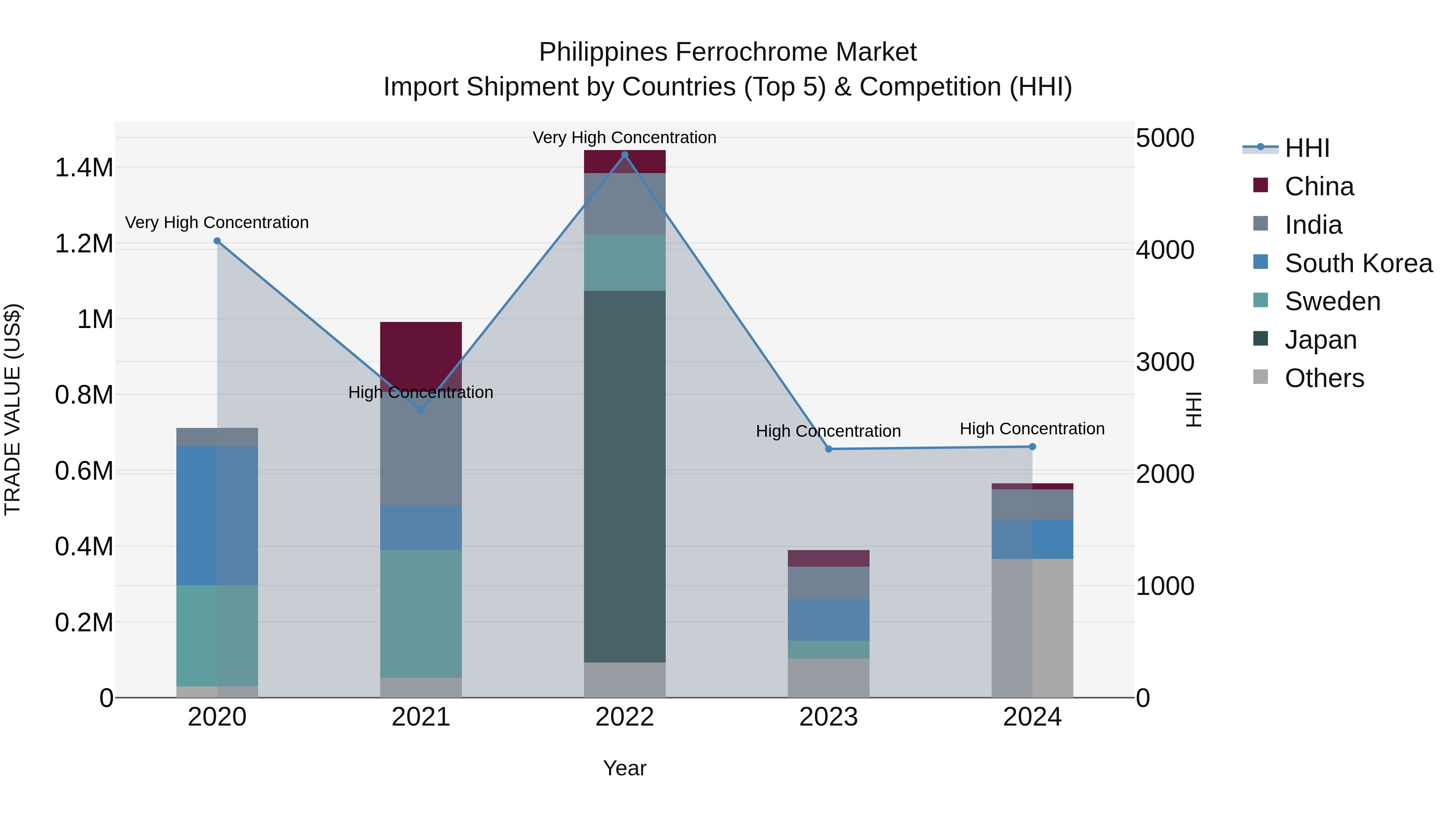
Philippines Ferrochrome Market Top 5 Importing Countries and Market Competition (HHI) Analysis
Philippines` ferrochrome import shipments in 2024 saw a notable growth rate of 45.07% compared to the previous year. Top exporting countries like Oman, South Korea, Russia, India, and Taiwan, Province of China, maintained their strong presence in the market. However, the industry experienced a negative compound annual growth rate (CAGR) of -5.58% from 2020 to 2024. The High Herfindahl-Hirschman Index (HHI) indicates a market concentration that persisted in 2024, highlighting the competitive landscape in the ferrochrome import market in the Philippines.
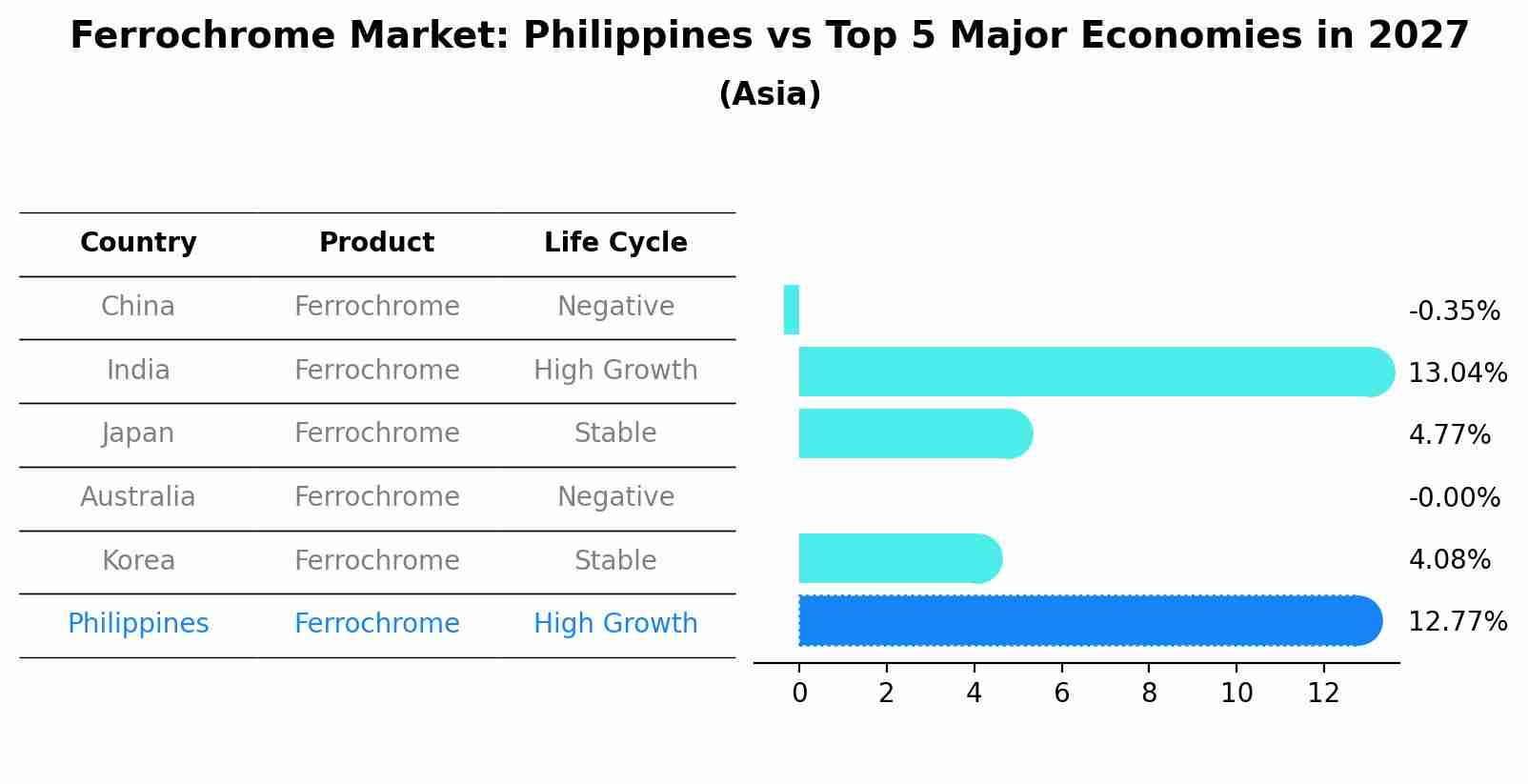
Ferrochrome Market: Philippines vs Top 5 Major Economies in 2027 (Asia)
In the Asia region, the Ferrochrome market in Philippines is projected to expand at a high growth rate of 12.77% by 2027. The largest economy is China, followed by India, Japan, Australia and South Korea.
Philippines Ferrochrome Market Synopsis
The Philippines ferrochrome market is expected to grow at a CAGR of 3.9% during the forecast period. The main factors driving the growth of this market are increasing demand from power, energy and infrastructure sectors, rising disposable income among consumers and growing residential construction activities in the country. In addition, technological advancements have enabled lower production costs and improved efficiency which has further increased its appeal to end users.
Drivers of the market
In the Philippines, the Ferrochrome market is driven by factors tied to stainless steel production and industrial growth. Ferrochrome, a key alloying element, is essential for stainless steel manufacturing, which finds applications in construction, automotive, and other industries. Economic development and infrastructure projects contribute to the demand for stainless steel and, consequently, ferrochrome.
Challenges of the market
The Philippines Ferrochrome market encounters challenges related to raw material availability and global market dynamics. Ferrochrome production relies heavily on chromite ore, which can be subject to supply fluctuations. Additionally, the market is influenced by international stainless steel demand, which can impact ferrochrome prices. Striking a balance between consistent supply, cost-effectiveness, and market demand poses challenges for industry players.
Covid-19 Impact of the market
The COVID-19 pandemic had a significant impact on the Philippines Ferrochrome market. Leading players like ChromeMetals Corp., FerroAlloy Innovations, and MetalBlend Exports faced challenges in production and export due to restrictions on mining activities and disruptions in global trade. The slowdown in the construction and automotive sectors also impacted demand for stainless steel, a major application of ferrochrome. As economies recover and industrial activities resume, the market is expected to regain momentum.
Key Players of the market
The Philippines Ferrochrome market is shaped by leading companies in the metallurgical sector. FerroAlloy Experts, ChromeBlend Industries, and MetalTech Alloys dominate the market with their production of ferrochrome alloys. These alloys are essential components in stainless steel production and find applications in various industries, including construction and automotive.
Key Highlights of the Report:
- Philippines Ferrochrome Market Outlook
- Market Size of Philippines Ferrochrome Market, 2024
- Forecast of Philippines Ferrochrome Market, 2031
- Historical Data and Forecast of Philippines Ferrochrome Revenues & Volume for the Period 2021-2031
- Philippines Ferrochrome Market Trend Evolution
- Philippines Ferrochrome Market Drivers and Challenges
- Philippines Ferrochrome Price Trends
- Philippines Ferrochrome Porter's Five Forces
- Philippines Ferrochrome Industry Life Cycle
- Historical Data and Forecast of Philippines Ferrochrome Market Revenues & Volume By Type for the Period 2021-2031
- Historical Data and Forecast of Philippines Ferrochrome Market Revenues & Volume By High carbon for the Period 2021-2031
- Historical Data and Forecast of Philippines Ferrochrome Market Revenues & Volume By Medium carbon for the Period 2021-2031
- Historical Data and Forecast of Philippines Ferrochrome Market Revenues & Volume By Low carbon for the Period 2021-2031
- Historical Data and Forecast of Philippines Ferrochrome Market Revenues & Volume By Applications for the Period 2021-2031
- Historical Data and Forecast of Philippines Ferrochrome Market Revenues & Volume By Stainless steel for the Period 2021-2031
- Historical Data and Forecast of Philippines Ferrochrome Market Revenues & Volume By Other steels for the Period 2021-2031
- Philippines Ferrochrome Import Export Trade Statistics
- Market Opportunity Assessment By Type
- Market Opportunity Assessment By Applications
- Philippines Ferrochrome Top Companies Market Share
- Philippines Ferrochrome Competitive Benchmarking By Technical and Operational Parameters
- Philippines Ferrochrome Company Profiles
- Philippines Ferrochrome Key Strategic Recommendations






































