Philippines Field Force Automation Market Size & Growth Rate (2026-2032)
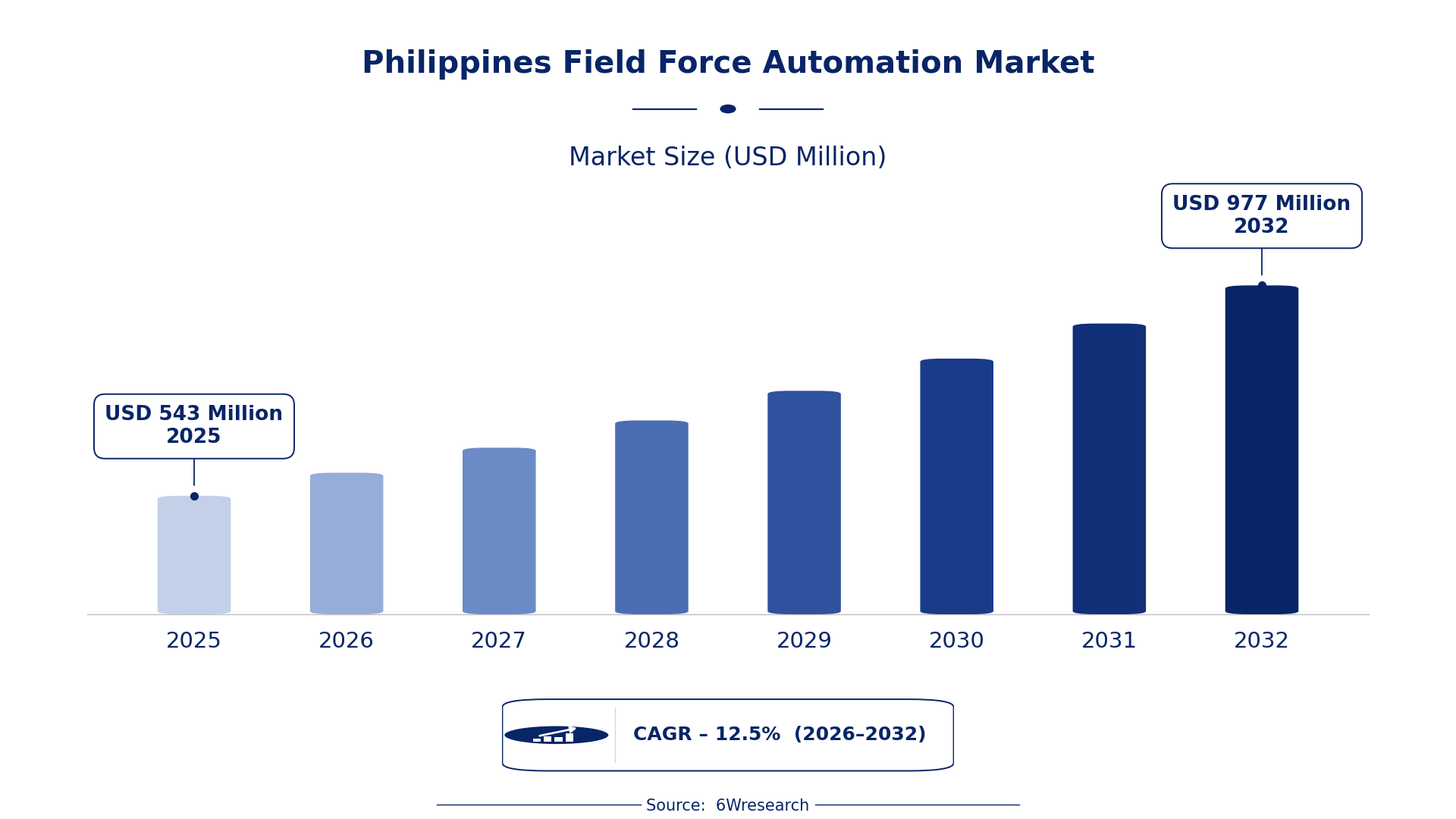
The Philippines Field Force Automation Market was estimated at USD 543 Million in 2025 and is projected to reach USD 977 Million by 2032, growing at a CAGR of 12.5% from 2026 to 2032.
Philippines Field Force Automation Market Synopsis
Field force automation has gained substantial traction in the Philippines as businesses increasingly focus on optimizing field operations. The integration of mobile technology and software solutions is enabling companies to manage their workforce with greater efficiency, thereby enhancing service delivery across sectors.
Industries such as logistics, healthcare, and utilities are leveraging these advancements to streamline operations, from scheduling to dispatching. The shift towards automation not only improves productivity but also elevates customer satisfaction, as timely and accurate service becomes the new norm.
Philippines Field Force Automation Market Year-wise Growth Rate and Key Drivers
This graph illustrates the annual growth rates of the Philippines Field Force Automation Market from 2021 to 2032, highlighting a steady upward trajectory and projected expansion over the forecast period.
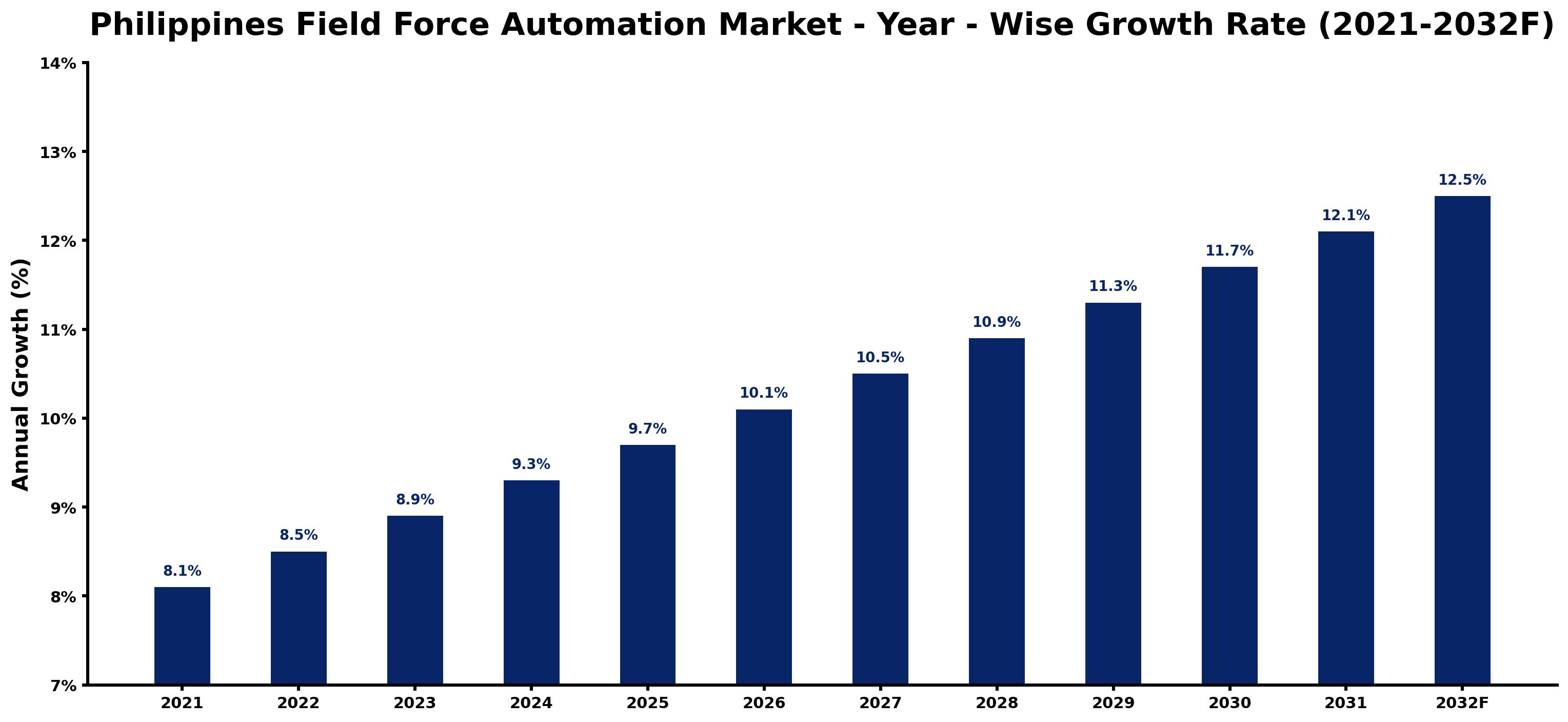
The table below presents the year‑wise growth rates along with the key drivers influencing the market
| Year | Growth Rate | Major Drivers |
| 2021 | 8.1% | Increased mobile penetration supports field automation growth. |
| 2022 | 8.5% | Adoption of cloud solutions by local businesses rising. |
| 2023 | 8.9% | Regulatory push for enhanced workforce efficiency noted. |
| 2024 | 9.3% | Government support for logistics sector improvements observed. |
| 2025 | 9.7% | Growing urbanization drives need for automation technologies. |
| 2026 | 10.1% | Increased competition among local retailers enhancing automation use. |
| 2027 | 10.5% | Rising labor costs propel demand for automation solutions. |
| 2028 | 10.9% | Focus on customer experience fuels field automation trends. |
| 2029 | 11.3% | Investment in agriculture tech promotes field automation needs. |
| 2030 | 11.7% | Digitalization initiatives in SMEs boost automation adoption. |
| 2031 | 12.1% | Local startups driving innovation in field automation solutions. |
| 2032 | 12.5% | Talent development programs enhancing tech adoption in industries. |
Note: Market size estimations and growth projections presented in this report are based on 6Wresearch's proprietary forecasting methodology, utilizing the latest available industry data, government publications, and primary research inputs.
Philippines Field Force Automation Market Key Takeaways
Below are some of the specific key takeaways from the market, including:
- The demand for field force automation is driven by the need for operational efficiency and improved customer service.
- Increased reliance on mobile technology is reshaping workforce management strategies across various industries.
- Challenges related to connectivity in remote areas continue to impede market growth.
- COVID-19 accelerated the adoption of automation solutions across essential sectors.
- Key industry players are continuously innovating to enhance service delivery and operational capabilities.
Evaluation of Restraints in Philippines Field Force Automation Market
The Philippines Field Force Automation Market faces several restraints that could hinder its expansion. Chief among these is the persistent issue of reliable connectivity, especially in rural and remote areas where infrastructure is lacking. This connectivity gap makes it difficult for field workers to access the necessary data and communication tools, ultimately affecting productivity. on top of that, integrating new automation solutions with existing systems can present technical challenges. Companies often struggle to ensure that new technologies work harmoniously with their established workflows, which can lead to delays and inefficiencies.
Philippines Field Force Automation Market Trends
Several trends are emerging in the Philippines Field Force Automation Market that are shaping demand. The increasing adoption of mobile devices among field workers is a notable trend, enabling real-time data access and communication. Companies are also prioritizing software solutions that offer advanced analytics, allowing them to make informed decisions based on workforce performance metrics. on top of that, there is a growing emphasis on customer relationship management (CRM) integration, as businesses recognize the value of maintaining strong customer connections in a competitive environment.
Philippines Field Force Automation Market Opportunities
The market presents numerous growth opportunities, particularly in industries that have been slower to adopt automation. The healthcare sector, for instance, is increasingly recognizing the benefits of field force automation in enhancing patient care and operational efficiency. Additionally, as urbanization accelerates, the demand for logistics and delivery services is rising, creating a fertile ground for automation solutions. Companies that can tailor their offerings to meet the specific needs of these sectors stand to gain a competitive edge.
Government Initiatives in the Philippines Field Force Automation Market
Government initiatives are playing a crucial role in shaping the Philippines Field Force Automation Market. The regulatory framework is becoming more supportive of technology adoption, which is essential for enhancing the efficiency of public services and the private sector alike. Policies aimed at improving digital infrastructure are paving the way for better connectivity, which is critical for the success of automation solutions.
- A national digital infrastructure upgrade programme now in its rollout phase aims to improve connectivity across rural areas.
- Current initiatives focus on public-private partnerships to enhance logistics infrastructure, facilitating smoother operations for businesses.
- A regulatory framework introduced in 2025 mandates the use of automated systems in utility management to enhance service delivery.
- Planned initiatives expected to launch by 2026 will provide funding for technology adoption in the healthcare sector.
Future Insights of the Philippines Field Force Automation Market
Looking ahead to 2026-2032, the Philippines Field Force Automation Market is expected to continue its upward trajectory. As businesses increasingly recognize the value of automation in driving efficiency and customer satisfaction, investments in technology will likely surge. The rise of data-driven decision-making will further influence market dynamics, encouraging companies to adopt solutions that offer robust analytical capabilities. With government support and a growing awareness of the benefits of automation, the future appears bright for this sector.
Philippines Field Force Automation Market Latest Developments
Recent developments in the Philippines Field Force Automation Market indicate a growing momentum towards technological integration. Companies are actively seeking innovative solutions to enhance their operational capabilities, and the market is witnessing an influx of new technologies designed to streamline field operations.
- A leading technology vendor launched a new field service management platform in early 2025, aimed at improving real-time communication among field teams.
- An ongoing initiative that began in mid-2025 focuses on training programs for field workers to better utilize automation tools, enhancing workforce productivity.
- By late 2025, a major regional operator plans to implement an upgraded scheduling system that integrates AI for more efficient route planning.
- An upcoming rollout expected to begin in the second half of 2026 will introduce mobile applications designed specifically for healthcare workers in remote areas.
Philippines Field Force Automation Market - Key Attractiveness of the Report
- 10 Years of Market Numbers
- Historical Data Starting from 2022 to 2025
- Base Year: 2025
- Forecast Data until 2032
- Key Performance Indicators Impacting the Market
- Major Upcoming Developments and Projects
Key Highlights of the Report:
- Philippines Field Force Automation Market Outlook
- Market Size of Philippines Field Force Automation Market, 2025
- Forecast of Philippines Field Force Automation Market, 2032
- Historical Data and Forecast of Philippines Field Force Automation Revenues & Volume for the Period 2022-2032F
- Philippines Field Force Automation Market Trend Evolution
- Philippines Field Force Automation Market Drivers and Challenges
- Philippines Field Force Automation Price Trends
- Philippines Field Force Automation Porter's Five Forces
- Philippines Field Force Automation Industry Life Cycle
- Historical Data and Forecast of Philippines Field Force Automation Market Revenues & Volume By Component for the Period 2022-2032F
- Historical Data and Forecast of Philippines Field Force Automation Market Revenues & Volume By Solution for the Period 2022-2032F
- Historical Data and Forecast of Philippines Field Force Automation Market Revenues & Volume By Services for the Period 2022-2032F
- Historical Data and Forecast of Philippines Field Force Automation Market Revenues & Volume By Industry for the Period 2022-2032F
- Historical Data and Forecast of Philippines Field Force Automation Market Revenues & Volume By IT and Telecom for the Period 2022-2032F
- Historical Data and Forecast of Philippines Field Force Automation Market Revenues & Volume By Healthcare and Life Sciences for the Period 2022-2032F
- Historical Data and Forecast of Philippines Field Force Automation Market Revenues & Volume By Manufacturing for the Period 2022-2032F
- Historical Data and Forecast of Philippines Field Force Automation Market Revenues & Volume By Transportation and Logistics for the Period 2022-2032F
- Historical Data and Forecast of Philippines Field Force Automation Market Revenues & Volume By Construction and Real Estate for the Period 2022-2032F
- Historical Data and Forecast of Philippines Field Force Automation Market Revenues & Volume By Energy and Utilities for the Period 2022-2032F
- Historical Data and Forecast of Philippines Field Force Automation Market Revenues & Volume By Others for the Period 2022-2032F
- Historical Data and Forecast of Philippines Field Force Automation Market Revenues & Volume By Deployment Type for the Period 2022-2032F
- Historical Data and Forecast of Philippines Field Force Automation Market Revenues & Volume By On-Premises for the Period 2022-2032F
- Historical Data and Forecast of Philippines Field Force Automation Market Revenues & Volume By Cloud for the Period 2022-2032F
- Historical Data and Forecast of Philippines Field Force Automation Market Revenues & Volume By Organization Size for the Period 2022-2032F
- Historical Data and Forecast of Philippines Field Force Automation Market Revenues & Volume By SMEs for the Period 2022-2032F
- Historical Data and Forecast of Philippines Field Force Automation Market Revenues & Volume By Large Enterprises for the Period 2022-2032F
- Philippines Field Force Automation Import Export Trade Statistics
- Market Opportunity Assessment By Component
- Market Opportunity Assessment By Industry
- Market Opportunity Assessment By Deployment Type
- Market Opportunity Assessment By Organization Size
- Philippines Field Force Automation Top Companies Market Share
- Philippines Field Force Automation Competitive Benchmarking By Technical and Operational Parameters
- Philippines Field Force Automation Company Profiles
- Philippines Field Force Automation Key Strategic Recommendations






































