Philippines Finance Cloud Market Size & Growth Rate (2026-2032)
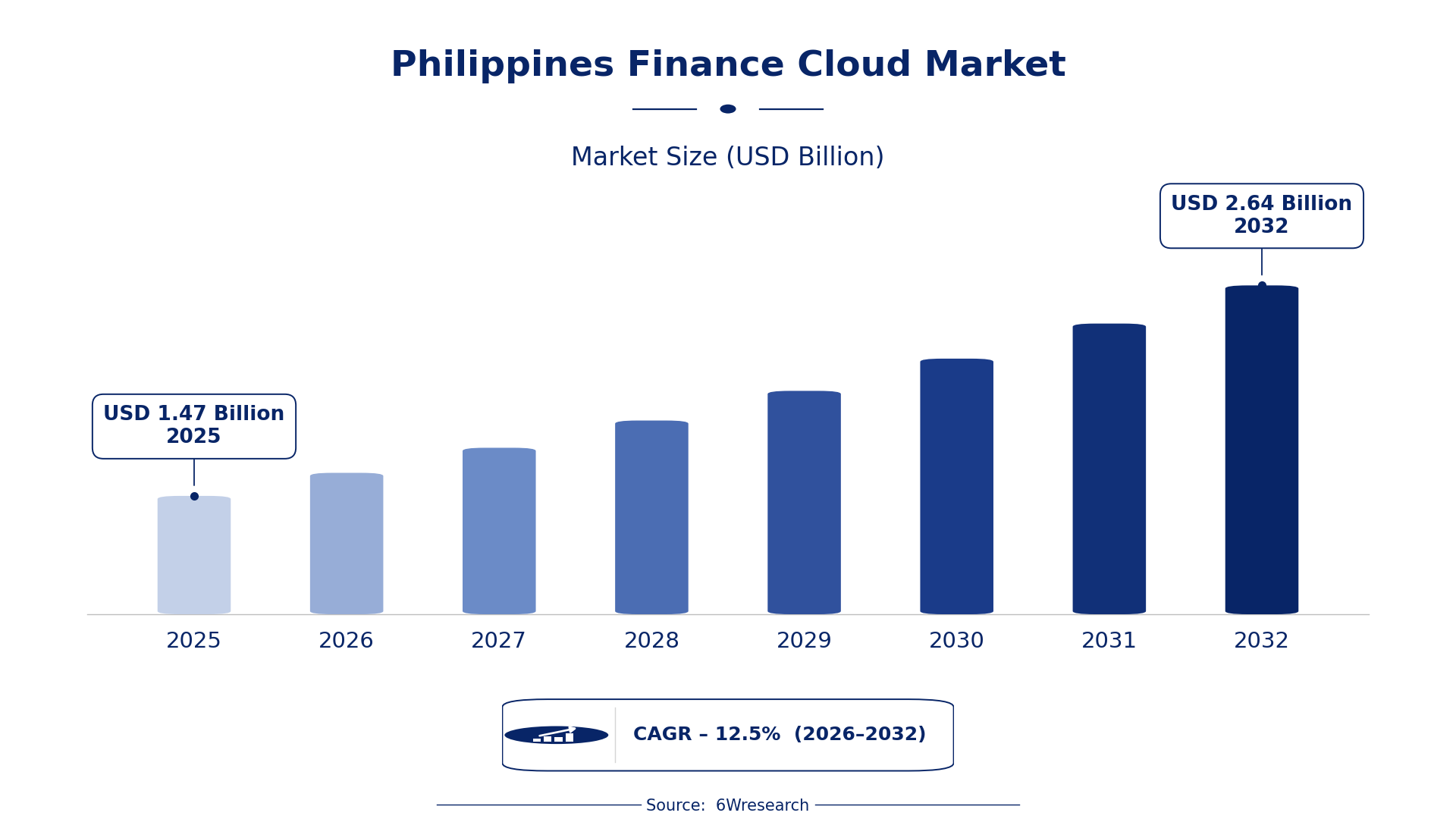
The Philippines Finance Cloud Market was estimated at USD 1467 Million in 2025 and is projected to reach USD 2641 Million by 2032, growing at a CAGR of 12.5% from 2026 to 2032.
Philippines Finance Cloud Market Synopsis
The Philippines Finance Cloud Market is currently experiencing a surge in adoption as financial institutions prioritize digital transformation. With the ongoing need for efficiency and enhanced customer service, the sector is witnessing a shift towards cloud-based solutions that streamline operations and improve accessibility.
Looking ahead, the market is set to evolve significantly, driven by innovations in technology and changing regulatory environments. Financial entities are increasingly recognizing the value of cloud services to not only meet compliance demands but also to deliver a superior customer experience.
Philippines Finance Cloud Market Year-wise Growth Rate and Key Drivers
This graph illustrates the annual growth rates of the Philippines Finance Cloud Market from 2021 to 2032, highlighting a steady upward trajectory and projected expansion over the forecast period.
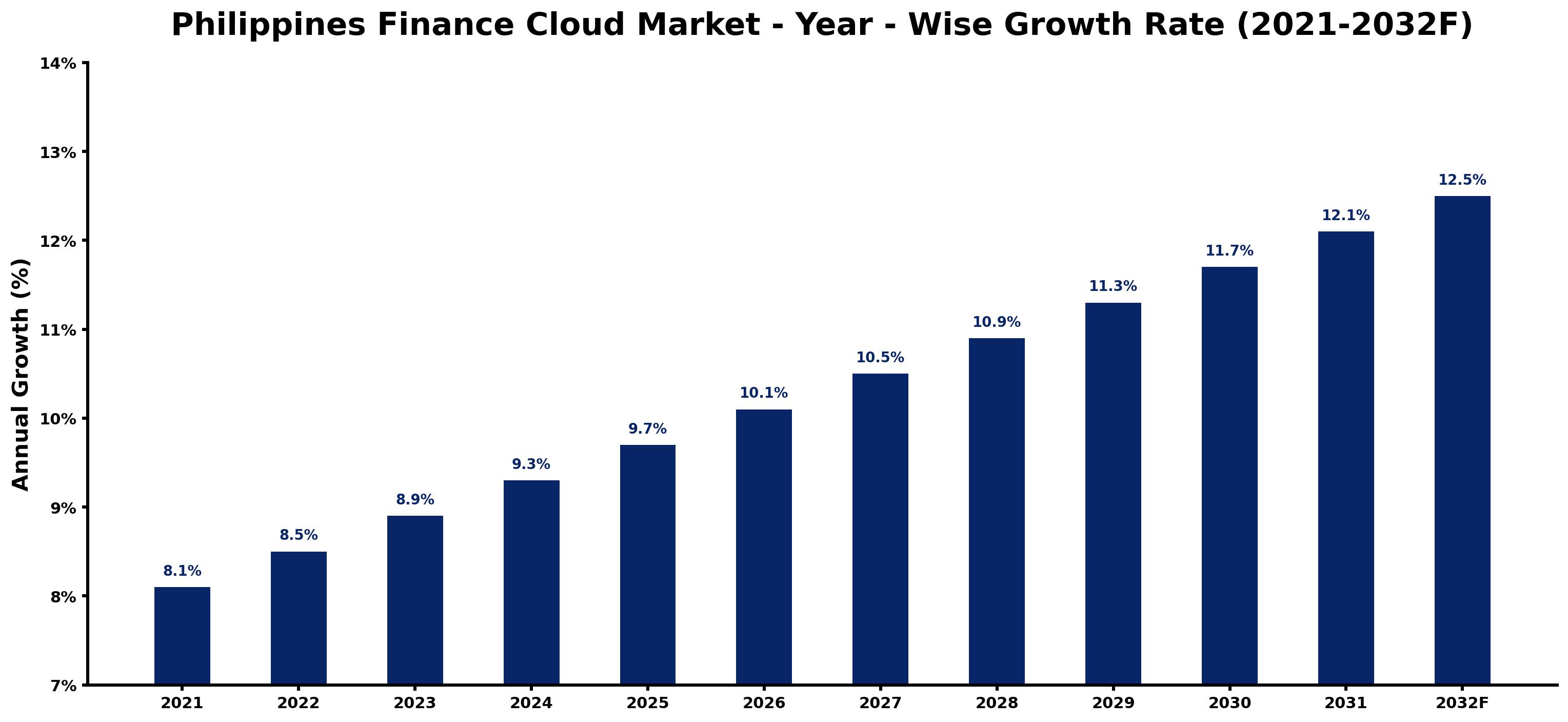
The table below presents the year‑wise growth rates along with the key drivers influencing the market
| Year | Growth Rate | Major Drivers |
| 2021 | 8.1% | Philippine government promotes fintech through regulatory sandbox. |
| 2022 | 8.5% | Increased adoption of online banking services among consumers. |
| 2023 | 8.9% | Digital Philippines initiative bolsters cloud infrastructure investments. |
| 2024 | 9.3% | Bank of the Philippine Islands enhances cloud-based services. |
| 2025 | 9.7% | Rising cybersecurity concerns drive cloud security solution demand. |
| 2026 | 10.1% | Growing remote work culture increases cloud software usage. |
| 2027 | 10.5% | Philippine Central Bank supports cloud solutions for financial literacy. |
| 2028 | 10.9% | Local startups innovate with cloud-based fintech applications. |
| 2029 | 11.3% | Legislative support for digital finance boosts cloud implementation. |
| 2030 | 11.7% | Growing middle class increases demand for digital financial services. |
| 2031 | 12.1% | Regulatory changes favoring cloud adoption in financial institutions. |
| 2032 | 12.5% | Fintech partnership incentives drive cloud service provider growth. |
Note: Market size estimations and growth projections presented in this report are based on 6Wresearch's proprietary forecasting methodology, utilizing the latest available industry data, government publications, and primary research inputs.
Philippines Finance Cloud Market Key Takeaways
Below are some of the specific key takeaways from the market, including:
- The market is fueled by a growing need for operational efficiency among financial institutions.
- Cloud adoption is accelerating as a response to the COVID-19 pandemic's impact on remote work.
- Regulatory compliance remains a critical challenge for cloud service providers in the financial sector.
- Investment in cybersecurity measures is increasingly essential as data protection becomes a priority.
- Emerging technologies like AI and machine learning are being integrated into cloud solutions for enhanced analytics.
Evaluation of Restraints in Philippines Finance Cloud Market
Despite its growth trajectory, the Philippines Finance Cloud Market faces notable constraints. Chief among these is the stringent regulatory framework that governs the financial sector. Financial institutions must ensure their cloud solutions comply with local laws, which can slow adoption rates. Additionally, concerns over data security and privacy persist, leading to hesitancy in fully embracing cloud technologies. The complexity of integrating legacy systems with new cloud solutions further complicates the transition, creating barriers for many institutions.
Philippines Finance Cloud Market Trends
Several trends are currently shaping the Philippines Finance Cloud Market. A notable shift is the increasing focus on customer experience, as institutions leverage cloud technology to offer personalized services. on top of that, the rise of fintech companies is intensifying competition, prompting traditional banks to adopt more agile cloud solutions. Another trend is the integration of advanced analytics and AI capabilities into cloud offerings, enabling better decision-making processes.
Philippines Finance Cloud Market Opportunities
Opportunities abound in the Philippines Finance Cloud Market, particularly for providers offering tailored solutions that address specific regulatory needs. The demand for hybrid cloud solutions is on the rise, allowing institutions to balance compliance with operational flexibility. on top of that, as financial literacy improves, more consumers are likely to engage with digital financial services, presenting a lucrative avenue for growth.
Government Initiatives in the Philippines Finance Cloud Market
Government policy plays a crucial role in shaping the Philippines Finance Cloud Market. The regulatory environment is evolving, with authorities focusing on enhancing digital infrastructure and ensuring compliance in the financial sector. As the government emphasizes digital transformation, initiatives aimed at improving cybersecurity and fostering innovation are particularly relevant.
- A national digital infrastructure upgrade programme launched recently aims to enhance connectivity for financial institutions.
- Current initiatives include a regulatory framework designed to streamline compliance processes for cloud services in finance.
- Plans are underway for a public-private partnership focused on expanding access to cloud technologies for underserved regions.
- In 2025, a new policy mandating data protection standards for cloud providers is expected to be implemented.
Future Insights of the Philippines Finance Cloud Market
Looking toward 2026-2032, the Philippines Finance Cloud Market is set to expand significantly. As financial institutions increasingly adopt cloud solutions to enhance operational agility, the focus will also shift towards cybersecurity enhancements and compliance with emerging regulations. The integration of AI and machine learning will further drive innovation, enabling institutions to provide more personalized services to customers. This trajectory suggests that organizations embracing cloud technology will be better positioned to thrive in a competitive landscape.
Philippines Finance Cloud Market Latest Developments
Over the past year, the Philippines Finance Cloud Market has witnessed several key developments that signal its growth and evolution. Financial institutions are actively pursuing cloud adoption to meet changing consumer expectations and regulatory demands, reflecting a broader commitment to digital transformation.
- A major technology vendor announced a partnership with local banks in Q2 2025 to enhance cloud-based service delivery.
- An initiative that began in early 2025 focuses on implementing advanced cybersecurity measures across financial cloud services.
- A rollout expected to begin in late 2026 will introduce new cloud analytics tools tailored for the financial sector.
- In early 2025, a leading regional operator launched a cloud-based platform aimed at improving customer engagement for insurance firms.
Philippines Finance Cloud Market - Key Attractiveness of the Report
- 10 Years of Market Numbers
- Historical Data Starting from 2022 to 2025
- Base Year: 2025
- Forecast Data until 2032
- Key Performance Indicators Impacting the Market
- Major Upcoming Developments and Projects
Key Highlights of the Report:
- Philippines Finance Cloud Market Outlook
- Market Size of Philippines Finance Cloud Market, 2025
- Forecast of Philippines Finance Cloud Market, 2032
- Historical Data and Forecast of Philippines Finance Cloud Revenues & Volume for the Period 2022-2032F
- Philippines Finance Cloud Market Trend Evolution
- Philippines Finance Cloud Market Drivers and Challenges
- Philippines Finance Cloud Price Trends
- Philippines Finance Cloud Porter's Five Forces
- Philippines Finance Cloud Industry Life Cycle
- Historical Data and Forecast of Philippines Finance Cloud Market Revenues & Volume By Solution for the Period 2022-2032F
- Historical Data and Forecast of Philippines Finance Cloud Market Revenues & Volume By Financial Forecasting for the Period 2022-2032F
- Historical Data and Forecast of Philippines Finance Cloud Market Revenues & Volume By Financial Reporting and Analysis for the Period 2022-2032F
- Historical Data and Forecast of Philippines Finance Cloud Market Revenues & Volume By Security for the Period 2022-2032F
- Historical Data and Forecast of Philippines Finance Cloud Market Revenues & Volume By Governance, Risk and Compliances for the Period 2022-2032F
- Historical Data and Forecast of Philippines Finance Cloud Market Revenues & Volume By Others for the Period 2022-2032F
- Historical Data and Forecast of Philippines Finance Cloud Market Revenues & Volume By Service for the Period 2022-2032F
- Historical Data and Forecast of Philippines Finance Cloud Market Revenues & Volume By Professional Services for the Period 2022-2032F
- Historical Data and Forecast of Philippines Finance Cloud Market Revenues & Volume By Managed Services for the Period 2022-2032F
- Historical Data and Forecast of Philippines Finance Cloud Market Revenues & Volume By Application for the Period 2022-2032F
- Historical Data and Forecast of Philippines Finance Cloud Market Revenues & Volume By Revenue Management for the Period 2022-2032F
- Historical Data and Forecast of Philippines Finance Cloud Market Revenues & Volume By Wealth Management System for the Period 2022-2032F
- Historical Data and Forecast of Philippines Finance Cloud Market Revenues & Volume By Account Management for the Period 2022-2032F
- Historical Data and Forecast of Philippines Finance Cloud Market Revenues & Volume By Customer Management for the Period 2022-2032F
- Historical Data and Forecast of Philippines Finance Cloud Market Revenues & Volume By Others for the Period 2022-2032F
- Historical Data and Forecast of Philippines Finance Cloud Market Revenues & Volume By Deployment Type for the Period 2022-2032F
- Historical Data and Forecast of Philippines Finance Cloud Market Revenues & Volume By Public Cloud for the Period 2022-2032F
- Historical Data and Forecast of Philippines Finance Cloud Market Revenues & Volume By Private Cloud for the Period 2022-2032F
- Historical Data and Forecast of Philippines Finance Cloud Market Revenues & Volume By Hybrid Cloud for the Period 2022-2032F
- Historical Data and Forecast of Philippines Finance Cloud Market Revenues & Volume By Organization Size for the Period 2022-2032F
- Historical Data and Forecast of Philippines Finance Cloud Market Revenues & Volume By Small and Medium Enterprise (SME) for the Period 2022-2032F
- Historical Data and Forecast of Philippines Finance Cloud Market Revenues & Volume By Large enterprise for the Period 2022-2032F
- Historical Data and Forecast of Philippines Finance Cloud Market Revenues & Volume By Sub Domain for the Period 2022-2032F
- Historical Data and Forecast of Philippines Finance Cloud Market Revenues & Volume By Banking and Financial Service for the Period 2022-2032F
- Historical Data and Forecast of Philippines Finance Cloud Market Revenues & Volume By Insurance for the Period 2022-2032F
- Philippines Finance Cloud Import Export Trade Statistics
- Market Opportunity Assessment By Solution
- Market Opportunity Assessment By Service
- Market Opportunity Assessment By Application
- Market Opportunity Assessment By Deployment Type
- Market Opportunity Assessment By Organization Size
- Market Opportunity Assessment By Sub Domain
- Philippines Finance Cloud Top Companies Market Share
- Philippines Finance Cloud Competitive Benchmarking By Technical and Operational Parameters
- Philippines Finance Cloud Company Profiles
- Philippines Finance Cloud Key Strategic Recommendations






































