Philippines Formic Acid Market Top 5 Importing Countries and Market Competition (HHI) Analysis
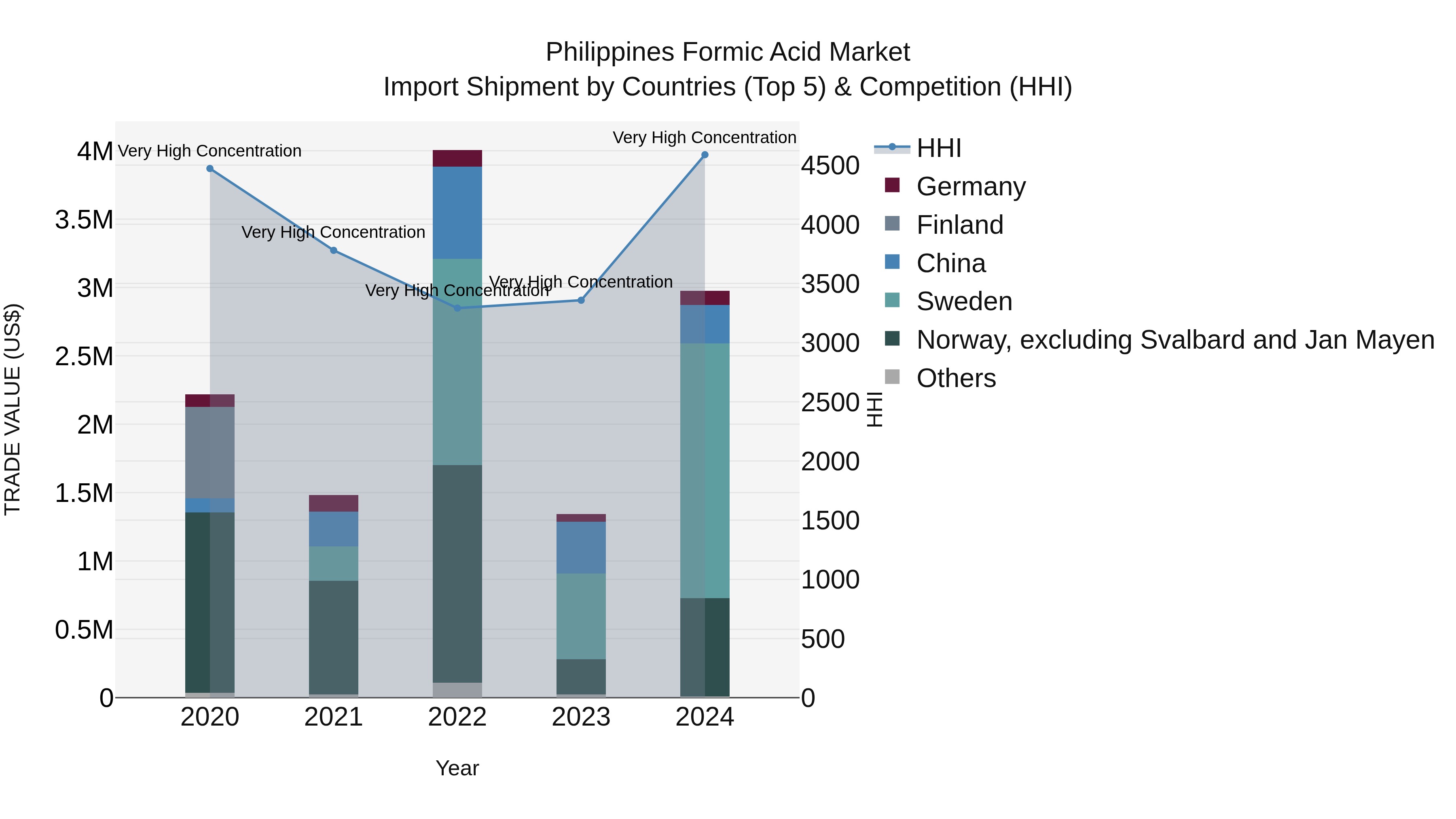
In 2024, the Philippines saw significant formic acid import shipments from top exporting countries such as Sweden, Norway (excluding Svalbard and Jan Mayen), China, Germany, and Spain. The high Herfindahl-Hirschman Index (HHI) indicates a concentrated market. With a strong compound annual growth rate (CAGR) of 7.61% from 2020 to 2024 and an impressive growth rate of 121.71% from 2023 to 2024, the formic acid import market in the Philippines is experiencing rapid expansion and diversification. This trend suggests opportunities for market players to capitalize on the growing demand for formic acid in the country.
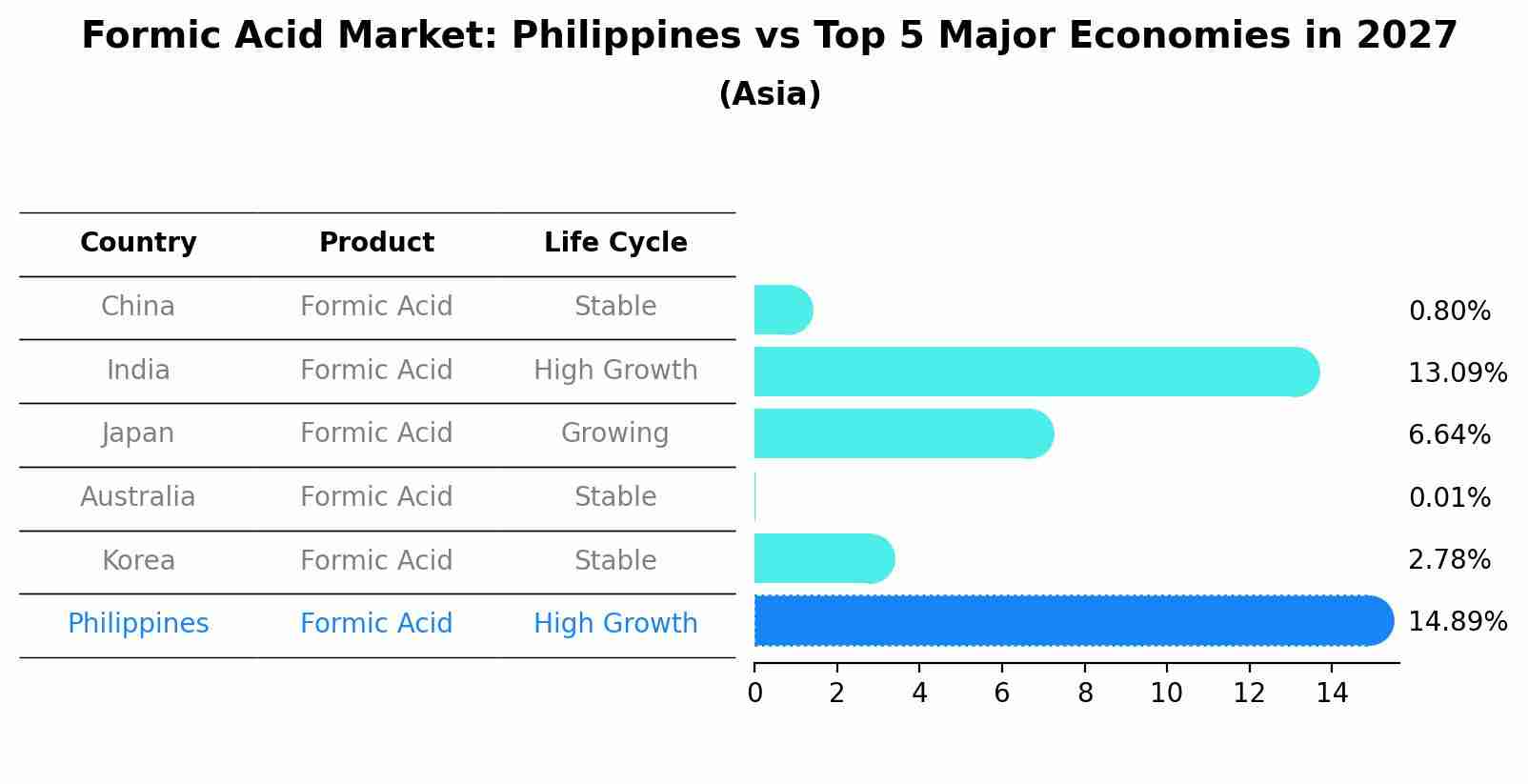
Formic Acid Market: Philippines vs Top 5 Major Economies in 2027 (Asia)
The Formic Acid market in Philippines is projected to grow at a high growth rate of 14.89% by 2027, highlighting the country's increasing focus on advanced technologies within the Asia region, where China holds the dominant position, followed closely by India, Japan, Australia and South Korea, shaping overall regional demand.
Philippines Formic Acid Market Synopsis
The Philippines formic acid market was valued at USD 4 million in 2018, registering a CAGR of 6% on account of its wide application scope across various end user industries including textile, pharmaceuticals food processing, leather tanning etc.,rising awareness about health benefits associated with organic products have further driven its consumption significantly in recent years. Growing focus towards environmental sustainability has shifted preference towards biodegradable products which will propel overall industry size over forecast timeline.
Drivers of the market
The Philippines Formic Acid Market is driven by its diverse applications across several industries. Formic acid is used in the leather industry for tanning, in the textile industry for dyeing and finishing processes, and in animal feed as a preservative and acidifier. Additionally, formic acid is utilized in cleaning agents and as a coagulant in the rubber industry. The growth of these industries contributes to the overall demand for formic acid in the country.
Challenges of the market
In the Philippines Formic Acid Market, manufacturers face challenges related to safety and handling. Formic acid is a corrosive and hazardous chemical, and its safe transportation and storage require strict adherence to safety regulations. Ensuring proper handling and disposal of formic acid can be demanding for producers and distributors.
Covid-19 Impact of the market
In the Philippines Formic Acid Market, the pandemic had a negative impact on demand. The construction and textile industries, major consumers of formic acid, experienced setbacks due to disruptions in projects and manufacturing activities. This led to reduced demand for formic acid, which is widely used as a preservative and coagulant in various applications.
Key Players of the market
In the Philippines Formic Acid Market, major players consist of companies like BASF SE, Eastman Chemical Company, and Perstorp Holding AB. These companies are significant producers and suppliers of formic acid, used in industries such as animal feed preservation, leather processing, and chemicals.
Key Highlights of the Report:
- Philippines Formic Acid Market Outlook
- Market Size of Philippines Formic Acid Market, 2024
- Forecast of Philippines Formic Acid Market, 2031
- Historical Data and Forecast of Philippines Formic Acid Revenues & Volume for the Period 2021-2031
- Philippines Formic Acid Market Trend Evolution
- Philippines Formic Acid Market Drivers and Challenges
- Philippines Formic Acid Price Trends
- Philippines Formic Acid Porter's Five Forces
- Philippines Formic Acid Industry Life Cycle
- Historical Data and Forecast of Philippines Formic Acid Market Revenues & Volume By Grade Type for the Period 2021-2031
- Historical Data and Forecast of Philippines Formic Acid Market Revenues & Volume By 0.75 for the Period 2021-2031
- Historical Data and Forecast of Philippines Formic Acid Market Revenues & Volume By 0.8 for the Period 2021-2031
- Historical Data and Forecast of Philippines Formic Acid Market Revenues & Volume By 0.85 for the Period 2021-2031
- Historical Data and Forecast of Philippines Formic Acid Market Revenues & Volume By 0.94 for the Period 2021-2031
- Historical Data and Forecast of Philippines Formic Acid Market Revenues & Volume By 0.99 for the Period 2021-2031
- Historical Data and Forecast of Philippines Formic Acid Market Revenues & Volume By Application for the Period 2021-2031
- Historical Data and Forecast of Philippines Formic Acid Market Revenues & Volume By Animal Feed for the Period 2021-2031
- Historical Data and Forecast of Philippines Formic Acid Market Revenues & Volume By Leather Tanning for the Period 2021-2031
- Historical Data and Forecast of Philippines Formic Acid Market Revenues & Volume By Textile Dyeing and Finishing for the Period 2021-2031
- Historical Data and Forecast of Philippines Formic Acid Market Revenues & Volume By Intermediary in Pharmaceuticals for the Period 2021-2031
- Historical Data and Forecast of Philippines Formic Acid Market Revenues & Volume By Other Applications for the Period 2021-2031
- Philippines Formic Acid Import Export Trade Statistics
- Market Opportunity Assessment By Grade Type
- Market Opportunity Assessment By Application
- Philippines Formic Acid Top Companies Market Share
- Philippines Formic Acid Competitive Benchmarking By Technical and Operational Parameters
- Philippines Formic Acid Company Profiles
- Philippines Formic Acid Key Strategic Recommendations






































