Philippines Hydrolysed Flour Market Size, Share & Growth Rate
The Philippines Hydrolysed Flour Market was estimated at USD 357 Million in 2025 and is projected to reach USD 488 Million by 2032, growing at a CAGR of 4.6% from 2026 to 2032. This growth trajectory is driven by the increasing demand for healthier food options, with consumers becoming more aware of the nutritional benefits of hydrolysed flour. Additionally, the versatility of this ingredient in enhancing flavors and textures is making it a favored choice among food manufacturers, thus expanding its applications across various segments.
Philippines Hydrolysed Flour Market Growth Rate Analysis (2021-2032)
The hydrolysed flour market in the Philippines has been experiencing stable growth, with rates hovering around 5.5% in 2021 and 2022, slightly tapering to 5.4% in 2023. This trend reflects a sustained demand driven by the food processing sector, which increasingly relies on hydrolysed flour for its versatile applications. As we progress into 2024 and 2025, growth is projected to ease to about 5.3% and 5.1%, influenced by potential saturation in some consumer segments. However, a resurgence in 2026 to 5.1% followed by 5.6% in 2027 showcases market resilience, likely fueled by advancements in food technology and a growing emphasis on nutritional products, aligning with broader consumer health trends. By 2032, growth could reach 5.7%, suggesting renewed investments in modernizing production facilities and infrastructure, driven by the digitalization of the industry.
Philippines Hydrolysed Flour Market Year-wise Growth Rate and Key Drivers
This graph highlights how the Philippines Hydrolysed Flour Market has steadily grown over the past five years, supported by major growth factors.
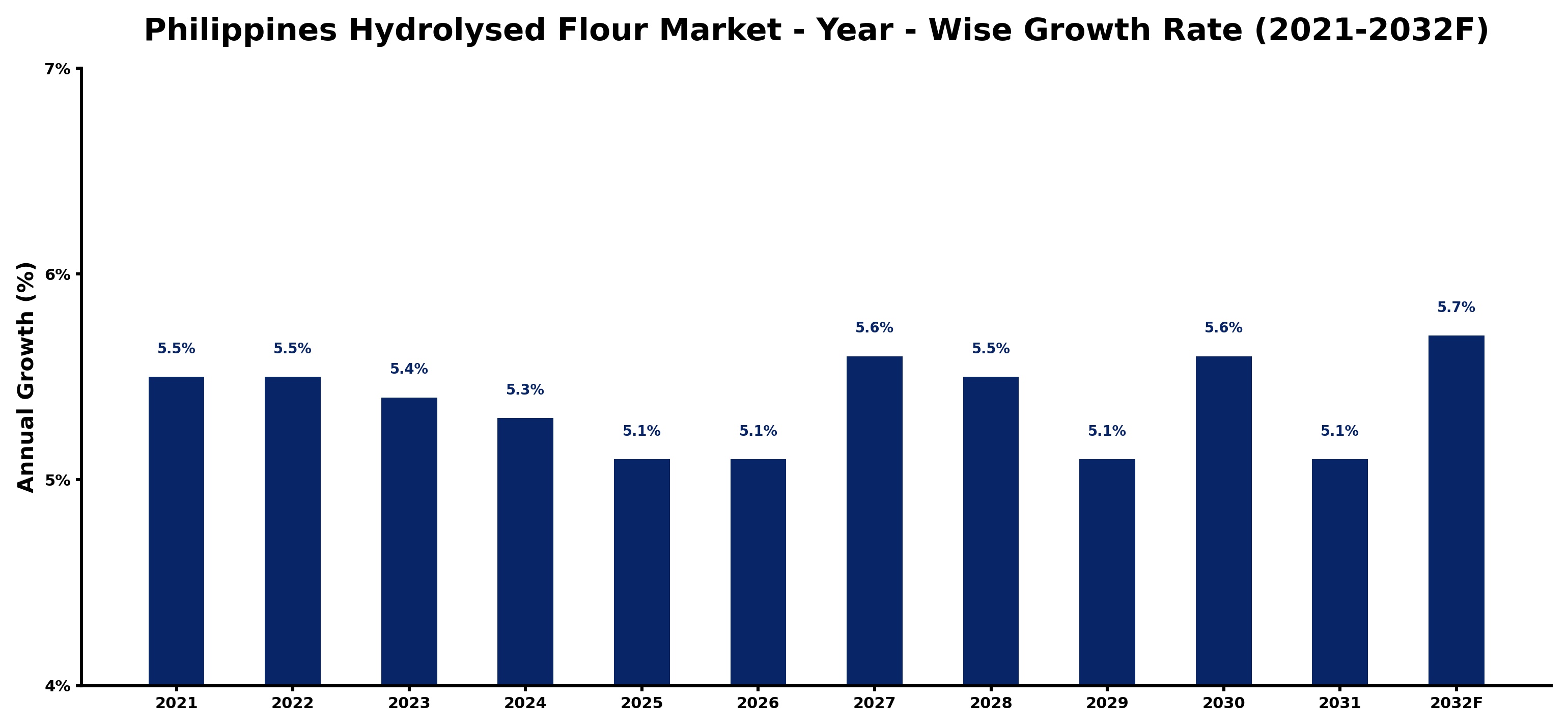
The table below presents the year‑wise growth rates along with the key drivers influencing the market
| Year | Growth Rate | Major Drivers |
| 2021 | 5.5% | Health consciousness drove demand |
| 2022 | 5.5% | Innovative product formulations emerged |
| 2023 | 5.4% | Increased baking applications expanded |
| 2024 | 5.3% | Rising gluten-free trends influenced |
| 2025 | 5.1% | Nutritional benefits gained recognition |
| 2026 | 5.1% | Food technology advancements improved |
| 2027 | 5.6% | Export opportunities enhanced growth |
| 2028 | 5.5% | Consumer preferences shifted positively |
| 2029 | 5.1% | Sustainability initiatives attracted interest |
| 2030 | 5.6% | Collaborations with chefs increased |
| 2031 | 5.1% | E-commerce platforms expanded reach |
| 2032 | 5.7% | Culinary education promoted usage |
Note - Market size estimations and growth projections presented in this report are based on 6Wresearch's advanced forecasting approach, validated with industry datasets as of June 2026.
Philippines Hydrolysed Flour Market Synopsis
The hydrolysed flour market in the Philippines is gaining momentum as a vital ingredient in the bakery and confectionery sectors. With its unique properties, hydrolysed flour offers enhanced digestibility and flavor profiles, catering to the evolving preferences of health-conscious consumers.
As manufacturers prioritize innovative and nutritious ingredients, hydrolysed flour is increasingly being incorporated into a diverse range of food products, including gluten-free options. The convergence of consumer trends toward healthier eating and the food industry's push for enhanced functionality positions this market for sustained growth.
Philippines Hydrolysed Flour Market Key Takeaways
- Growing consumer awareness of health benefits is propelling demand.
- Hydrolysed flour is becoming essential for product innovation in the food sector.
- The market is seeing increased applications, particularly in gluten-free offerings.
- Quality control and adherence to safety standards are paramount challenges.
- Companies are adapting to changes in consumer preferences post-COVID-19.
Evaluation of Restraints in Philippines Hydrolysed Flour Market
Despite the promising growth potential, the Philippines hydrolysed flour market faces several restraints. One of the most significant challenges is ensuring consistent quality and safety standards throughout the production process. Variability in raw materials can lead to fluctuations in the final product's characteristics, which may impact consumer trust. Additionally, navigating the complex landscape of food safety regulations requires ongoing attention from manufacturers. Balancing cost-effectiveness with the need for high-quality outputs remains a critical concern that companies must address to maintain market confidence.
Philippines Hydrolysed Flour Market Trends
Current trends in the Philippines hydrolysed flour market include an increasing focus on clean-label products and the growing demand for gluten-free alternatives. As more consumers seek transparency regarding ingredients, food manufacturers are gravitating toward hydrolysed flour for its natural sweetness and enhanced flavor profile. Furthermore, innovations in processing techniques are enhancing the functionality of hydrolysed flour, making it suitable for a broader array of food applications.
Philippines Hydrolysed Flour Market Opportunities
The Philippines hydrolysed flour market offers numerous growth opportunities, particularly in the health and wellness segment. As the population becomes more health-conscious, the potential for incorporating hydrolysed flour into nutritional products such as protein bars, meal replacements, and specialty baked goods is vast. Moreover, rising export possibilities for Philippine-produced hydrolysed flour to neighboring countries may further bolster market growth. Capitalizing on these opportunities could provide food manufacturers with a competitive edge.
Government Initiatives in the Philippines Hydrolysed Flour Market
The Philippine government is increasingly focused on enhancing food safety standards and promoting local food production. Through various policies aimed at improving agricultural practices and increasing food security, the government is setting the stage for the hydrolysed flour market to flourish. Initiatives to support research and development in food processing technologies are encouraging innovation, potentially benefiting manufacturers of hydrolysed flour and related products.
Future Insights of the Philippines Hydrolysed Flour Market
Looking ahead to the period between 2026 and 2032, the Philippines hydrolysed flour market is expected to continue its upward trajectory. The increasing preference for health-oriented products, combined with innovative applications across various food segments, suggests a robust market environment. As companies refine their production techniques and expand their product offerings, the market will likely witness a significant enhancement in the quality and versatility of hydrolysed flour, solidifying its role in contemporary food manufacturing.
Philippines Hydrolysed Flour Market Latest Developments (May 2025 - June 2026)
Recent developments in the hydrolysed flour market have centered on the introduction of new product lines that cater to the rising demand for gluten-free and functional food ingredients. Manufacturers are also embracing technological advancements to improve processing efficiency and product quality. The industry's response to shifting consumer preferences in the wake of the COVID-19 pandemic has resulted in a more diverse range of hydrolysed flour applications, further invigorating market activity.
Philippines Hydrolysed Flour Market - Key Attractiveness of the Report
- 10 Years of Market Numbers
- Historical Data Starting from 2022 to 2025
- Base Year: 2025
- Forecast Data until 2032
- Key Performance Indicators Impacting the Market
- Major Upcoming Developments and Projects
Key Highlights of the Report:
- Philippines Hydrolysed Flour Market Outlook
- Market Size of Philippines Hydrolysed Flour Market, 2025
- Forecast of Philippines Hydrolysed Flour Market, 2032F
- Historical Data and Forecast of Philippines Hydrolysed Flour Revenues & Volume for the Period 2022-2032F
- Philippines Hydrolysed Flour Market Trend Evolution
- Philippines Hydrolysed Flour Market Drivers and Challenges
- Philippines Hydrolysed Flour Price Trends
- Philippines Hydrolysed Flour Porter's Five Forces
- Philippines Hydrolysed Flour Industry Life Cycle
- Historical Data and Forecast of Philippines Hydrolysed Flour Market Revenues & Volume By Type for the Period 2022-2032F
- Historical Data and Forecast of Philippines Hydrolysed Flour Market Revenues & Volume By Rice for the Period 2022-2032F
- Historical Data and Forecast of Philippines Hydrolysed Flour Market Revenues & Volume By Wheat for the Period 2022-2032F
- Historical Data and Forecast of Philippines Hydrolysed Flour Market Revenues & Volume By Corn for the Period 2022-2032F
- Historical Data and Forecast of Philippines Hydrolysed Flour Market Revenues & Volume By Others for the Period 2022-2032F
- Historical Data and Forecast of Philippines Hydrolysed Flour Market Revenues & Volume By Application for the Period 2022-2032F
- Historical Data and Forecast of Philippines Hydrolysed Flour Market Revenues & Volume By Baby Foods for the Period 2022-2032F
- Historical Data and Forecast of Philippines Hydrolysed Flour Market Revenues & Volume By Sports Drinks for the Period 2022-2032F
- Historical Data and Forecast of Philippines Hydrolysed Flour Market Revenues & Volume By Breakfast Cereals for the Period 2022-2032F
- Historical Data and Forecast of Philippines Hydrolysed Flour Market Revenues & Volume By Bakery for the Period 2022-2032F
- Historical Data and Forecast of Philippines Hydrolysed Flour Market Revenues & Volume By Snacks for the Period 2022-2032F
- Historical Data and Forecast of Philippines Hydrolysed Flour Market Revenues & Volume By Others for the Period 2022-2032F
- Philippines Hydrolysed Flour Import Export Trade Statistics
- Market Opportunity Assessment By Type
- Market Opportunity Assessment By Application
- Philippines Hydrolysed Flour Top Companies Market Share
- Philippines Hydrolysed Flour Competitive Benchmarking By Technical and Operational Parameters
- Philippines Hydrolysed Flour Company Profiles
- Philippines Hydrolysed Flour Key Strategic Recommendations






































