Philippines Instant Tea Market Top 5 Importing Countries and Market Competition (HHI) Analysis
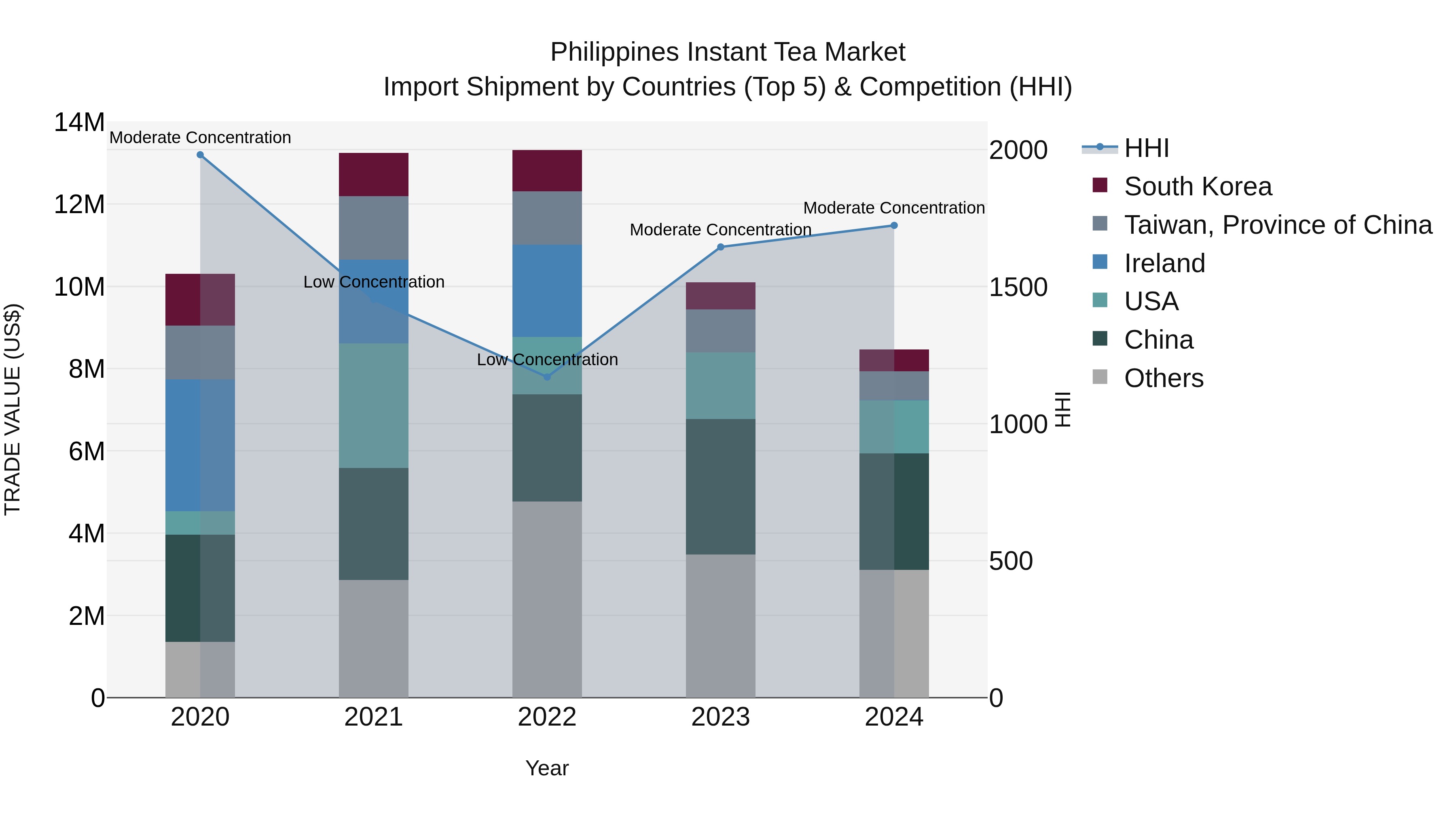
In 2024, the Philippines continued to import instant tea primarily from China, USA, Malaysia, Taiwan, Province of China, and Indonesia. Despite a moderate concentration with the Herfindahl-Hirschman Index (HHI), the market experienced a negative compound annual growth rate (CAGR) of -4.8% from 2020 to 2024. Interestingly, there was a significant decline in growth rate from 2023 to 2024, with a decrease of -16.21%. This data suggests a challenging landscape for instant tea imports in the Philippines, potentially impacted by various factors influencing consumer preferences and market dynamics.
Philippines Instant Tea Market Overview
The instant tea market in the Philippines is experiencing growth fueled by convenience, affordability, and rising tea culture. Products include powdered milk teas, iced teas, and herbal infusions. Urbanization and the popularity of ready-to-drink beverages support this trend, especially among younger consumers and working professionals.
Drivers of the market
The instant tea market in the Philippines is gaining popularity as consumer lifestyles become increasingly fast-paced and health-conscious. Instant tea products, including herbal, green, and milk tea variants, are being embraced for their convenience and perceived health benefits. Manufacturers are innovating with flavors and formulations to cater to evolving tastes. Online retail and ready-to-drink (RTD) channels are contributing to market expansion, with younger consumers driving demand for premium and organic options.
Challenges of the market
Growth in the instant tea market is constrained by traditional beverage preferences and competition from other ready-to-drink products. The market also faces issues with maintaining taste and aroma consistency in instant formats. Additionally, poor distribution infrastructure limits product availability in rural areas, and inconsistent branding makes it harder to gain consumer trust.
Investment opportunities in the Market
The instant tea market in the Philippines is booming due to fast-paced lifestyles and a growing preference for convenient health beverages. Investors can explore opportunities in ready-to-drink (RTD) formulations, flavored instant tea powders, and herbal product lines, especially those focused on wellness and detox benefits.
Government Policy of the market
The FDA regulates the safety, quality, and labeling of instant tea products. The DA promotes value addition to agricultural products, including tea and herbal drinks, while trade policies under the ASEAN Free Trade Area (AFTA) facilitate importation of raw or processed tea from partner countries.
Key Highlights of the Report:
- Philippines Instant Tea Market Outlook
- Market Size of Philippines Instant Tea Market, 2024
- Forecast of Philippines Instant Tea Market, 2031
- Historical Data and Forecast of Philippines Instant Tea Revenues & Volume for the Period 2021- 2031
- Philippines Instant Tea Market Trend Evolution
- Philippines Instant Tea Market Drivers and Challenges
- Philippines Instant Tea Price Trends
- Philippines Instant Tea Porter's Five Forces
- Philippines Instant Tea Industry Life Cycle
- Historical Data and Forecast of Philippines Instant Tea Market Revenues & Volume By Type for the Period 2021- 2031
- Historical Data and Forecast of Philippines Instant Tea Market Revenues & Volume By Cardamom Tea for the Period 2021- 2031
- Historical Data and Forecast of Philippines Instant Tea Market Revenues & Volume By Ginger Tea for the Period 2021- 2031
- Historical Data and Forecast of Philippines Instant Tea Market Revenues & Volume By Masala Tea for the Period 2021- 2031
- Historical Data and Forecast of Philippines Instant Tea Market Revenues & Volume By Lemon Tea for the Period 2021- 2031
- Historical Data and Forecast of Philippines Instant Tea Market Revenues & Volume By Plain Tea for the Period 2021- 2031
- Historical Data and Forecast of Philippines Instant Tea Market Revenues & Volume By Application for the Period 2021- 2031
- Historical Data and Forecast of Philippines Instant Tea Market Revenues & Volume By Household for the Period 2021- 2031
- Historical Data and Forecast of Philippines Instant Tea Market Revenues & Volume By Commercial for the Period 2021- 2031
- Philippines Instant Tea Import Export Trade Statistics
- Market Opportunity Assessment By Type
- Market Opportunity Assessment By Application
- Philippines Instant Tea Top Companies Market Share
- Philippines Instant Tea Competitive Benchmarking By Technical and Operational Parameters
- Philippines Instant Tea Company Profiles
- Philippines Instant Tea Key Strategic Recommendations






































