Philippines Internet Protocol Television (IPTV) CDN Market Size & Growth Rate (2026-2032)
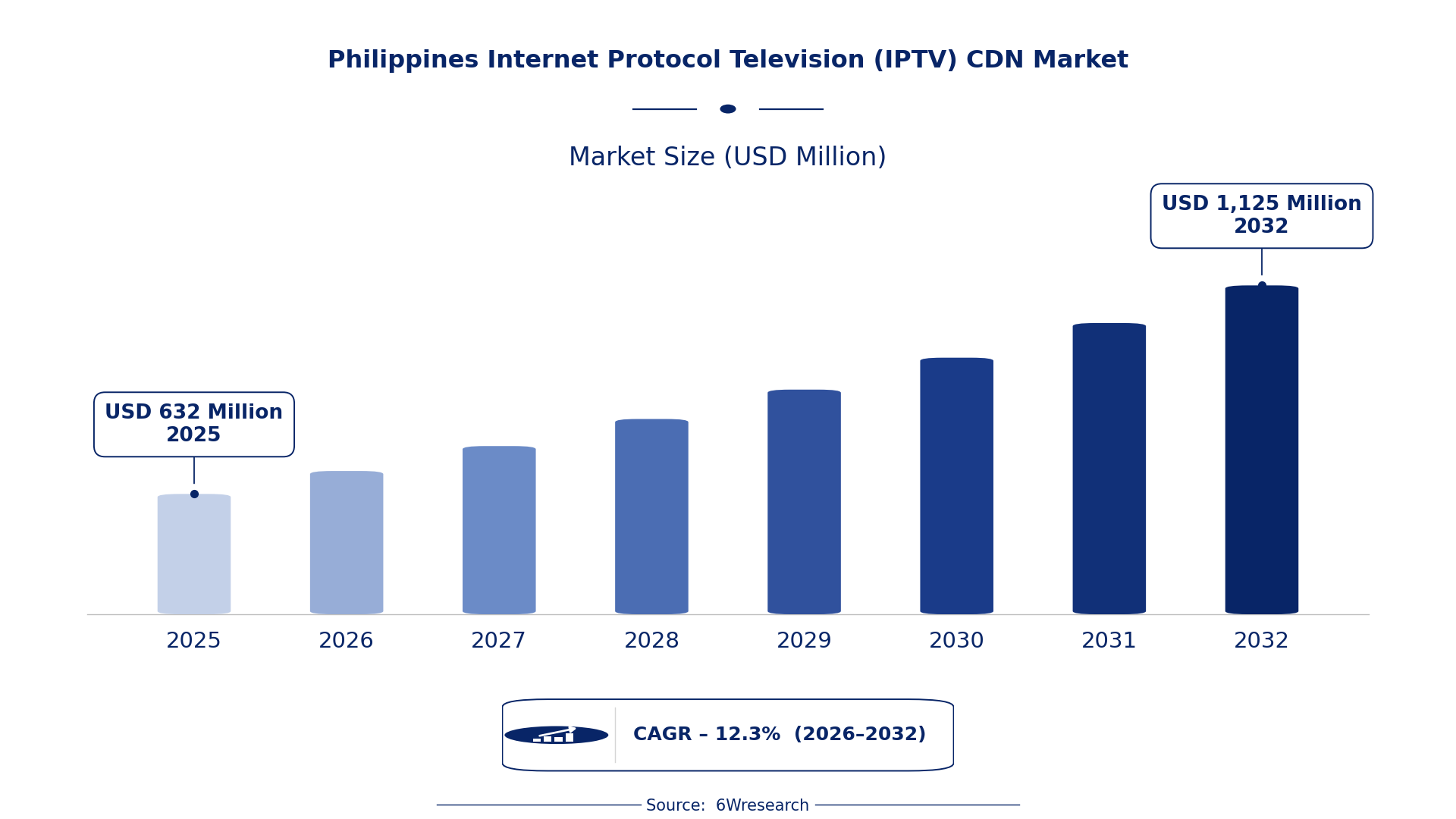
The Philippines Internet Protocol Television (IPTV) CDN Market was estimated at USD 632 Million in 2025 and is projected to reach USD 1125 Million by 2032, growing at a CAGR of 12.3% from 2026 to 2032.
Philippines Internet Protocol Television (IPTV) CDN Market Synopsis
The Philippines Internet Protocol Television (IPTV) CDN Market has gained notable traction as digital consumption evolves. High-speed internet and changing viewer preferences have been instrumental in this growth, particularly among the younger demographic that prefers tailored content delivery.
Looking ahead, the market is set to further capitalize on advancements in CDN technology, which enables enhanced streaming experiences. With rising competition among service providers, consumers can expect to see improvements in service quality, content variety, and pricing structures.
Philippines Internet Protocol Television (IPTV) CDN Market Year-wise Growth Rate and Key Drivers
This graph illustrates the annual growth rates of the Philippines Internet Protocol Television (IPTV) CDN Market from 2021 to 2032, highlighting a steady upward trajectory and projected expansion over the forecast period.
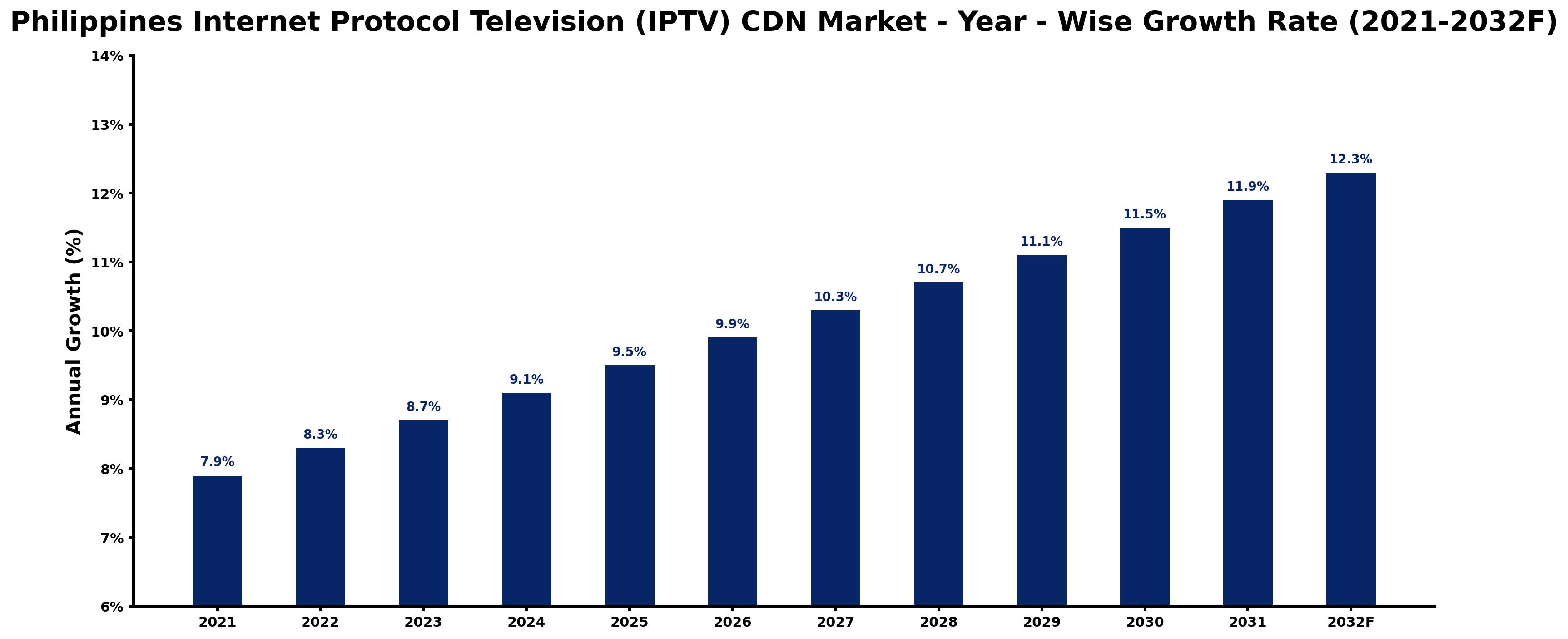
The table below presents the year‑wise growth rates along with the key drivers influencing the market
| Year | Growth Rate | Major Drivers |
| 2021 | 7.9% | Increasing mobile internet penetration boosting IPTV subscriptions. |
| 2022 | 8.3% | Telecommunication Infrastructure Development Plan enhancing network capabilities. |
| 2023 | 8.7% | Government support for digital content distribution increasing market growth. |
| 2024 | 9.1% | Rising viewership for on-demand streaming services driving demand. |
| 2025 | 9.5% | Regulatory support for foreign investments in local IPTV markets. |
| 2026 | 9.9% | Growing popularity of localized content attracting more users. |
| 2027 | 10.3% | Enhanced user experience through better CDN technologies adoption. |
| 2028 | 10.7% | Launch of 5G networks improving streaming quality and accessibility. |
| 2029 | 11.1% | Increased digital literacy promoting IPTV adoption among households. |
| 2030 | 11.5% | Emerging e-sports market driving content delivery network utilization. |
| 2031 | 11.9% | Local partnerships enhancing service delivery and customer engagement. |
| 2032 | 12.3% | Increased ad revenues from IPTV platforms attracting investments. |
Note: Market size estimations and growth projections presented in this report are based on 6Wresearch's proprietary forecasting methodology, utilizing the latest available industry data, government publications, and primary research inputs.
Philippines Internet Protocol Television (IPTV) CDN Market Key Takeaways
Below are some of the specific key takeaways from the market, including:
- Rapid growth driven by increased demand for personalized viewing experiences.
- Technological advancements in CDN are improving streaming quality.
- Content variety is expanding, catering to diverse audience preferences.
- Competitive pricing strategies are becoming more common among providers.
Evaluation of Restraints in Philippines Internet Protocol Television (IPTV) CDN Market
Despite its potential, the market faces challenges, particularly in underdeveloped regions where network infrastructure is lacking. This disparity can lead to inconsistent streaming quality, frustrating users and stifling growth. Addressing these infrastructural deficiencies is crucial for unlocking the full potential of the IPTV CDN market. Content delivery also faces hurdles, as providers strive to ensure reliability and performance in diverse conditions.
Philippines Internet Protocol Television (IPTV) CDN Market Trends
Current trends show an increasing shift towards on-demand content, reflecting consumer preferences for flexibility in viewing schedules. Additionally, there's a noticeable integration of interactive features, such as audience engagement tools, which are becoming essential in enhancing viewer experience.
As competition heats up, IPTV service providers are focusing on exclusive content agreements, which are aimed at attracting and retaining subscribers. The demand for high-definition content is also on the rise, prompting investments in technology that supports higher quality streams.
Philippines Internet Protocol Television (IPTV) CDN Market Opportunities
The landscape presents various opportunities, particularly as digital penetration expands. Partnerships with local content creators can enrich offerings and cater to niche audiences. Furthermore, as mobile data consumption grows, optimizing services for mobile platforms can open new avenues for revenue generation.
Emerging technologies like edge computing hold the potential to enhance the efficiency of CDN, enabling more localized and faster content delivery. This is especially crucial in urban areas with dense populations.
Government Initiatives in the Philippines Internet Protocol Television (IPTV) CDN Market
The Philippine government has been proactive in fostering a favorable environment for digital media growth, including the IPTV CDN sector. With a commitment to improving telecommunications infrastructure, regulatory frameworks are being shaped to encourage investments in this area. Public-sector initiatives focus on expanding access and enhancing service quality, which is vital for consumer satisfaction and market growth.
- A national digital infrastructure upgrade programme initiated in early 2023 aims to enhance network capacity across underserved regions.
- Ongoing discussions regarding a regulatory framework that encourages transparency in content pricing and delivery practices.
- A planned public-private partnership expected to enhance broadband access by 2026, supporting IPTV service proliferation.
- Recent policy adjustments regarding spectrum allocation to facilitate improved wireless connectivity for streaming services.
Future Insights of the Philippines Internet Protocol Television (IPTV) CDN Market
The market is on a clear upward trajectory through 2032. As technology continues to evolve, the focus will shift towards providing unparalleled user experiences. With an increasing reliance on digital platforms, service providers must prioritize infrastructure improvements and content diversity to meet rising consumer expectations.
Anticipated growth in mobile IPTV services further indicates where the market is heading. Providers who adapt swiftly to technological advancements and consumer trends will likely secure a strong market position in the coming years.
Philippines Internet Protocol Television (IPTV) CDN Market Latest Developments
Recent activity in the Philippines Internet Protocol Television (IPTV) CDN Market indicates a dynamic period of growth and evolution. Service providers are increasingly focusing on enhancing user experiences while expanding content offerings. The competitive atmosphere is also encouraging innovation as businesses seek to distinguish themselves.
- A major technology vendor completed a rollout of enhanced CDN capabilities in Q1 2025 to improve content delivery efficiency.
- A partnership between regional service providers launched in early 2025 aims to share resources for better content delivery.
- An initiative that began in late 2024 and remains underway focuses on integrating AI-driven analytics for improved viewer engagement.
- Plans are in motion for a product launch in mid-2026 that will introduce immersive content experiences using augmented reality.
Philippines Internet Protocol Television (IPTV) CDN Market - Key Attractiveness of the Report
- 10 Years of Market Numbers
- Historical Data Starting from 2022 to 2025
- Base Year: 2025
- Forecast Data until 2032
- Key Performance Indicators Impacting the Market
- Major Upcoming Developments and Projects
Key Highlights of the Report:
- Philippines Internet Protocol Television (IPTV) CDN Market Outlook
- Market Size of Philippines Internet Protocol Television (IPTV) CDN Market, 2025
- Forecast of Philippines Internet Protocol Television (IPTV) CDN Market, 2032
- Historical Data and Forecast of Philippines Internet Protocol Television (IPTV) CDN Revenues & Volume for the Period 2022-2032F
- Philippines Internet Protocol Television (IPTV) CDN Market Trend Evolution
- Philippines Internet Protocol Television (IPTV) CDN Market Drivers and Challenges
- Philippines Internet Protocol Television (IPTV) CDN Price Trends
- Philippines Internet Protocol Television (IPTV) CDN Porter's Five Forces
- Philippines Internet Protocol Television (IPTV) CDN Industry Life Cycle
- Historical Data and Forecast of Philippines Internet Protocol Television (IPTV) CDN Market Revenues & Volume By Type for the Period 2022-2032F
- Historical Data and Forecast of Philippines Internet Protocol Television (IPTV) CDN Market Revenues & Volume By Video for the Period 2022-2032F
- Historical Data and Forecast of Philippines Internet Protocol Television (IPTV) CDN Market Revenues & Volume By Non-Video Content for the Period 2022-2032F
- Historical Data and Forecast of Philippines Internet Protocol Television (IPTV) CDN Market Revenues & Volume By Service for the Period 2022-2032F
- Historical Data and Forecast of Philippines Internet Protocol Television (IPTV) CDN Market Revenues & Volume By In-House for the Period 2022-2032F
- Historical Data and Forecast of Philippines Internet Protocol Television (IPTV) CDN Market Revenues & Volume By Manage Service for the Period 2022-2032F
- Historical Data and Forecast of Philippines Internet Protocol Television (IPTV) CDN Market Revenues & Volume By End-User for the Period 2022-2032F
- Historical Data and Forecast of Philippines Internet Protocol Television (IPTV) CDN Market Revenues & Volume By SME for the Period 2022-2032F
- Historical Data and Forecast of Philippines Internet Protocol Television (IPTV) CDN Market Revenues & Volume By Large Enterprise for the Period 2022-2032F
- Historical Data and Forecast of Philippines Internet Protocol Television (IPTV) CDN Market Revenues & Volume By Residential Customers for the Period 2022-2032F
- Philippines Internet Protocol Television (IPTV) CDN Import Export Trade Statistics
- Market Opportunity Assessment By Type
- Market Opportunity Assessment By Service
- Market Opportunity Assessment By End-User
- Philippines Internet Protocol Television (IPTV) CDN Top Companies Market Share
- Philippines Internet Protocol Television (IPTV) CDN Competitive Benchmarking By Technical and Operational Parameters
- Philippines Internet Protocol Television (IPTV) CDN Company Profiles
- Philippines Internet Protocol Television (IPTV) CDN Key Strategic Recommendations






































