Philippines Kitchen Cabinets Market Top 5 Importing Countries and Market Competition (HHI) Analysis
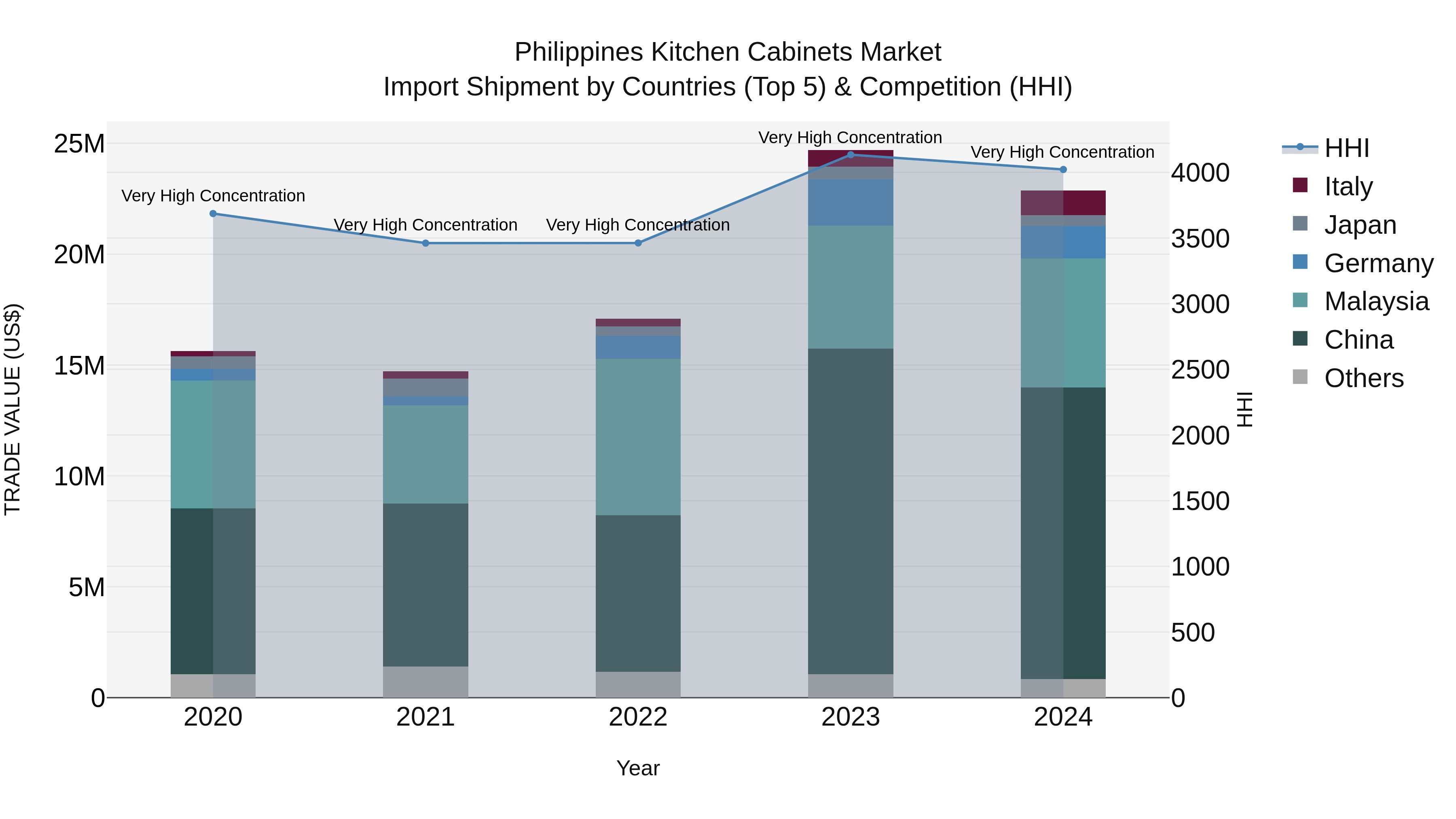
In 2024, the Philippines continued to see a significant volume of kitchen cabinets imports, with top exporters being China, Malaysia, Germany, Italy, and Japan. Despite a slight decrease in growth rate from 2023 to 2024, the industry maintained a high level of market concentration, as indicated by the high Herfindahl-Hirschman Index (HHI). With a strong compound annual growth rate (CAGR) of 9.99% from 2020 to 2024, the market for kitchen cabinets imports in the Philippines remains dynamic and competitive, offering opportunities for both domestic and international players.
philippines kitchen cabinets market Synopsis
The kitchen cabinet industry size was valued at around USD 500 million during 2025 and is projected to reach around USD 700 million by 2025 registering a CAGR of 5. 1% over the coming years owing largely to its significant presence throughout residential buildings especially apartments across major cities like Manila. In addition urbanization along with rapid investments being made into infrastructure development projects mainly targeting housing, offices, schools, hospitals etc. have created ample opportunities within this sector. Manufacturers are increasingly looking into using different materials ranging from wood veneer, melamine board, stainless steel amongst others while focusing on unique designs catering directly.
Drivers of the Market
The Philippines kitchen cabinets market is expected to experience growth as home improvement and renovation activities gain momentum. The growing real estate sector and urbanization are driving the demand for modern and well-designed kitchen spaces. Kitchen cabinets, being an essential component of kitchen interiors, are anticipated to witness increased demand for innovative designs, space optimization, and durable materials. The trend of modular kitchens will also contribute to the market`s positive outlook.
Challenges of the Market
The kitchen cabinets market in the Philippines faces notable challenges. While urbanization and the growth of the real estate sector drive demand for kitchen cabinets, quality disparities among products are common. Many consumers prioritize cost over durability, resulting in dissatisfaction with subpar products. Moreover, customization options may be limited, impacting the ability to cater to diverse consumer preferences and kitchen layouts.
COVID-19 Impact on the Market
The kitchen cabinets market faced challenges due to decreased construction activity and home remodeling projects. With economic concerns and limited mobility, consumers deferred non-essential renovations, impacting the demand for kitchen cabinets.
Key Players in the Market
The Philippines kitchen cabinets market has witnessed significant growth in recent years, driven by the rising demand for modern and efficient kitchen storage solutions. Key players in this market include well-established local manufacturers such as Pacific Paint (Boysen) Philippines, Inc., and Matimco, as well as international companies like IKEA and Hafele. These companies offer a diverse range of kitchen cabinet designs, materials, and customization options to cater to the varying preferences of consumers.
Key Highlights of the Report:
- Philippines Kitchen Cabinets Market Outlook
- Market Size of Philippines Kitchen Cabinets Market, 2024
- Forecast of Philippines Kitchen Cabinets Market, 2031
- Historical Data and Forecast of Philippines Kitchen Cabinets Revenues & Volume for the Period 2021-2031
- Philippines Kitchen Cabinets Market Trend Evolution
- Philippines Kitchen Cabinets Market Drivers and Challenges
- Philippines Kitchen Cabinets Price Trends
- Philippines Kitchen Cabinets Porter's Five Forces
- Philippines Kitchen Cabinets Industry Life Cycle
- Historical Data and Forecast of Philippines Kitchen Cabinets Market Revenues & Volume By Type for the Period 2021-2031
- Historical Data and Forecast of Philippines Kitchen Cabinets Market Revenues & Volume By Ready-to-assemble (RTA) for the Period 2021-2031
- Historical Data and Forecast of Philippines Kitchen Cabinets Market Revenues & Volume By Stock Kitchen Cabinets for the Period 2021-2031
- Historical Data and Forecast of Philippines Kitchen Cabinets Market Revenues & Volume By Semi-custom Kitchen Cabinets for the Period 2021-2031
- Historical Data and Forecast of Philippines Kitchen Cabinets Market Revenues & Volume By Custom Kitchen Cabinets for the Period 2021-2031
- Historical Data and Forecast of Philippines Kitchen Cabinets Market Revenues & Volume By Raw Material for the Period 2021-2031
- Historical Data and Forecast of Philippines Kitchen Cabinets Market Revenues & Volume By Wood for the Period 2021-2031
- Historical Data and Forecast of Philippines Kitchen Cabinets Market Revenues & Volume By Metal for the Period 2021-2031
- Historical Data and Forecast of Philippines Kitchen Cabinets Market Revenues & Volume By Other Raw Materials for the Period 2021-2031
- Historical Data and Forecast of Philippines Kitchen Cabinets Market Revenues & Volume By Distribution Channel for the Period 2021-2031
- Historical Data and Forecast of Philippines Kitchen Cabinets Market Revenues & Volume By Retail for the Period 2021-2031
- Historical Data and Forecast of Philippines Kitchen Cabinets Market Revenues & Volume By Online for the Period 2021-2031
- Historical Data and Forecast of Philippines Kitchen Cabinets Market Revenues & Volume By Other Distribution Channels for the Period 2021-2031
- Historical Data and Forecast of Philippines Kitchen Cabinets Market Revenues & Volume By Application for the Period 2021-2031
- Historical Data and Forecast of Philippines Kitchen Cabinets Market Revenues & Volume By Home for the Period 2021-2031
- Historical Data and Forecast of Philippines Kitchen Cabinets Market Revenues & Volume By Restaurants for the Period 2021-2031
- Historical Data and Forecast of Philippines Kitchen Cabinets Market Revenues & Volume By Other Applications for the Period 2021-2031
- Philippines Kitchen Cabinets Import Export Trade Statistics
- Market Opportunity Assessment By Type
- Market Opportunity Assessment By Raw Material
- Market Opportunity Assessment By Distribution Channel
- Market Opportunity Assessment By Application
- Philippines Kitchen Cabinets Top Companies Market Share
- Philippines Kitchen Cabinets Competitive Benchmarking By Technical and Operational Parameters
- Philippines Kitchen Cabinets Company Profiles
- Philippines Kitchen Cabinets Key Strategic Recommendations






































