Philippines Kitchenware Market Top 5 Importing Countries and Market Competition (HHI) Analysis
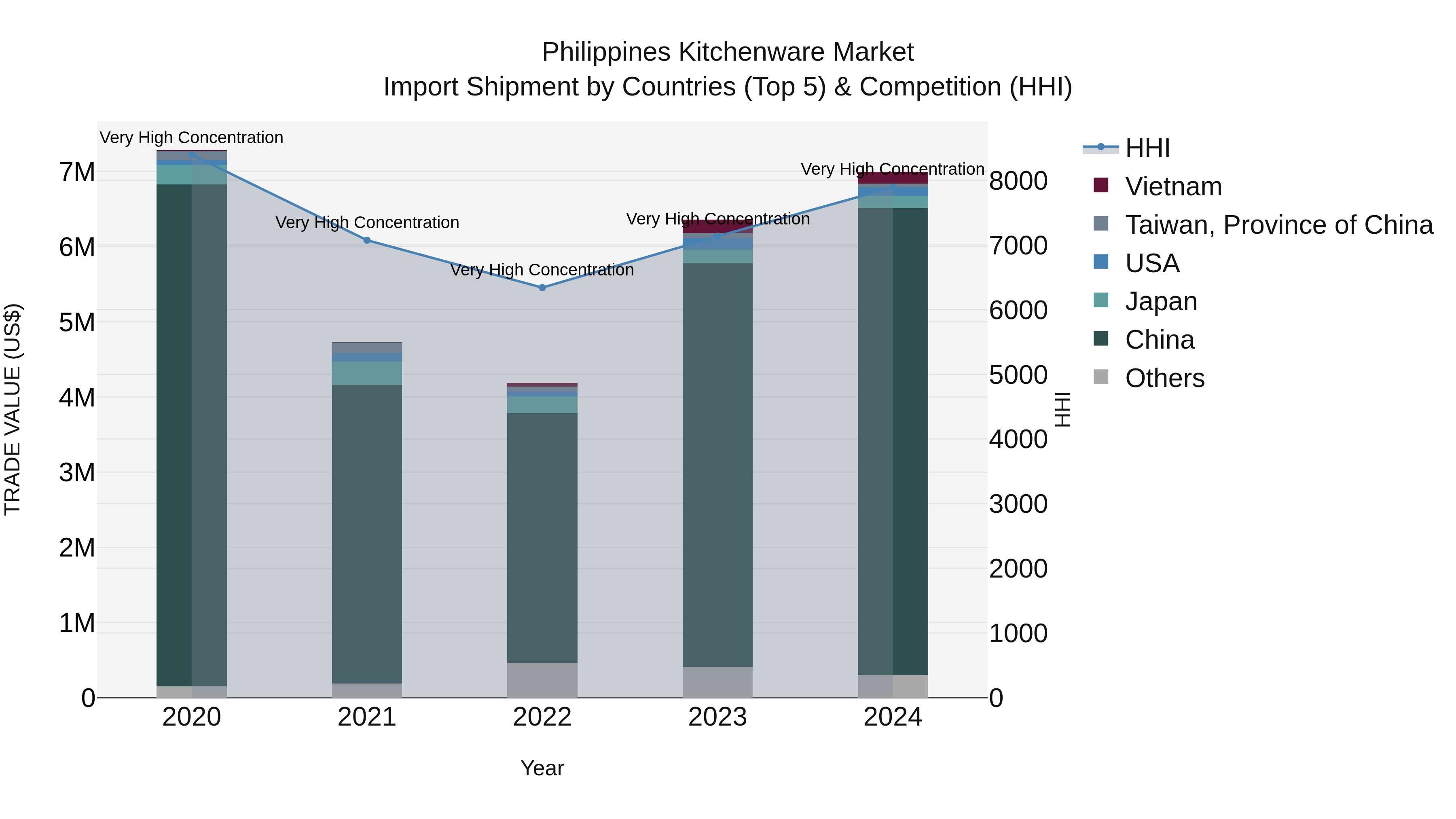
The Philippines kitchenware import market continues to be dominated by key players such as China, Japan, Vietnam, USA, and Hong Kong in 2024. Despite a negative CAGR of -1.0% from 2020 to 2024, there was a notable growth rate of 9.96% from 2023 to 2024. The high Herfindahl-Hirschman Index (HHI) indicates a concentrated market, suggesting potential challenges for new entrants. The steady growth rate in 2024 highlights ongoing opportunities for international suppliers to meet the demand for kitchenware products in the Philippines.
Kitchenware Market: Philippines vs Top 5 Major Economies in 2027 (Asia)
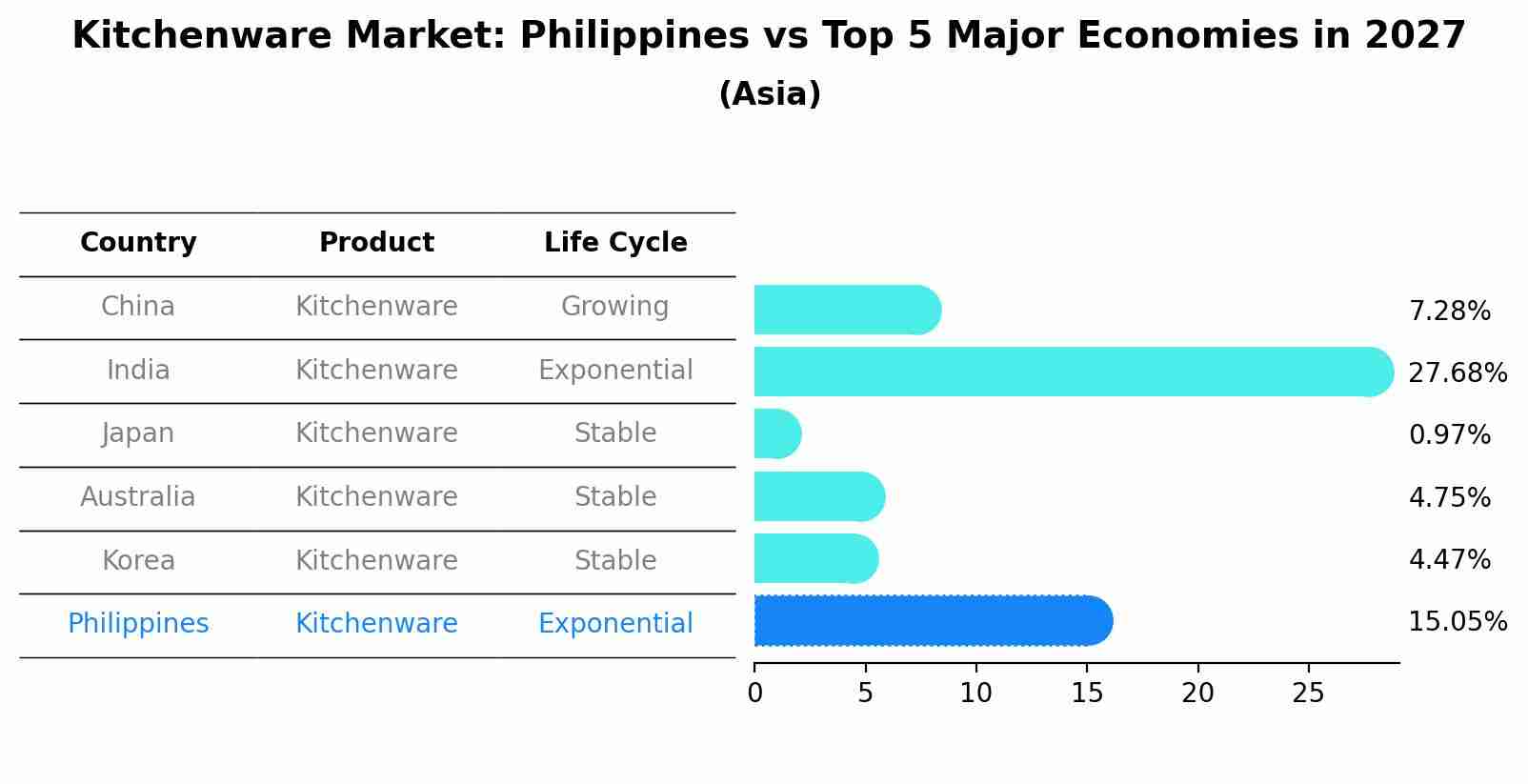
The Kitchenware market in Philippines is projected to grow at a exponential growth rate of 15.05% by 2027, within the Asia region led by China, along with other countries like India, Japan, Australia and South Korea, collectively shaping a dynamic and evolving market environment driven by innovation and increasing adoption of emerging technologies.
philippines kitchenware market Synopsis
Total market size of kitchenware in the Philippines was estimated to be around USD 619. 7 million in 2025 and is expected to grow at a compound annual growth rate (CAGR) of 3. 3% during the forecast period, reaching USD 758. 2 million by 2031. The sector has seen strong demand for stainless steel and aluminum cookwares, with both materials contributing more than 80% of total sales volume in 2025.
Drivers of the Market
The Philippines kitchenware market is anticipated to experience growth driven by changing consumer lifestyles, a rise in disposable incomes, and a growing interest in cooking and food preparation. Innovative and functional kitchenware products are likely to remain in demand as consumers seek convenience and efficiency in their culinary activities.
Challenges of the Market
The Philippines kitchenware market confronts challenges related to changing consumer preferences and competition from low-cost alternatives. Traditional kitchenware may face difficulties in adapting to modern cooking methods and styles, creating a demand for innovative and versatile products. Moreover, inexpensive imported kitchenware can dominate the market, posing a challenge for local manufacturers to differentiate themselves.
COVID-19 Impact on the Market
The Philippines kitchenware market experienced shifts in consumer preferences and buying patterns during the COVID-19 pandemic. As more people cooked at home, there was increased demand for kitchenware products. However, supply chain disruptions impacted the availability of certain items. The market is expected to adapt to changing consumer behaviors and preferences, with a continued focus on functional and durable kitchenware products.
Key Players in the Market
Key players like PQR Forging and STU StampWorks are driving the growth of the forging and stamping market in the Philippines. These companies are known for their extensive manufacturing capabilities, producing a diverse range of forged and stamped components for various industries such as automotive, aerospace, and construction. Their adherence to international quality standards and emphasis on precision engineering have earned them a competitive edge. By consistently delivering reliable and customized solutions, they have become integral partners for both local and international clients seeking high-quality forging and stamping services.
Key Highlights of the Report:
- Philippines Kitchenware Market Outlook
- Market Size of Philippines Kitchenware Market, 2024
- Forecast of Philippines Kitchenware Market, 2031
- Historical Data and Forecast of Philippines Kitchenware Revenues & Volume for the Period 2021-2031
- Philippines Kitchenware Market Trend Evolution
- Philippines Kitchenware Market Drivers and Challenges
- Philippines Kitchenware Price Trends
- Philippines Kitchenware Porter's Five Forces
- Philippines Kitchenware Industry Life Cycle
- Historical Data and Forecast of Philippines Kitchenware Market Revenues & Volume By Product Type for the Period 2021-2031
- Historical Data and Forecast of Philippines Kitchenware Market Revenues & Volume By Cookware for the Period 2021-2031
- Historical Data and Forecast of Philippines Kitchenware Market Revenues & Volume By Bakeware for the Period 2021-2031
- Historical Data and Forecast of Philippines Kitchenware Market Revenues & Volume By Others for the Period 2021-2031
- Historical Data and Forecast of Philippines Kitchenware Market Revenues & Volume By End User for the Period 2021-2031
- Historical Data and Forecast of Philippines Kitchenware Market Revenues & Volume By Residential Kitchen for the Period 2021-2031
- Historical Data and Forecast of Philippines Kitchenware Market Revenues & Volume By Commercial Kitchens for the Period 2021-2031
- Historical Data and Forecast of Philippines Kitchenware Market Revenues & Volume By Sales Channel for the Period 2021-2031
- Historical Data and Forecast of Philippines Kitchenware Market Revenues & Volume By Online for the Period 2021-2031
- Historical Data and Forecast of Philippines Kitchenware Market Revenues & Volume By Offline for the Period 2021-2031
- Philippines Kitchenware Import Export Trade Statistics
- Market Opportunity Assessment By Product Type
- Market Opportunity Assessment By End User
- Market Opportunity Assessment By Sales Channel
- Philippines Kitchenware Top Companies Market Share
- Philippines Kitchenware Competitive Benchmarking By Technical and Operational Parameters
- Philippines Kitchenware Company Profiles
- Philippines Kitchenware Key Strategic Recommendations






































