Philippines Lead Acid Market (2025-2031) | Challenges, Strategy, Revenue, Share, Opportunities, Growth, Demand, Segments, Consumer Insights, Strategic Insights, Segmentation, Competitive, Outlook, Investment Trends, Supply, Pricing Analysis, Companies, Forecast, Value, Drivers, Trends, Restraints, Analysis, Competition, Size, Industry
Market Forecast By Battery Type (Flooded Lead Acid, Sealed Lead Acid (SLA), Gel Cell, Absorbed Glass Mat (AGM), Deep Cycle), By Application (Automotive Starters, Uninterruptible Power Supplies (UPS), Solar Energy Storage, Electric Vehicles, Marine Applications), By Construction (Sealed, Vented, Maintenance-Free, Deep Cycle, Valve-Regulated), By Capacity Range (<50 Ah, 50-100 Ah, 100-200 Ah, 200-500 Ah, >500 Ah), By Charging Method (Constant Voltage, Constant Current, Trickle Charging, Float Charging, Fast Charging) And Competitive Landscape
| Product Code: ETC12644449 | Publication Date: Apr 2025 | Updated Date: Nov 2025 | Product Type: Market Research Report | |
| Publisher: 6Wresearch | Author: Ravi Bhandari | No. of Pages: 65 | No. of Figures: 34 | No. of Tables: 19 |
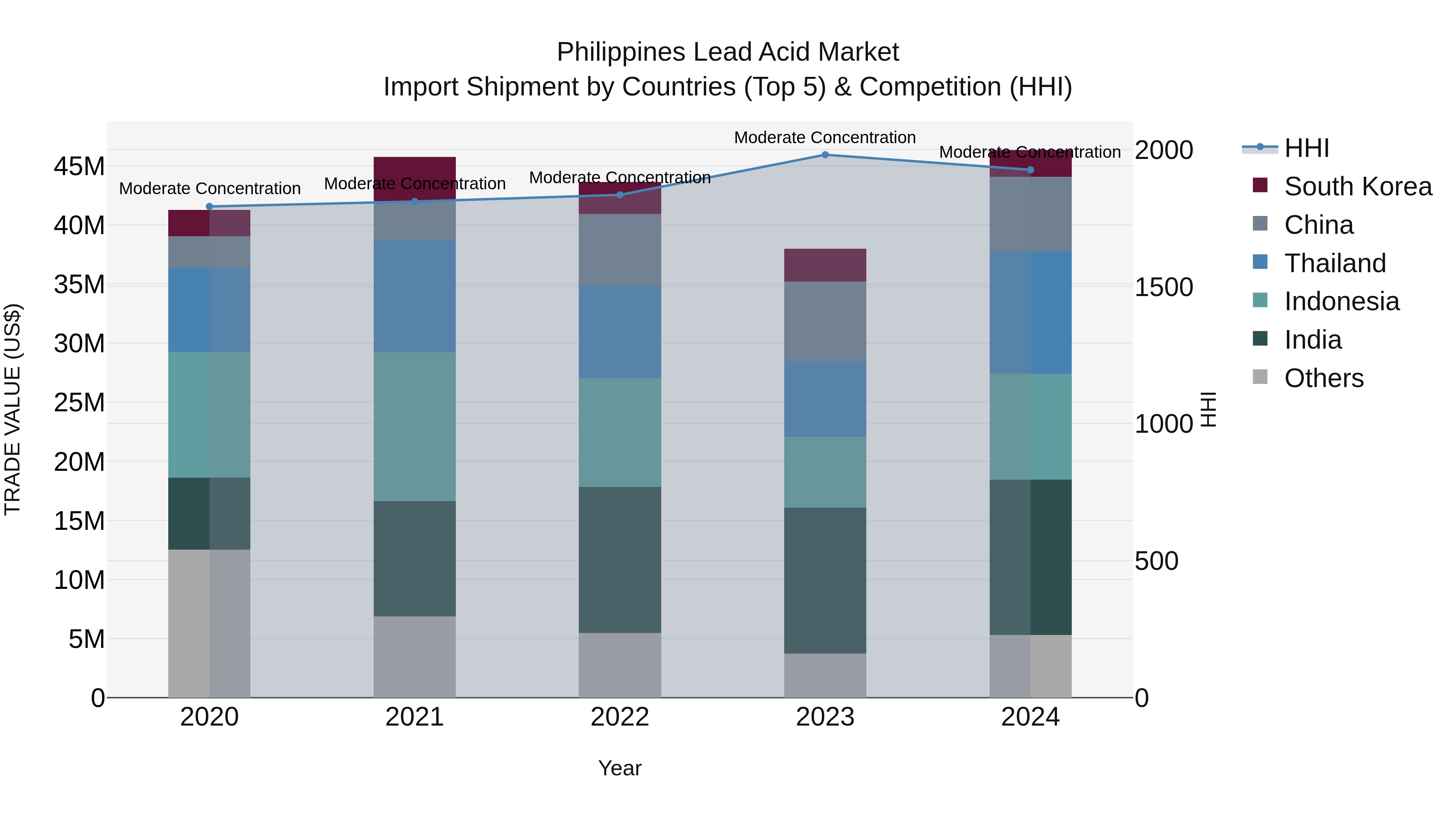
Philippines Lead Acid Market Top 5 Importing Countries and Market Competition (HHI) Analysis
In 2024, the Philippines saw significant lead acid import shipments from top countries including India, Thailand, Indonesia, China, and Japan. Despite moderate concentration, the market experienced steady growth with a CAGR of 2.94% from 2020 to 2024. A notable growth rate of 21.99% from 2023 to 2024 indicates a rising demand for lead acid imports in the Philippines, reflecting a positive trend in the market.
Philippines Lead Acid Market Growth Rate
According to 6Wresearch internal database and industry insights, the Philippines lead-acid battery market is projected to grow at a compound annual growth rate (CAGR) of approximately 6.7% from 2025 to 2031, fueled by increased demand from the telecommunication and industrial sectors as well as automotive usage.
Philippines Lead Acid Market Highlights
| Report Name | Philippines Lead Acid Market |
| Forecast Period | 2025 - 2031 |
| CAGR | 6.7% |
| Growing Sector | Automotive |
Topics Covered in the Philippines Lead Acid Market Report
The Philippines Lead Acid Market report thoroughly covers the market by Type, End-user, and Application. The report provides an unbiased and detailed analysis of the ongoing market trends, opportunities/high-growth areas, and market drivers to help stakeholders align their strategies with current and future market dynamics.
Philippines Lead Acid Market Synopsis
The Philippines lead-acid battery market is developing consistently, led by demand from telecom backups, solar installations, automotive starters, and eco-friendly EV mobility. For reasons of storage and safety, sealed lead-acid variants are the preferred choice. Recycling measures and government initiatives support domestic production. While competition from lithium-ion introduces hurdles, lead-acid maintains its cost-efficiency in major sectors, and prospects lie in sustainable production and waste management.
Philippines Lead Acid Market is anticipated to grow at a CAGR of 6.7% during the forecast period 2025-2031. The Philippines lead-acid battery market is driven by vigorous growth in the automotive industry, where starter batteries are crucial. The expanding industrial and telecommunication segment also has a high demand for lead-acid batteries requiring reliable backup power. Progress in renewable energy, including microgrids and solar, opens new avenues for stationary and deep-cycle lead‑acid batteries. There's a rise in sealed variants' preference (SLA/AGM) due to their advanced performance and safety in power storage applications.
Philippines Lead Acid Market Challenges
The Philippines lead-acid battery industry faces difficulties with increasing environmental issues caused by informal smelting operations and widespread improper recycling, which causes serious health and ecological threats. Regulatory enforcement gaps make compliance unstable, while hazardous waste regulations and export bans are weakly integrated. Meanwhile, increasing competition from AGM batteries and lithium-ion, along with uncertain raw material costs, restrains the benefits. Recycling infrastructure and high compliance costs also obstruct market expansion.
Philippines Lead Acid Market Trends
The Philippines lead‑acid battery market is trending toward sustainability and circular practices, centered on high recycling rates. Technological enhancements in AGM and VRLA (sealed) batteries are accelerating lifespan, charging efficiency, and energy density. Demand is driven by data centers, telecommunications, and renewable energy storage, while automotive starter batteries remain essential. In spite of the competition from lithium‑ion, steady replacement cycles and strong cost-effectiveness contribute to maintaining the relevance of lead‑acid in the standby and industrial power sectors.
Investment Opportunities in the Philippines Lead Acid Market
The Philippines lead-acid market provides attractive investment opportunities in lead-acid battery recycling, especially closed‑loop systems that reclaim nearly all lead and acid from spent units for reuse. The boost in opportunities in stationary and motive battery production is due to the increasing demand in UPS, industrial, telecom backup, and automotive starter applications. Local production incentives and circular economy initiatives support expansion into sealed (AGM/VRLA) and lead-carbon variants, which present differentiation in energy storage sectors.
Leading Players in the Philippines Lead Acid Market
The Philippines lead-acid battery market is dominated by Motolite, the prominent local brand in automotive batteries. Some other key players are Amaron, Panasonic, and Yuasa. In the industrial sector, global firms such as EnerSys, GS Yuasa, Exide, and Leoch supply batteries for UPS, telecom, and renewable backup. Developing local companies such as Altenergy and BatteryMate are also expanding robustly, propelled by increasing demand in energy storage and hybrid battery technologies.
Government Regulations in the Philippines Lead Acid Market
Government regulations play a significant role in shaping the lead acid market in the Philippines. Environmental policies aimed at reducing hazardous waste and stricter recycling laws have pushed manufacturers to adopt more sustainable practices. Initiatives such as mandatory recycling programs and restrictions on lead disposal ensure that the market adheres to globally recognized environmental standards. Additionally, taxation and import regulations directly influence the production and pricing dynamics of lead acid batteries. These policies not only protect the environment but also foster innovation in green battery technologies, encouraging local businesses to evolve in compliance with international norms.
Future Insights of the Philippines Lead Acid Market
The lead acid market in the Philippines is poised for steady growth in the coming years, driven by increasing demand in sectors such as automotive, energy storage, and telecommunications. The transition toward renewable energy sources presents significant opportunities for lead acid batteries, particularly in off-grid and backup energy systems. Furthermore, advancements in battery technology, such as improved life cycles and enhanced energy efficiency, are expected to enhance the market's competitiveness. While challenges related to environmental concerns persist, the government's regulatory measures and private sector investment in sustainability indicate a promising future for the industry.
Market Segmentation Analysis
The report offers a comprehensive study of the following market segments and their leading categories:
Sealed Lead Acid (SLA) batteries to Dominate the Market – By Type
According to Mansi Kaushik, Senior Research Analyst at 6Wresearch, Sealed Lead Acid (SLA) batteries are currently leading the Philippines Lead Acid Market due to their versatility, maintenance-free design, and safety features. These batteries are widely adopted across multiple industries, including automotive, solar energy systems, and emergency power supplies, owing to their reliability and adaptability to various requirements.
Solar Energy Storage to Dominate the Market – By Application
Solar Energy Storage stands out as the leading application in the Philippines Lead Acid Market. With the country's growing focus on renewable energy, lead acid batteries have become a critical component in storing solar power for off-grid systems. Their cost-effectiveness and durability make them an attractive choice for this emerging sector.
Valve-Regulated Lead Acid (VRLA) batteries to Emerge as a Key Segment – By Construction
Valve-Regulated Lead Acid (VRLA) batteries dominate the market by construction type. These batteries' leak-proof design, low maintenance requirements, and robust performance under various conditions have made them a preferred choice for both industrial and consumer applications.
Key Attractiveness of the Report
- 10 Years of Market Numbers.
- Historical Data Starting from 2021 to 2024.
- Base Year: 2024
- Forecast Data until 2031.
- Key Performance Indicators Impacting the Market.
- Major Upcoming Developments and Projects.
Key Highlights of the Report:
- Philippines Lead Acid Market Outlook
- Market Size of Philippines Lead Acid Market,2024
- Forecast of Philippines Lead Acid Market, 2031
- Historical Data and Forecast of Philippines Lead Acid Revenues & Volume for the Period 2021-2031
- Philippines Lead Acid Market Trend Evolution
- Philippines Lead Acid Market Drivers and Challenges
- Philippines Lead Acid Price Trends
- Philippines Lead Acid Porter's Five Forces
- Philippines Lead Acid Industry Life Cycle
- Historical Data and Forecast of Philippines Lead Acid Market Revenues & Volume By Battery Type for the Period 2021-2031
- Historical Data and Forecast of Philippines Lead Acid Market Revenues & Volume By Flooded Lead Acid for the Period 2021-2031
- Historical Data and Forecast of Philippines Lead Acid Market Revenues & Volume By Sealed Lead Acid (SLA) for the Period 2021-2031
- Historical Data and Forecast of Philippines Lead Acid Market Revenues & Volume By Gel Cell for the Period 2021-2031
- Historical Data and Forecast of Philippines Lead Acid Market Revenues & Volume By Absorbed Glass Mat (AGM) for the Period 2021-2031
- Historical Data and Forecast of Philippines Lead Acid Market Revenues & Volume By Deep Cycle for the Period 2021 - 2031
- Historical Data and Forecast of Philippines Lead Acid Market Revenues & Volume By Application for the Period 2021-2031
- Historical Data and Forecast of Philippines Lead Acid Market Revenues & Volume By Automotive Starters for the Period 2021-2031
- Historical Data and Forecast of Philippines Lead Acid Market Revenues & Volume By Uninterruptible Power Supplies (UPS) for the Period 2021-2031
- Historical Data and Forecast of Philippines Lead Acid Market Revenues & Volume By Solar Energy Storage for the Period 2021-2031
- Historical Data and Forecast of Philippines Lead Acid Market Revenues & Volume By Electric Vehicles for the Period 2021-2031
- Historical Data and Forecast of Philippines Lead Acid Market Revenues & Volume By Marine Applications for the Period 2021 - 2031
- Historical Data and Forecast of Philippines Lead Acid Market Revenues & Volume By Construction for the Period 2021-2031
- Historical Data and Forecast of Philippines Lead Acid Market Revenues & Volume By Sealed for the Period 2021-2031
- Historical Data and Forecast of Philippines Lead Acid Market Revenues & Volume By Vented for the Period 2021-2031
- Historical Data and Forecast of Philippines Lead Acid Market Revenues & Volume By Maintenance-Free for the Period 2021-2031
- Historical Data and Forecast of Philippines Lead Acid Market Revenues & Volume By Deep Cycle for the Period 2021-2031
- Historical Data and Forecast of Philippines Lead Acid Market Revenues & Volume By Valve-Regulated for the Period 2021 - 2031
- Historical Data and Forecast of Philippines Lead Acid Market Revenues & Volume By Capacity Range for the Period 2021-2031
- Historical Data and Forecast of Philippines Lead Acid Market Revenues & Volume By <50 Ah for the Period 2021-2031
- Historical Data and Forecast of Philippines Lead Acid Market Revenues & Volume By 50-100 Ah for the Period 2021-2031
- Historical Data and Forecast of Philippines Lead Acid Market Revenues & Volume By 100-200 Ah for the Period 2021-2031
- Historical Data and Forecast of Philippines Lead Acid Market Revenues & Volume By 200-500 Ah for the Period 2021-2031
- Historical Data and Forecast of Philippines Lead Acid Market Revenues & Volume By >500 Ah for the Period 2021 - 2031
- Historical Data and Forecast of Philippines Lead Acid Market Revenues & Volume By Charging Method for the Period 2021-2031
- Historical Data and Forecast of Philippines Lead Acid Market Revenues & Volume By Constant Voltage for the Period 2021-2031
- Historical Data and Forecast of Philippines Lead Acid Market Revenues & Volume By Constant Current for the Period 2021-2031
- Historical Data and Forecast of Philippines Lead Acid Market Revenues & Volume By Trickle Charging for the Period 2021-2031
- Historical Data and Forecast of Philippines Lead Acid Market Revenues & Volume By Float Charging for the Period 2021 - 2031
- Historical Data and Forecast of Philippines Lead Acid Market Revenues & Volume By Fast Charging for the Period 2021 - 2031
- Philippines Lead Acid Import Export Trade Statistics
- Market Opportunity Assessment By Battery Type
- Market Opportunity Assessment By Application
- Market Opportunity Assessment By Construction
- Market Opportunity Assessment By Capacity Range
- Market Opportunity Assessment By Charging Method
- Philippines Lead Acid Top Companies Market Share
- Philippines Lead Acid Competitive Benchmarking By Technical and Operational Parameters
- Philippines Lead Acid Company Profiles
- Philippines Lead Acid Key Strategic Recommendations
Market Segmentation
The Market report covers a detailed analysis of the following market segments:
By Type
- Flooded Lead Acid Batteries
- Sealed Lead Acid Batteries
By End User
- Automotive
- Oil & Gas
- Utilities
- Telecommunications
- Construction
- Marine
By Application
- Portable-Rechargeable
- Stationary
- Motive/Traction
Philippines Lead Acid Market (2025-2031) : FAQs
The Philippines Lead Acid market is expected to grow at a CAGR of approximately 6.7% between 2025 and 2031.
The Philippines lead-acid battery market is developing consistently, led by demand from telecom backups, solar installations, and automotive starters.
The Philippines lead-acid battery market is dominated by Motolite.
The Philippines lead‑acid battery market is trending toward sustainability and circular practices, centered on high recycling rates.
6Wresearch actively monitors the Philippines Lead Acid Market and publishes its comprehensive annual report, highlighting emerging trends, growth drivers, revenue analysis, and forecast outlook. Our insights help businesses to make data-backed strategic decisions with ongoing market dynamics. Our analysts track relevent industries related to the Philippines Lead Acid Market, allowing our clients with actionable intelligence and reliable forecasts tailored to emerging regional needs.
Yes, we provide customisation as per your requirements. To learn more, feel free to contact us on sales@6wresearch.com
| 1 Executive Summary |
| 2 Introduction |
| 2.1 Key Highlights of the Report |
| 2.2 Report Description |
| 2.3 Market Scope & Segmentation |
| 2.4 Research Methodology |
| 2.5 Assumptions |
| 3 Philippines Lead Acid Market Overview |
| 3.1 Philippines Country Macro Economic Indicators |
| 3.2 Philippines Lead Acid Market Revenues & Volume, 2021 & 2031F |
| 3.3 Philippines Lead Acid Market - Industry Life Cycle |
| 3.4 Philippines Lead Acid Market - Porter's Five Forces |
| 3.5 Philippines Lead Acid Market Revenues & Volume Share, By Battery Type, 2021 & 2031F |
| 3.6 Philippines Lead Acid Market Revenues & Volume Share, By Application, 2021 & 2031F |
| 3.7 Philippines Lead Acid Market Revenues & Volume Share, By Construction, 2021 & 2031F |
| 3.8 Philippines Lead Acid Market Revenues & Volume Share, By Capacity Range, 2021 & 2031F |
| 3.9 Philippines Lead Acid Market Revenues & Volume Share, By Charging Method, 2021 & 2031F |
| 4 Philippines Lead Acid Market Dynamics |
| 4.1 Impact Analysis |
| 4.2 Market Drivers |
| 4.2.1 Increasing demand for uninterrupted power supply in various industries |
| 4.2.2 Growth in the automotive sector driving the demand for lead-acid batteries |
| 4.2.3 Growing investments in renewable energy projects boosting the need for energy storage solutions |
| 4.3 Market Restraints |
| 4.3.1 Environmental concerns regarding lead-acid battery disposal and recycling |
| 4.3.2 Competition from alternative energy storage technologies such as lithium-ion batteries |
| 4.3.3 Volatility in lead prices impacting the overall production costs |
| 5 Philippines Lead Acid Market Trends |
| 6 Philippines Lead Acid Market, By Types |
| 6.1 Philippines Lead Acid Market, By Battery Type |
| 6.1.1 Overview and Analysis |
| 6.1.2 Philippines Lead Acid Market Revenues & Volume, By Battery Type, 2021 - 2031F |
| 6.1.3 Philippines Lead Acid Market Revenues & Volume, By Flooded Lead Acid, 2021 - 2031F |
| 6.1.4 Philippines Lead Acid Market Revenues & Volume, By Sealed Lead Acid (SLA), 2021 - 2031F |
| 6.1.5 Philippines Lead Acid Market Revenues & Volume, By Gel Cell, 2021 - 2031F |
| 6.1.6 Philippines Lead Acid Market Revenues & Volume, By Absorbed Glass Mat (AGM), 2021 - 2031F |
| 6.1.7 Philippines Lead Acid Market Revenues & Volume, By Deep Cycle, 2021 - 2031F |
| 6.2 Philippines Lead Acid Market, By Application |
| 6.2.1 Overview and Analysis |
| 6.2.2 Philippines Lead Acid Market Revenues & Volume, By Automotive Starters, 2021 - 2031F |
| 6.2.3 Philippines Lead Acid Market Revenues & Volume, By Uninterruptible Power Supplies (UPS), 2021 - 2031F |
| 6.2.4 Philippines Lead Acid Market Revenues & Volume, By Solar Energy Storage, 2021 - 2031F |
| 6.2.5 Philippines Lead Acid Market Revenues & Volume, By Electric Vehicles, 2021 - 2031F |
| 6.2.6 Philippines Lead Acid Market Revenues & Volume, By Marine Applications, 2021 - 2031F |
| 6.3 Philippines Lead Acid Market, By Construction |
| 6.3.1 Overview and Analysis |
| 6.3.2 Philippines Lead Acid Market Revenues & Volume, By Sealed, 2021 - 2031F |
| 6.3.3 Philippines Lead Acid Market Revenues & Volume, By Vented, 2021 - 2031F |
| 6.3.4 Philippines Lead Acid Market Revenues & Volume, By Maintenance-Free, 2021 - 2031F |
| 6.3.5 Philippines Lead Acid Market Revenues & Volume, By Deep Cycle, 2021 - 2031F |
| 6.3.6 Philippines Lead Acid Market Revenues & Volume, By Valve-Regulated, 2021 - 2031F |
| 6.4 Philippines Lead Acid Market, By Capacity Range |
| 6.4.1 Overview and Analysis |
| 6.4.2 Philippines Lead Acid Market Revenues & Volume, By <50 Ah, 2021 - 2031F |
| 6.4.3 Philippines Lead Acid Market Revenues & Volume, By 50-100 Ah, 2021 - 2031F |
| 6.4.4 Philippines Lead Acid Market Revenues & Volume, By 100-200 Ah, 2021 - 2031F |
| 6.4.5 Philippines Lead Acid Market Revenues & Volume, By 200-500 Ah, 2021 - 2031F |
| 6.4.6 Philippines Lead Acid Market Revenues & Volume, By >500 Ah, 2021 - 2031F |
| 6.5 Philippines Lead Acid Market, By Charging Method |
| 6.5.1 Overview and Analysis |
| 6.5.2 Philippines Lead Acid Market Revenues & Volume, By Constant Voltage, 2021 - 2031F |
| 6.5.3 Philippines Lead Acid Market Revenues & Volume, By Constant Current, 2021 - 2031F |
| 6.5.4 Philippines Lead Acid Market Revenues & Volume, By Trickle Charging, 2021 - 2031F |
| 6.5.5 Philippines Lead Acid Market Revenues & Volume, By Float Charging, 2021 - 2031F |
| 6.5.6 Philippines Lead Acid Market Revenues & Volume, By Fast Charging, 2021 - 2031F |
| 7 Philippines Lead Acid Market Import-Export Trade Statistics |
| 7.1 Philippines Lead Acid Market Export to Major Countries |
| 7.2 Philippines Lead Acid Market Imports from Major Countries |
| 8 Philippines Lead Acid Market Key Performance Indicators |
| 8.1 Average selling price (ASP) of lead-acid batteries |
| 8.2 Number of new industrial projects requiring uninterrupted power supply |
| 8.3 Adoption rate of lead-acid batteries in the automotive sector |
| 8.4 Percentage of lead-acid battery recycling rates |
| 8.5 Investment inflow in renewable energy projects utilizing lead-acid batteries |
| 9 Philippines Lead Acid Market - Opportunity Assessment |
| 9.1 Philippines Lead Acid Market Opportunity Assessment, By Battery Type, 2021 & 2031F |
| 9.2 Philippines Lead Acid Market Opportunity Assessment, By Application, 2021 & 2031F |
| 9.3 Philippines Lead Acid Market Opportunity Assessment, By Construction, 2021 & 2031F |
| 9.4 Philippines Lead Acid Market Opportunity Assessment, By Capacity Range, 2021 & 2031F |
| 9.5 Philippines Lead Acid Market Opportunity Assessment, By Charging Method, 2021 & 2031F |
| 10 Philippines Lead Acid Market - Competitive Landscape |
| 10.1 Philippines Lead Acid Market Revenue Share, By Companies, 2024 |
| 10.2 Philippines Lead Acid Market Competitive Benchmarking, By Operating and Technical Parameters |
| 11 Company Profiles |
| 12 Recommendations |
| 13 Disclaimer |
Export potential assessment - trade Analytics for 2030
Export potential enables firms to identify high-growth global markets with greater confidence by combining advanced trade intelligence with a structured quantitative methodology. The framework analyzes emerging demand trends and country-level import patterns while integrating macroeconomic and trade datasets such as GDP and population forecasts, bilateral import–export flows, tariff structures, elasticity differentials between developed and developing economies, geographic distance, and import demand projections. Using weighted trade values from 2020–2024 as the base period to project country-to-country export potential for 2030, these inputs are operationalized through calculated drivers such as gravity model parameters, tariff impact factors, and projected GDP per-capita growth. Through an analysis of hidden potentials, demand hotspots, and market conditions that are most favorable to success, this method enables firms to focus on target countries, maximize returns, and global expansion with data, backed by accuracy.
By factoring in the projected importer demand gap that is currently unmet and could be potential opportunity, it identifies the potential for the Exporter (Country) among 190 countries, against the general trade analysis, which identifies the biggest importer or exporter.
To discover high-growth global markets and optimize your business strategy:
Click Here
Pricing
- Single User License$ 1,995
- Department License$ 2,400
- Site License$ 3,120
- Global License$ 3,795

Search
Thought Leadership and Analyst Meet





Our Clients








Latest Reports
- Taiwan Food Delivery Platform Market (2026-2032) | Companies, Outlook, Analysis, Trends, Value, Revenue, Segmentation, Share, Forecast, Competitive Landscape, Growth, Size & Forecast
- United Kingdom (UK) Long-term Care Insurance Market (2026-2032) | Growth, Share, Consumer Insights, Drivers, Opportunities, Competition, Pricing Analysis, Segments, Restraints, Companies, Competitive, Value, Outlook, Size, Demand, Analysis, Challenges, Strategic Insights, Investment Trends, Revenue, Trends, Supply, Forecast
- United Kingdom (UK) Long Term Care Market (2026-2032) | Companies, Outlook, Analysis, Trends, Value, Revenue, Segmentation, Share, Forecast, Competitive Landscape, Growth, Size & Forecast
- Iraq Insulation and Waterproofing Market (2026-2032) | Outlook, Drivers, Growth, Size, Share, Industry, Revenue, Trends, Demand, Competitive, Strategic Insights, Opportunities, Segments, Companies, Challenges, Strategy, Consumer Insights, Analysis, Investment Trends, Value, Segmentation, Forecast, Restraints
- India Switchgear Market Outlook (2026-2032) | Size, Share, Trends, Growth, Revenue, Forecast, Analysis, Value, Outlook
- Pakistan Contraceptive Implants Market (2025-2031) | Demand, Growth, Size, Share, Industry, Pricing Analysis, Competitive, Strategic Insights, Strategy, Consumer Insights, Analysis, Investment Trends, Opportunities, Revenue, Segments, Value, Segmentation, Supply, Forecast, Restraints, Outlook, Competition, Drivers, Trends, Companies, Challenges
- Sri Lanka Packaging Market (2026-2032) | Outlook, Competition, Drivers, Trends, Demand, Pricing Analysis, Competitive, Strategic Insights, Companies, Challenges, Strategy, Consumer Insights, Analysis, Investment Trends, Opportunities, Growth, Size, Share, Industry, Revenue, Segments, Value, Segmentation, Supply, Forecast, Restraints
- India Kids Watches Market (2026-2032) | Strategy, Consumer Insights, Analysis, Investment Trends, Opportunities, Growth, Size, Share, Industry, Revenue, Segments, Value, Segmentation, Supply, Forecast, Restraints, Outlook, Competition, Drivers, Trends, Demand, Pricing Analysis, Competitive, Strategic Insights, Companies, Challenges
- Saudi Arabia Core Assurance Service Market (2025-2031) | Strategy, Consumer Insights, Analysis, Investment Trends, Opportunities, Growth, Size, Share, Industry, Revenue, Segments, Value, Segmentation, Supply, Forecast, Restraints, Outlook, Competition, Drivers, Trends, Demand, Pricing Analysis, Competitive, Strategic Insights, Companies, Challenges
- Romania Uninterruptible Power Supply (UPS) Market (2026-2032) | Industry, Analysis, Revenue, Size, Forecast, Outlook, Value, Trends, Share, Growth & Companies
Industry Events and Analyst Meet

India EV Show 2026

EV tech India Expo 2026

Auto Tech Asia 2026
Battery Tech India 2026

Smart Production Solutions Guangzhou 2026
Whitepaper
- Middle East & Africa Commercial Security Market Click here to view more.
- Middle East & Africa Fire Safety Systems & Equipment Market Click here to view more.
- GCC Drone Market Click here to view more.
- Middle East Lighting Fixture Market Click here to view more.
- GCC Physical & Perimeter Security Market Click here to view more.
6WResearch In News
- Doha a strategic location for EV manufacturing hub: IPA Qatar
- Demand for luxury TVs surging in the GCC, says Samsung
- Empowering Growth: The Thriving Journey of Bangladesh’s Cable Industry
- Demand for luxury TVs surging in the GCC, says Samsung
- Video call with a traditional healer? Once unthinkable, it’s now common in South Africa
- Intelligent Buildings To Smooth GCC’s Path To Net Zero


