Philippines Limonene Market Top 5 Importing Countries and Market Competition (HHI) Analysis
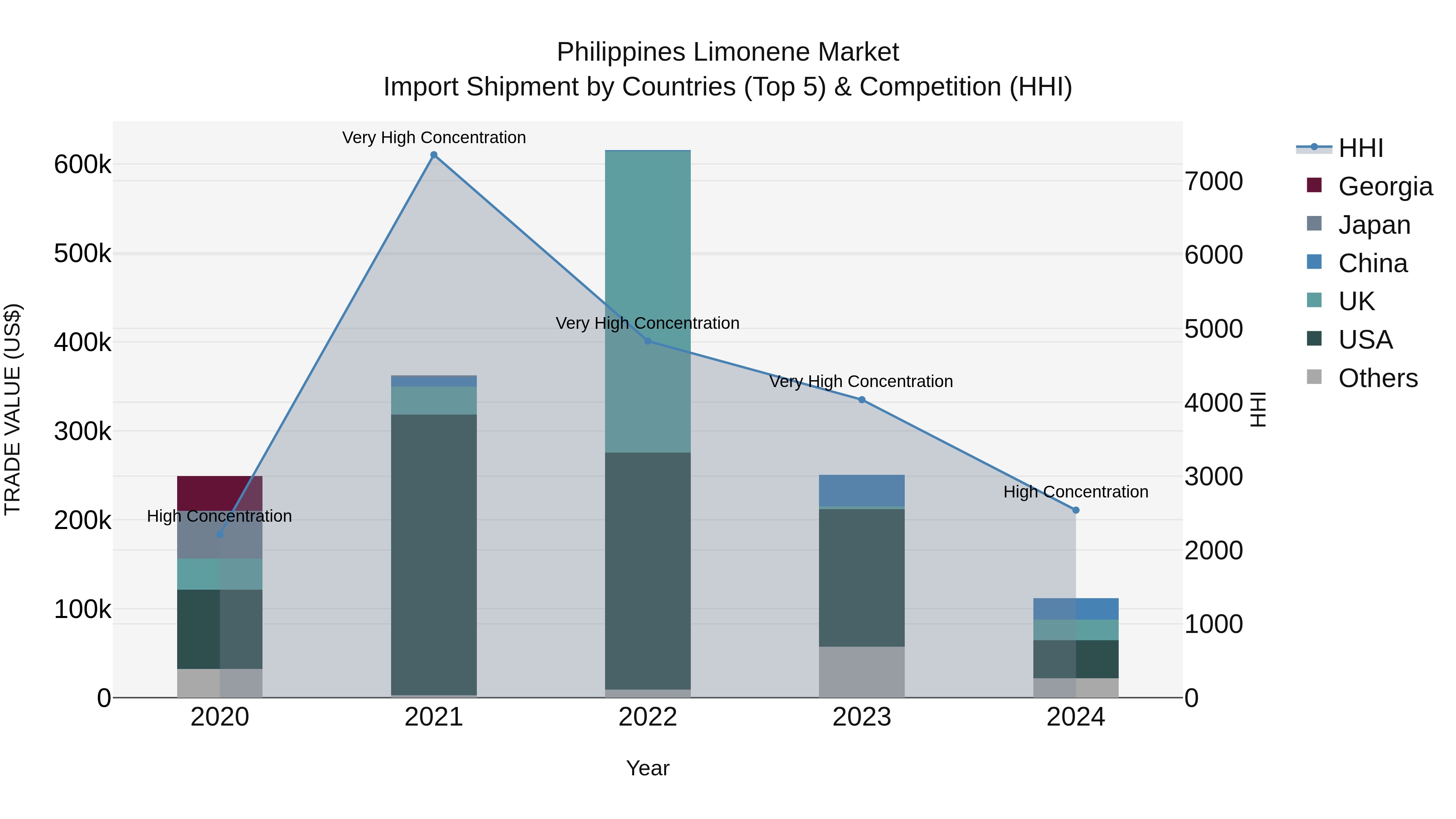
The Philippines saw a notable decline in limonene import shipments from 2023 to 2024, with a high concentration of imports coming from top exporting countries such as the USA, China, UK, Spain, and India. Despite the challenging market conditions, the Herfindahl-Hirschman Index (HHI) indicated a shift from very high concentration in 2023 to high concentration in 2024. The compound annual growth rate (CAGR) from 2020 to 2024 was -18.14%, with a significant growth rate decline of -55.33% from 2023 to 2024, reflecting a challenging period for the limonene import market in the Philippines.
Philippines Limonene Market Overview
The limonene market in the Philippines is expanding due to its applications in cleaning products, cosmetics, and pharmaceuticals. Limonene, a natural citrus-derived compound, is valued for its solvent properties and pleasant aroma. The rising demand for eco-friendly and bio-based chemicals is driving market growth. However, fluctuations in citrus production and supply chain challenges impact market stability.
Drivers of the market
The increasing demand for natural and bio-based chemicals in personal care, food, and pharmaceutical industries is propelling the limonene market in the Philippines. Limonene, derived from citrus peels, is widely used in cleaning products, fragrances, and medicinal applications. The shift towards organic and chemical-free consumer goods is further fueling market growth.
Challenges of the market
The limonene market faces supply chain and cost-related challenges. Extracting limonene from citrus peels requires efficient processing facilities, which are limited in the Philippines. Additionally, fluctuating citrus production due to climate conditions affects raw material availability. The competition from synthetic solvents and alternative bio-based chemicals also limits market expansion.
Investment opportunities in the Market
Limonene, a naturally occurring compound, has growing applications in cosmetics, cleaning products, and pharmaceuticals. Investment opportunities lie in extraction, formulation, and distribution of limonene-based products. With increasing consumer preference for natural ingredients, the market is poised for expansion.
Government Policy of the market
The DA and DTI regulate limonene production and importation, ensuring compliance with food safety and industrial standards. Policies support local cultivation of citrus crops to boost domestic limonene extraction. Trade agreements facilitate the export of limonene-based products while maintaining strict quality control.
Key Highlights of the Report:
- Philippines Limonene Market Outlook
- Market Size of Philippines Limonene Market, 2024
- Forecast of Philippines Limonene Market, 2031
- Historical Data and Forecast of Philippines Limonene Revenues & Volume for the Period 2021- 2031
- Philippines Limonene Market Trend Evolution
- Philippines Limonene Market Drivers and Challenges
- Philippines Limonene Price Trends
- Philippines Limonene Porter's Five Forces
- Philippines Limonene Industry Life Cycle
- Historical Data and Forecast of Philippines Limonene Market Revenues & Volume By Source for the Period 2021- 2031
- Historical Data and Forecast of Philippines Limonene Market Revenues & Volume By Oranges for the Period 2021- 2031
- Historical Data and Forecast of Philippines Limonene Market Revenues & Volume By Lemons for the Period 2021- 2031
- Historical Data and Forecast of Philippines Limonene Market Revenues & Volume By Mandarin for the Period 2021- 2031
- Historical Data and Forecast of Philippines Limonene Market Revenues & Volume By Others for the Period 2021- 2031
- Historical Data and Forecast of Philippines Limonene Market Revenues & Volume By Application for the Period 2021- 2031
- Historical Data and Forecast of Philippines Limonene Market Revenues & Volume By Food & beverages for the Period 2021- 2031
- Historical Data and Forecast of Philippines Limonene Market Revenues & Volume By Pharmaceutical for the Period 2021- 2031
- Historical Data and Forecast of Philippines Limonene Market Revenues & Volume By Cosmetics & Personal care for the Period 2021- 2031
- Historical Data and Forecast of Philippines Limonene Market Revenues & Volume By Others for the Period 2021- 2031
- Philippines Limonene Import Export Trade Statistics
- Market Opportunity Assessment By Source
- Market Opportunity Assessment By Application
- Philippines Limonene Top Companies Market Share
- Philippines Limonene Competitive Benchmarking By Technical and Operational Parameters
- Philippines Limonene Company Profiles
- Philippines Limonene Key Strategic Recommendations






































