Philippines Low Density Polyethylene Ldpe Market Top 5 Importing Countries and Market Competition (HHI) Analysis
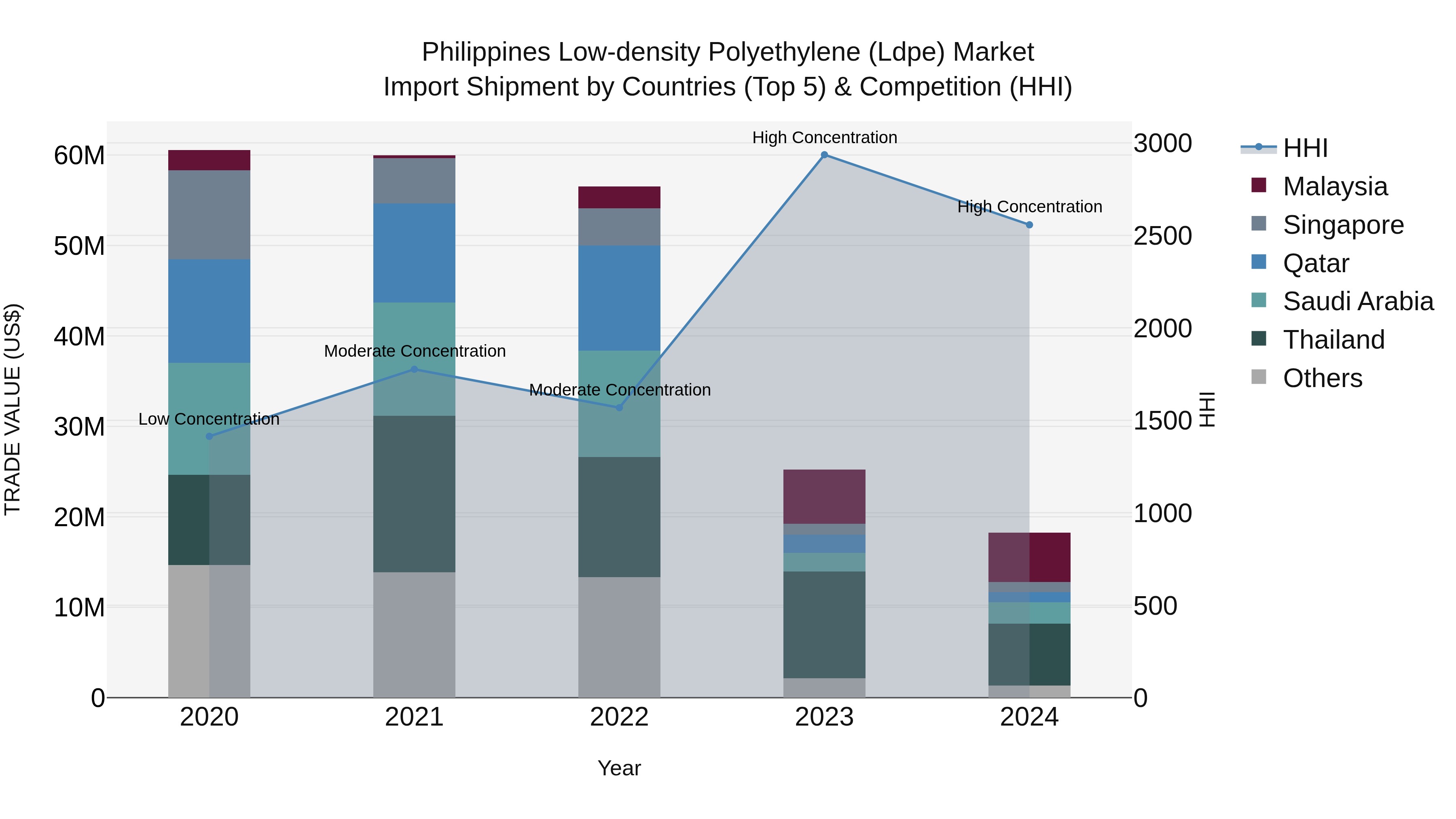
The low-density polyethylene (LDPE) import market in the Philippines in 2024 saw consistent top exporters including Thailand, Malaysia, and Saudi Arabia, indicating established trade relationships. Despite a negative compound annual growth rate (CAGR) of -25.89% from 2020 to 2024, the high Herfindahl-Hirschman Index (HHI) suggests a concentrated market. The growth rate drop from 2023 to 2024 by -27.63% highlights potential challenges or shifts in demand. The market may benefit from diversification strategies to mitigate risks associated with high concentration and negative growth trends.
Philippines Low-Density Polyethylene (LDPE) Market Overview
The LDPE market in the Philippines is expanding due to its widespread use in packaging, construction, and agriculture. LDPE is favored for its flexibility, durability, and moisture resistance, making it ideal for plastic bags, films, and coatings. Growth in the retail and food packaging industries is driving demand. However, environmental concerns regarding plastic waste and increasing regulations on single-use plastics pose challenges to market growth.
Drivers of the market
The growing demand for flexible and lightweight packaging solutions is fueling the LDPE market in the Philippines. Industries such as food and beverage, pharmaceuticals, and agriculture are major consumers of LDPE for packaging applications. The increasing focus on sustainable and recyclable plastics is also influencing market trends. Additionally, infrastructure development and construction activities are driving the demand for LDPE in piping, insulation, and waterproofing materials.
Challenges of the market
The LDPE market in the Philippines is impacted by the growing push for sustainable packaging alternatives. Government regulations on plastic waste reduction pose challenges for traditional LDPE applications. Additionally, fluctuating crude oil prices affect raw material costs, leading to pricing volatility in the market.
Investment opportunities in the Market
The growing demand for flexible packaging, construction materials, and agricultural films is fueling the LDPE market in the Philippines. Industries rely on LDPE for its durability, moisture resistance, and cost-effectiveness. Investment opportunities exist in local LDPE production, recycling initiatives, and bio-based alternatives. Government regulations on plastic waste management and sustainability trends further shape market dynamics. However, raw material price volatility and environmental concerns over plastic usage may pose challenges. Companies focusing on sustainable LDPE solutions can align with regulatory requirements and market demand.
Government Policy of the market
The Philippine government enforces environmental regulations affecting the production and use of LDPE. The Department of Environment and Natural Resources (DENR) has implemented policies under the Ecological Solid Waste Management Act, pushing for sustainable plastic use and waste reduction. Import restrictions and local manufacturing incentives are also in place to regulate the supply chain and encourage eco-friendly alternatives. The government is supporting research into biodegradable and recyclable plastics, which impacts the future of LDPE use in packaging and industrial applications.
Key Highlights of the Report:
- Philippines Low-Density Polyethylene (LDPE) Market Outlook
- Market Size of Philippines Low-Density Polyethylene (LDPE) Market, 2024
- Forecast of Philippines Low-Density Polyethylene (LDPE) Market, 2031
- Historical Data and Forecast of Philippines Low-Density Polyethylene (LDPE) Revenues & Volume for the Period 2021- 2031
- Philippines Low-Density Polyethylene (LDPE) Market Trend Evolution
- Philippines Low-Density Polyethylene (LDPE) Market Drivers and Challenges
- Philippines Low-Density Polyethylene (LDPE) Price Trends
- Philippines Low-Density Polyethylene (LDPE) Porter's Five Forces
- Philippines Low-Density Polyethylene (LDPE) Industry Life Cycle
- Historical Data and Forecast of Philippines Low-Density Polyethylene (LDPE) Market Revenues & Volume By Product Type for the Period 2021- 2031
- Historical Data and Forecast of Philippines Low-Density Polyethylene (LDPE) Market Revenues & Volume By Blow Molded for the Period 2021- 2031
- Historical Data and Forecast of Philippines Low-Density Polyethylene (LDPE) Market Revenues & Volume By Sheets and Films for the Period 2021- 2031
- Historical Data and Forecast of Philippines Low-Density Polyethylene (LDPE) Market Revenues & Volume By Injection Molded for the Period 2021- 2031
- Historical Data and Forecast of Philippines Low-Density Polyethylene (LDPE) Market Revenues & Volume By Extrusion Coating for the Period 2021- 2031
- Historical Data and Forecast of Philippines Low-Density Polyethylene (LDPE) Market Revenues & Volume By Other Product types for the Period 2021- 2031
- Historical Data and Forecast of Philippines Low-Density Polyethylene (LDPE) Market Revenues & Volume By End-user Industry for the Period 2021- 2031
- Historical Data and Forecast of Philippines Low-Density Polyethylene (LDPE) Market Revenues & Volume By Agriculture for the Period 2021- 2031
- Historical Data and Forecast of Philippines Low-Density Polyethylene (LDPE) Market Revenues & Volume By Automotive for the Period 2021- 2031
- Historical Data and Forecast of Philippines Low-Density Polyethylene (LDPE) Market Revenues & Volume By Electrical and Electronics for the Period 2021- 2031
- Historical Data and Forecast of Philippines Low-Density Polyethylene (LDPE) Market Revenues & Volume By Packaging for the Period 2021- 2031
- Historical Data and Forecast of Philippines Low-Density Polyethylene (LDPE) Market Revenues & Volume By Construction for the Period 2021- 2031
- Historical Data and Forecast of Philippines Low-Density Polyethylene (LDPE) Market Revenues & Volume By Healthcare for the Period 2021- 2031
- Historical Data and Forecast of Philippines Low-Density Polyethylene (LDPE) Market Revenues & Volume By Other End-user Industries for the Period 2021- 2031
- Philippines Low-Density Polyethylene (LDPE) Import Export Trade Statistics
- Market Opportunity Assessment By Product Type
- Market Opportunity Assessment By End-user Industry
- Philippines Low-Density Polyethylene (LDPE) Top Companies Market Share
- Philippines Low-Density Polyethylene (LDPE) Competitive Benchmarking By Technical and Operational Parameters
- Philippines Low-Density Polyethylene (LDPE) Company Profiles
- Philippines Low-Density Polyethylene (LDPE) Key Strategic Recommendations






































