Philippines Maize Seed Market Top 5 Importing Countries and Market Competition (HHI) Analysis
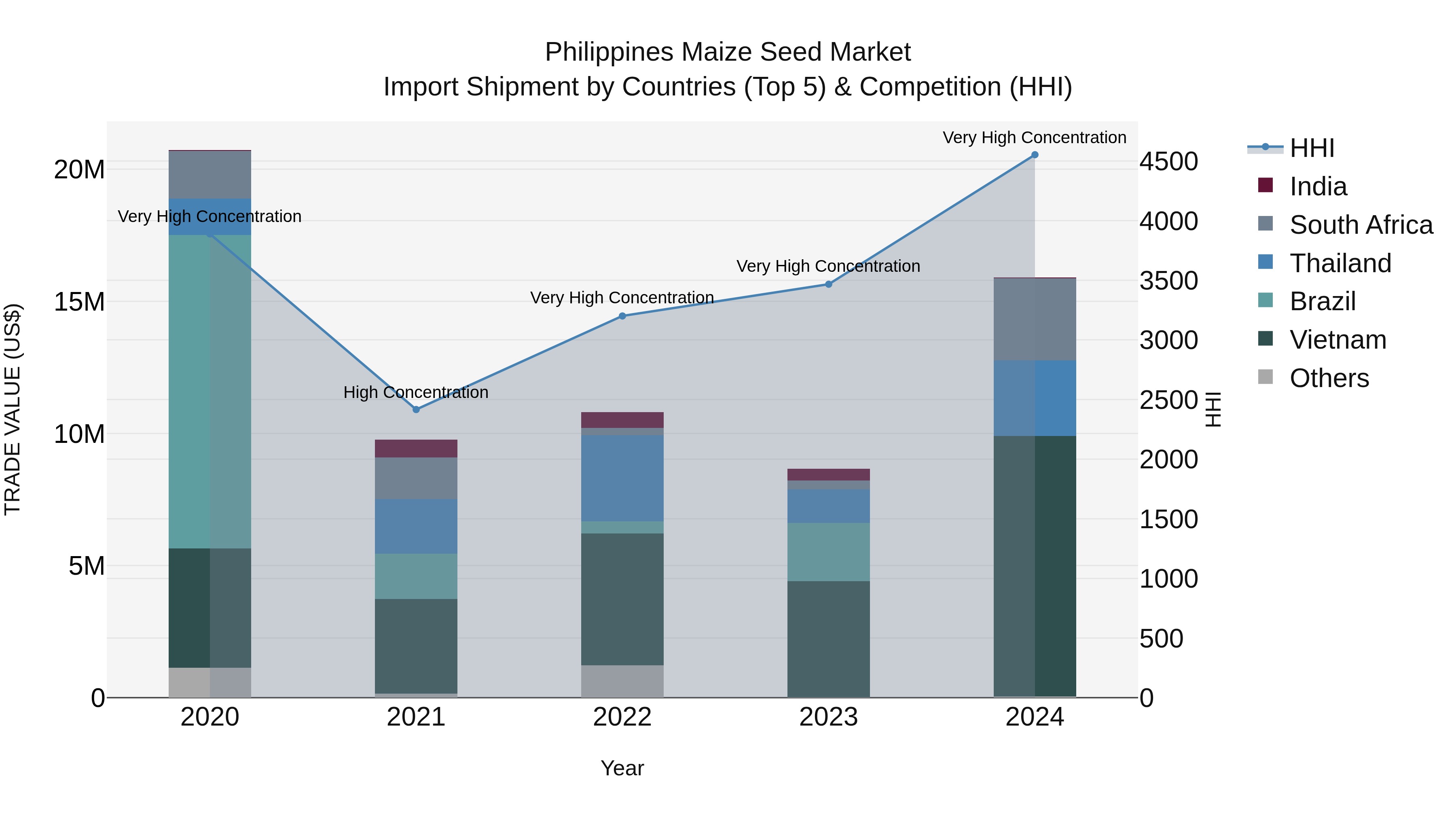
The Philippines maize seed import market in 2024 continued to be dominated by key suppliers such as Vietnam, South Africa, Thailand, Indonesia, and India. Despite a negative Compound Annual Growth Rate (CAGR) from 2020 to 2024, the market experienced a significant growth spurt in 2024 with a growth rate of 83.49% from the previous year. However, the high Herfindahl-Hirschman Index (HHI) indicates a very concentrated market, suggesting potential challenges for market competition and pricing dynamics in the coming years.
Philippines Maize Seed Market Overview
The maize seed market in the Philippines is expanding as the agricultural sector embraces high-yield and genetically modified (GM) seed varieties. Maize is a staple crop in the country, and advancements in seed technology are improving productivity and resistance to pests and diseases. Government support for sustainable farming and the adoption of hybrid seeds are further boosting market growth. However, concerns over GM crops and climate variability impact the sector.
Drivers of the market
The growing demand for maize as a staple food and feed in the Philippines is a primary driver of the maize seed market. The increasing focus on agricultural productivity and food security is pushing farmers to adopt high-yield, drought-resistant, and pest-resistant maize seeds. Government initiatives and subsidies aimed at promoting sustainable farming practices and enhancing crop yields are further driving the demand for improved maize seed varieties.
Challenges of the market
The maize seed market in the Philippines faces issues related to climate change and declining soil fertility, which impact crop yields. Farmers also struggle with the high cost of genetically modified and hybrid seeds, limiting accessibility. Additionally, inadequate government support for agricultural research and development affects seed innovation and distribution.
Investment opportunities in the Market
Agriculture remains a critical sector in the Philippines, and maize production plays a significant role in food security and livestock feed. Investment opportunities exist in the development and distribution of high-yield, pest-resistant maize seed varieties. Companies can also invest in research and development of genetically modified maize to improve yield efficiency and sustainability. Expansion of seed processing and storage facilities can further enhance supply chain efficiency.
Government Policy of the market
Agricultural policies in the Philippines prioritize maize production through subsidies and technical support programs under the Department of Agriculture (DA). The government promotes genetically modified (GM) maize to improve yield and pest resistance while ensuring compliance with biosafety regulations. The National Seed Industry Council (NSIC) oversees seed certification and distribution to maintain high-quality seed availability.
Key Highlights of the Report:
- Philippines Maize Seed Market Outlook
- Market Size of Philippines Maize Seed Market, 2024
- Forecast of Philippines Maize Seed Market, 2031
- Historical Data and Forecast of Philippines Maize Seed Revenues & Volume for the Period 2021- 2031
- Philippines Maize Seed Market Trend Evolution
- Philippines Maize Seed Market Drivers and Challenges
- Philippines Maize Seed Price Trends
- Philippines Maize Seed Porter's Five Forces
- Philippines Maize Seed Industry Life Cycle
- Historical Data and Forecast of Philippines Maize Seed Market Revenues & Volume By Breeding Technology for the Period 2021- 2031
- Historical Data and Forecast of Philippines Maize Seed Market Revenues & Volume By Hybrids for the Period 2021- 2031
- Historical Data and Forecast of Philippines Maize Seed Market Revenues & Volume By Open Pollinated Varities for the Period 2021- 2031
- Philippines Maize Seed Import Export Trade Statistics
- Market Opportunity Assessment By Breeding Technology
- Philippines Maize Seed Top Companies Market Share
- Philippines Maize Seed Competitive Benchmarking By Technical and Operational Parameters
- Philippines Maize Seed Company Profiles
- Philippines Maize Seed Key Strategic Recommendations






































