Philippines Melamine Market Top 5 Importing Countries and Market Competition (HHI) Analysis
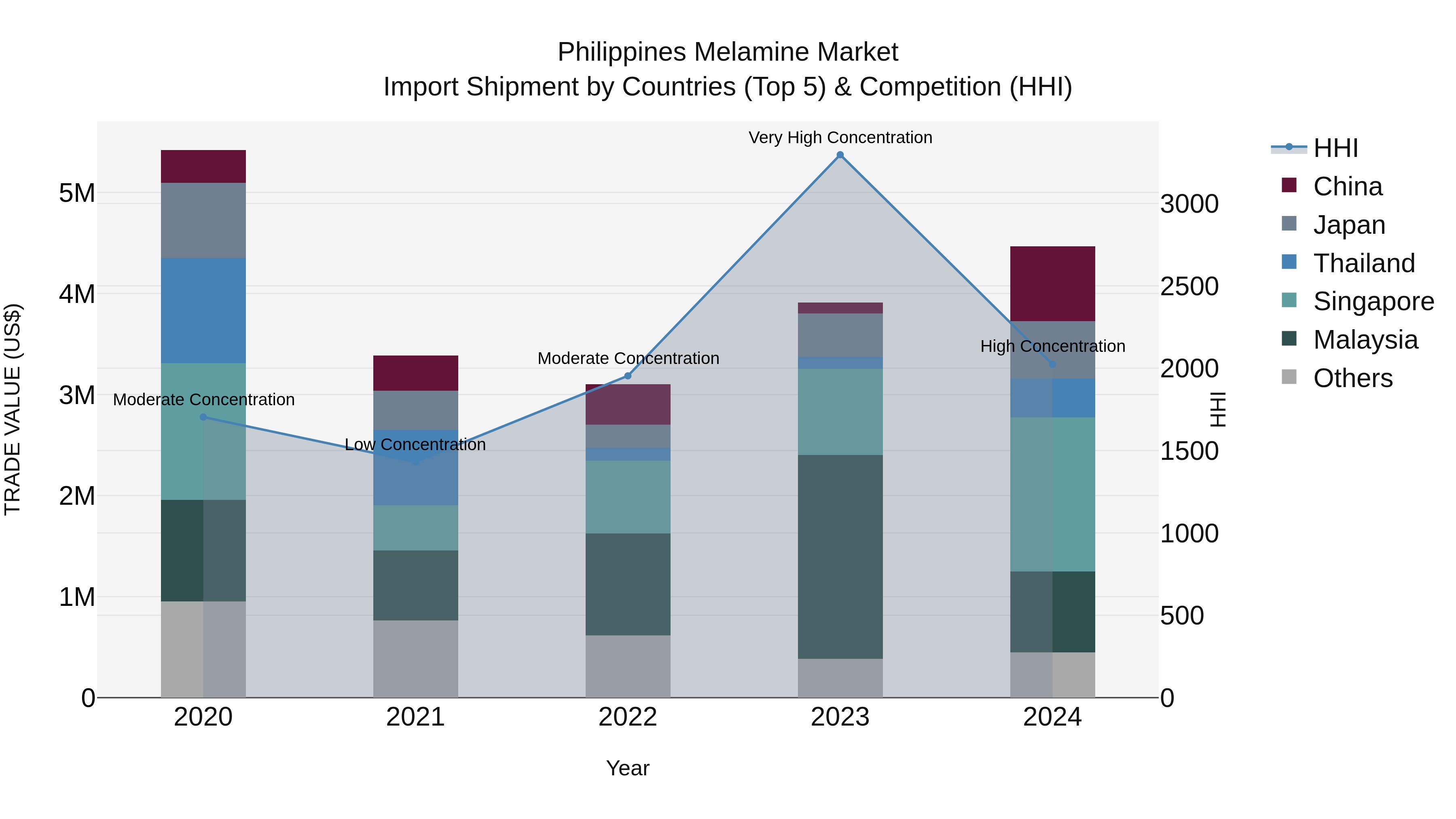
Philippines` melamine import shipments in 2024 saw a notable increase in concentration, with top exporters being Singapore, Malaysia, China, Japan, and Thailand. Despite a negative CAGR from 2020-24, the market experienced a significant growth rate of 14.13% from 2023-24. This shift in concentration indicates a potential change in market dynamics and could present new opportunities for businesses operating in the melamine import sector in the Philippines.
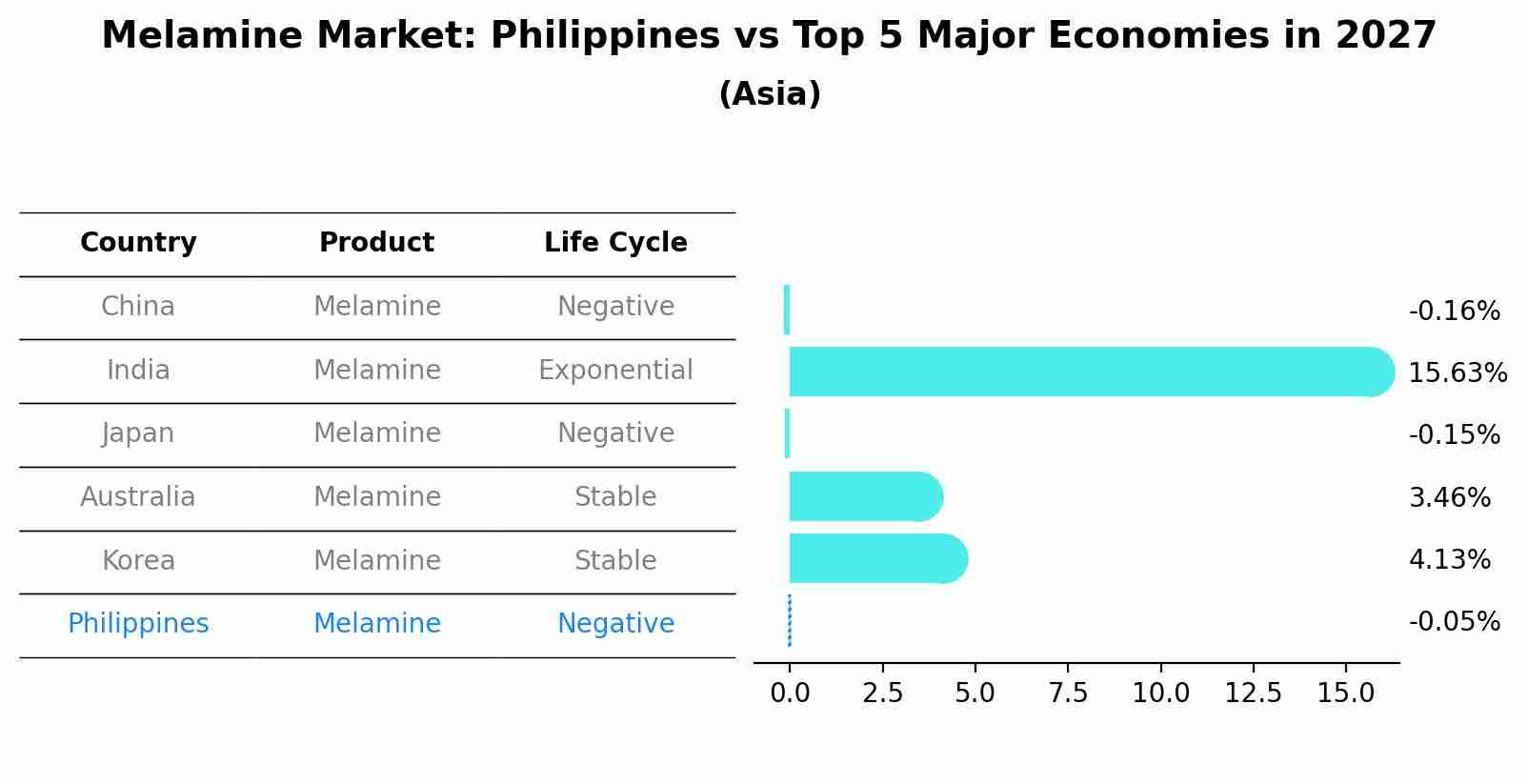
Melamine Market: Philippines vs Top 5 Major Economies in 2027 (Asia)
By 2027, the Melamine market in Philippines is anticipated to reach a growth rate of -0.05%, as part of an increasingly competitive Asia region, where China remains at the forefront, supported by India, Japan, Australia and South Korea, driving innovations and market adoption across sectors.
Philippines Melamine Market Synopsis
The Philippines melamine market is expected to register a CAGR of 5.5%, reaching US$ 27 million mfrom US$ 20 million driven primarily by increasing usage of melamine resins for production of laminated boards used extensively for manufacturing furniture items and decorative laminates which are increasingly being used across residential sector especially in urban areas where there is increase trend towards modularization and home interior decoration activities taking place due to higher disposable incomes amongst middle class population group leading to new demand sources for this product type within country?s economy. Growing construction activities coupled with rising preference towards ecofriendly materials across commercial buildings have further propelled the growth prospects for this product type over forecast period.
Drivers of the market
The Philippines melamine market is integral to industries like plastics, adhesives, and furniture manufacturing, offering a versatile chemical used in the production of durable and heat-resistant materials. The market`s growth is driven by the construction and home improvement sectors, where melamine-based products such as laminates and decorative panels are widely used. The demand for functional and aesthetically appealing materials in interior design, furniture, and building materials contributes to the market`s expansion.
Challenges of the market
The Philippines melamine market is essential for industries like plastics, textiles, and furniture manufacturing. A significant challenge in this market is the association of melamine with food safety concerns. Melamine has been linked to health issues when used improperly in food products. Ensuring strict compliance with regulations, using melamine for approved applications, and providing accurate information to consumers are critical to addressing these challenges and maintaining the market`s integrity.
Covid-19 Impact of the market
The Philippines melamine market serves industries like construction, furniture, and food packaging, offering a versatile chemical compound used in laminates, coatings, and food-grade containers. The COVID-19 pandemic influenced this market due to disruptions in manufacturing and construction activities. Lockdowns and restrictions affected the demand for products like furniture and construction materials. However, the market demonstrated adaptability by catering to changing consumer needs, such as the increased demand for safe and hygienic food packaging solutions. As the economy rebounds, the market is anticipated to recover while responding to evolving consumer preferences.
Key Players of the market
Key players in the Philippines Melamine market are dedicated to the chemical and manufacturing sectors. Melamine is used in the production of plastics, resins, and household items. Companies such as MelamineChem Industries, ResinTech Solutions, and HouseholdMold Innovations contribute to producing and supplying melamine, supporting various manufacturing processes and product applications.
Key Highlights of the Report:
- Philippines Melamine Market Outlook
- Market Size of Philippines Melamine Market, 2024
- Forecast of Philippines Melamine Market, 2031
- Historical Data and Forecast of Philippines Melamine Revenues & Volume for the Period 2021-2031
- Philippines Melamine Market Trend Evolution
- Philippines Melamine Market Drivers and Challenges
- Philippines Melamine Price Trends
- Philippines Melamine Porter's Five Forces
- Philippines Melamine Industry Life Cycle
- Historical Data and Forecast of Philippines Melamine Market Revenues & Volume By Forms for the Period 2021-2031
- Historical Data and Forecast of Philippines Melamine Market Revenues & Volume By Melamine Resin for the Period 2021-2031
- Historical Data and Forecast of Philippines Melamine Market Revenues & Volume By Melamine Foams for the Period 2021-2031
- Historical Data and Forecast of Philippines Melamine Market Revenues & Volume By Applications for the Period 2021-2031
- Historical Data and Forecast of Philippines Melamine Market Revenues & Volume By Laminates for the Period 2021-2031
- Historical Data and Forecast of Philippines Melamine Market Revenues & Volume By Wood Adhesives for the Period 2021-2031
- Historical Data and Forecast of Philippines Melamine Market Revenues & Volume By Surface Coatings for the Period 2021-2031
- Historical Data and Forecast of Philippines Melamine Market Revenues & Volume By Thermoset Plastics for the Period 2021-2031
- Historical Data and Forecast of Philippines Melamine Market Revenues & Volume By End-users for the Period 2021-2031
- Historical Data and Forecast of Philippines Melamine Market Revenues & Volume By Construction for the Period 2021-2031
- Historical Data and Forecast of Philippines Melamine Market Revenues & Volume By Chemical for the Period 2021-2031
- Historical Data and Forecast of Philippines Melamine Market Revenues & Volume By Textile for the Period 2021-2031
- Historical Data and Forecast of Philippines Melamine Market Revenues & Volume By Automotive for the Period 2021-2031
- Philippines Melamine Import Export Trade Statistics
- Market Opportunity Assessment By Forms
- Market Opportunity Assessment By Applications
- Market Opportunity Assessment By End-users
- Philippines Melamine Top Companies Market Share
- Philippines Melamine Competitive Benchmarking By Technical and Operational Parameters
- Philippines Melamine Company Profiles
- Philippines Melamine Key Strategic Recommendations






































