Philippines Mobility Scooter Market Top 5 Importing Countries and Market Competition (HHI) Analysis
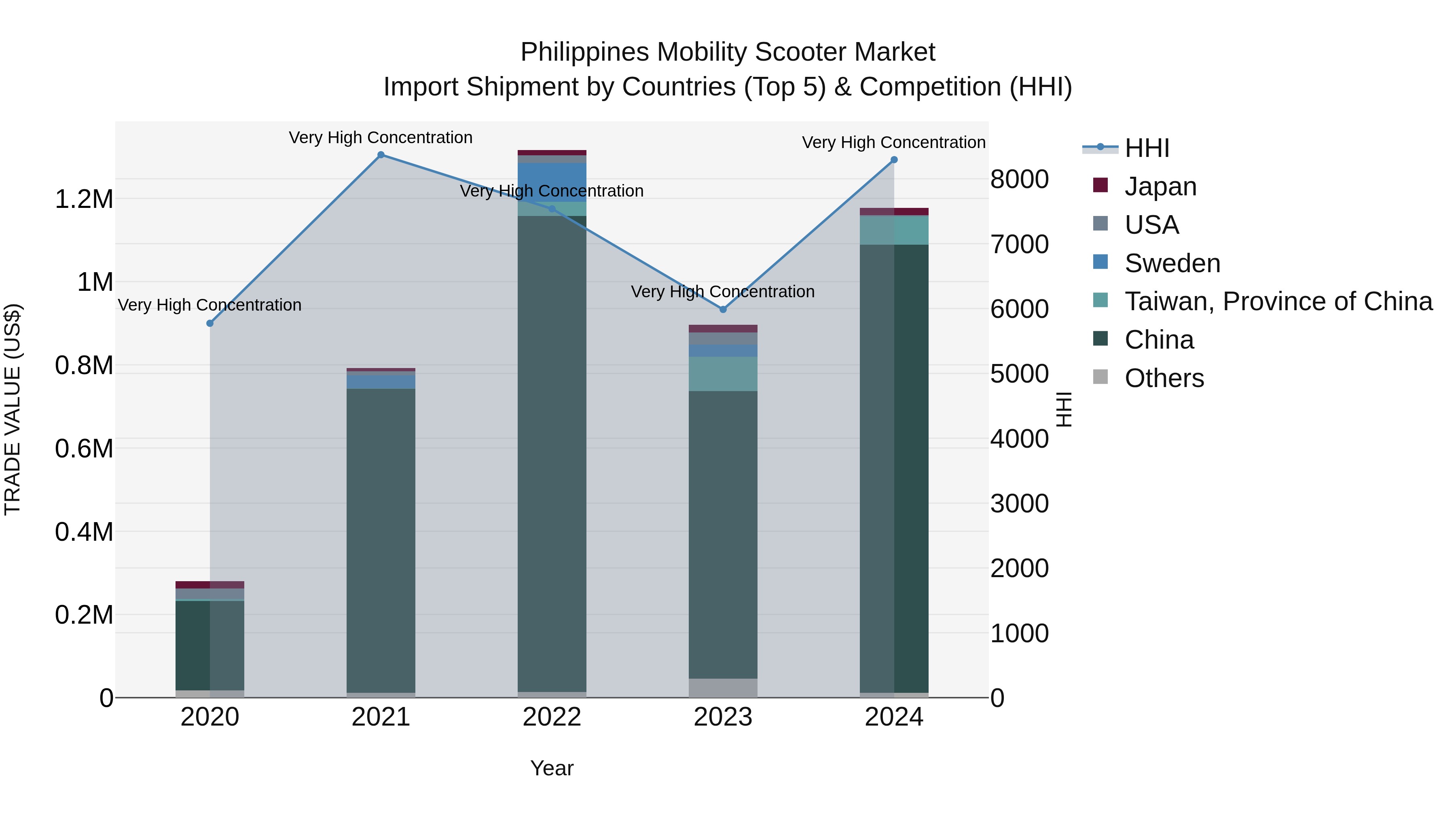
The Philippines saw a significant increase in mobility scooter imports in 2024, with top exporters being China, Taiwan, Japan, UK, and Germany. Despite high concentration with a high Herfindahl-Hirschman Index (HHI), the market continued to grow rapidly with a remarkable CAGR of 43.14% from 2020 to 2024. The growth rate in 2024 alone stood at 31.28%, indicating a strong demand for mobility scooters in the Philippines. This trend highlights the importance of these key exporting countries in meeting the mobility needs of the population in the Philippines.
Philippines Mobility Scooter Market Overview
The mobility scooter market in the Philippines is expanding as more elderly individuals and people with disabilities seek independence and ease of movement. Compact and battery-powered scooters are becoming popular due to their convenience and affordability. Healthcare accessibility programs and the availability of customized mobility solutions are contributing to market expansion.
Drivers of the market
The demand for independent mobility solutions among the elderly and disabled population is fueling the mobility scooter market in the Philippines. Improvements in battery life, portability, and comfort are making mobility scooters more attractive for users. Additionally, government support for disability inclusion and accessibility initiatives is further promoting market growth.
Challenges of the market
The adoption of mobility scooters in the Philippines is hindered by inadequate infrastructure, affordability concerns, and limited public awareness. Many areas lack proper accessibility features such as ramps and smooth pathways, making it difficult for mobility scooter users to navigate public spaces.
Investment opportunities in the Market
The increasing number of elderly and disabled individuals seeking independence is driving demand for mobility scooters. Investment opportunities lie in compact, foldable, and battery-efficient scooters designed for urban and rural use. Businesses that focus on affordability, durability, and smart mobility features such as GPS tracking and remote diagnostics can capitalize on this expanding market.
Government Policy of the market
The Land Transportation Office (LTO) regulates the use of mobility scooters in public areas. Government policies encourage the adoption of electric mobility scooters through incentives and import tax reductions. Safety regulations require manufacturers to meet international quality standards, ensuring user safety and product durability.
Key Highlights of the Report:
- Philippines Mobility Scooter Market Outlook
- Market Size of Philippines Mobility Scooter Market, 2024
- Forecast of Philippines Mobility Scooter Market, 2031
- Historical Data and Forecast of Philippines Mobility Scooter Revenues & Volume for the Period 2021- 2031
- Philippines Mobility Scooter Market Trend Evolution
- Philippines Mobility Scooter Market Drivers and Challenges
- Philippines Mobility Scooter Price Trends
- Philippines Mobility Scooter Porter's Five Forces
- Philippines Mobility Scooter Industry Life Cycle
- Historical Data and Forecast of Philippines Mobility Scooter Market Revenues & Volume By Type for the Period 2021- 2031
- Historical Data and Forecast of Philippines Mobility Scooter Market Revenues & Volume By Small (Less than 110cm) for the Period 2021- 2031
- Historical Data and Forecast of Philippines Mobility Scooter Market Revenues & Volume By Medium (110-150cm) for the Period 2021- 2031
- Historical Data and Forecast of Philippines Mobility Scooter Market Revenues & Volume By Large (More than 150cm) for the Period 2021- 2031
- Historical Data and Forecast of Philippines Mobility Scooter Market Revenues & Volume By Application for the Period 2021- 2031
- Historical Data and Forecast of Philippines Mobility Scooter Market Revenues & Volume By In-House for the Period 2021- 2031
- Historical Data and Forecast of Philippines Mobility Scooter Market Revenues & Volume By Outdoor for the Period 2021- 2031
- Historical Data and Forecast of Philippines Mobility Scooter Market Revenues & Volume By Off-Road for the Period 2021- 2031
- Historical Data and Forecast of Philippines Mobility Scooter Market Revenues & Volume By Number of Wheels for the Period 2021- 2031
- Historical Data and Forecast of Philippines Mobility Scooter Market Revenues & Volume By Three Wheels for the Period 2021- 2031
- Historical Data and Forecast of Philippines Mobility Scooter Market Revenues & Volume By Four Wheels for the Period 2021- 2031
- Historical Data and Forecast of Philippines Mobility Scooter Market Revenues & Volume By Others for the Period 2021- 2031
- Historical Data and Forecast of Philippines Mobility Scooter Market Revenues & Volume By Battery Range for the Period 2021- 2031
- Historical Data and Forecast of Philippines Mobility Scooter Market Revenues & Volume By Less than 10 Miles for the Period 2021- 2031
- Historical Data and Forecast of Philippines Mobility Scooter Market Revenues & Volume By 10-20 Miles for the Period 2021- 2031
- Historical Data and Forecast of Philippines Mobility Scooter Market Revenues & Volume By More than 20 Miles for the Period 2021- 2031
- Historical Data and Forecast of Philippines Mobility Scooter Market Revenues & Volume By End use for the Period 2021- 2031
- Historical Data and Forecast of Philippines Mobility Scooter Market Revenues & Volume By Personal Use for the Period 2021- 2031
- Historical Data and Forecast of Philippines Mobility Scooter Market Revenues & Volume By Institutional Use for the Period 2021- 2031
- Philippines Mobility Scooter Import Export Trade Statistics
- Market Opportunity Assessment By Type
- Market Opportunity Assessment By Application
- Market Opportunity Assessment By Number of Wheels
- Market Opportunity Assessment By Battery Range
- Market Opportunity Assessment By End use
- Philippines Mobility Scooter Top Companies Market Share
- Philippines Mobility Scooter Competitive Benchmarking By Technical and Operational Parameters
- Philippines Mobility Scooter Company Profiles
- Philippines Mobility Scooter Key Strategic Recommendations






































