Philippines Modular Kitchen Market Top 5 Importing Countries and Market Competition (HHI) Analysis
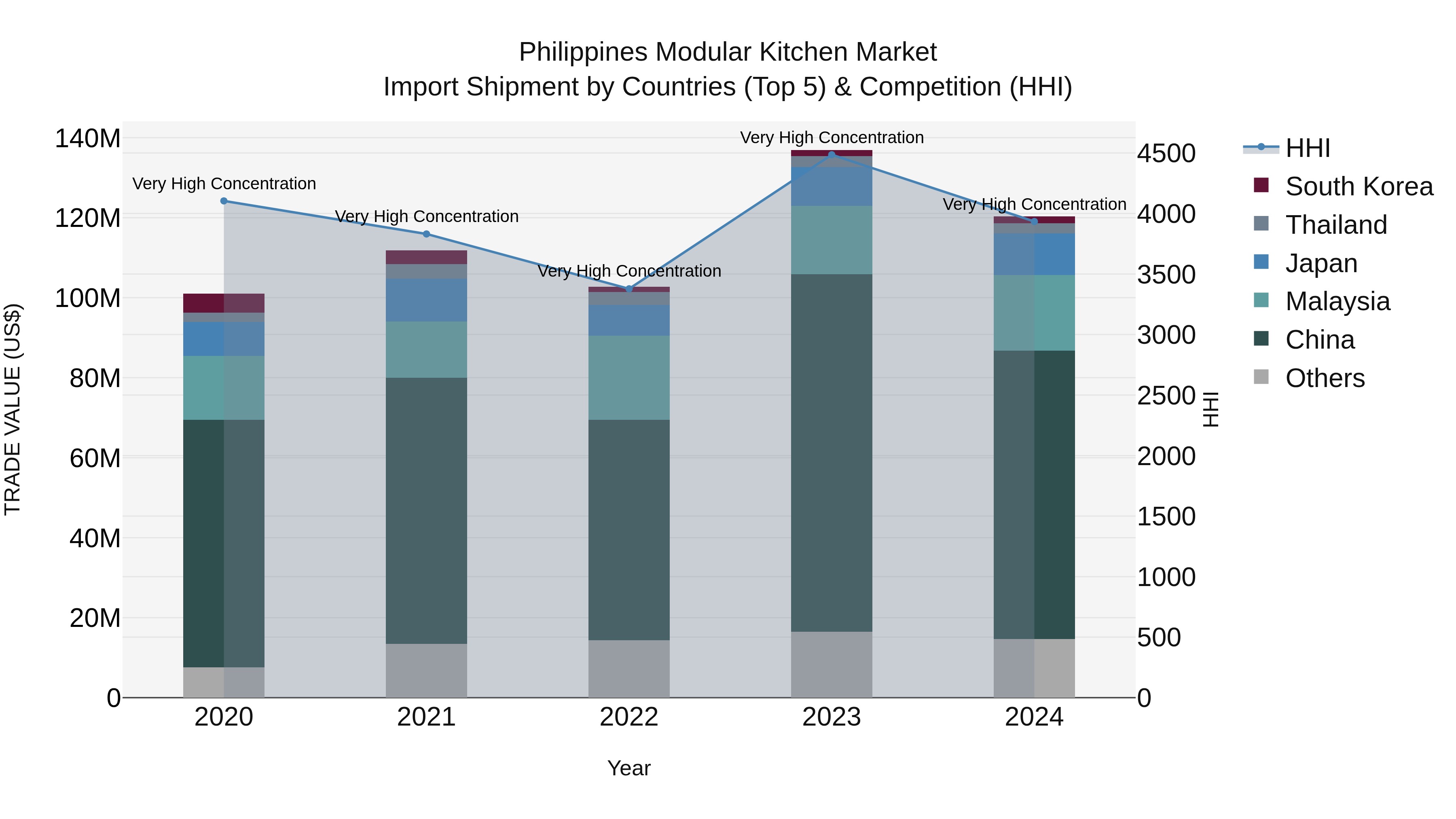
In 2024, the Philippines continued to see significant import shipments of modular kitchens, with top exporters being China, Malaysia, Japan, Singapore, and Thailand. Despite high concentration with a high Herfindahl-Hirschman Index (HHI), the industry showed steady growth with a compound annual growth rate (CAGR) of 4.48% from 2020 to 2024. However, there was a slight decline in growth rate from 2023 to 2024 at -12.07%. This data indicates a competitive market landscape for modular kitchen imports in the Philippines, with opportunities for further expansion and diversification in the future.
Philippines Modular Kitchen Market Growth Rate
According to 6Wresearch internal database and industry insights, the Philippines Modular Kitchen Market is projected to grow at a compound annual growth rate (CAGR) of 7.6% during the forecast period (2026-2032).
Topics Covered in the Philippines Modular Kitchen Market Report
The Philippines Modular Kitchen Market report thoroughly covers the market by product type, end-user, and distribution channel. The market report provides an unbiased and detailed analysis of ongoing market trends, opportunities/high growth areas, and market drivers, which help stakeholders devise and align their market strategies according to the current and future market dynamics.
Philippines Modular Kitchen Market Highlights
| Report Name | Philippines Modular Kitchen Market |
| Forecast Period | 2026–2032 |
| CAGR | 7.6% |
| Growing Sector | Residential |
Philippines Modular Kitchen Market Synopsis
Philippines Modular Kitchen Market is anticipated to record notable growth due to rapid urbanization, increasing residential construction, and rising consumer preference for organized and space-efficient kitchen layouts. The growing number of condominium developments in major cities is encouraging the adoption of compact and functional modular kitchen systems. Also, more people are looking for beautiful and unique kitchen solutions because their disposable incomes are going up and their lifestyle goals are changing. The expansion of organized home improvement retailers and the availability of affordable modular designs are further improving accessibility and encouraging wider adoption across urban households.
Evaluation of Growth Drivers in the Philippines Modular Kitchen Market
Below mentioned are some prominent drivers and their influence on the market dynamics:
| Drivers | Primary Segments Affected | Why it Matters (Evidence) |
| Rising Urban Housing Development | Floor & Wall Cabinets; Residential | Growing condominium projects increase demand for compact modular kitchens. |
| Increasing Home Renovation Trends | All Products; Residential | Homeowners are upgrading kitchens for functionality and aesthetics. |
| Growth in Organized Retail | All Types; Offline Stores | Showrooms and retail chains improve product visibility and customer confidence. |
| Rising Disposable Income | Premium Cabinets; Residential | Higher spending power supports demand for customized solutions. |
| Expansion of Real Estate Sector | All Products; Residential & Commercial | New residential and hospitality projects drive installation demand. |
Philippines Modular Kitchen Market is expected to grow at the CAGR of 7.6% during the forecast period of 2026-2032. Growth is being driven by more homes being built, more people moving to cities, and more people being interested in modern home interiors. The expanding middle-income segment is encouraging investment in functional and aesthetically appealing kitchen spaces. Additionally, the development of organized retail networks and design consultation services is improving consumer awareness and product accessibility.
Evaluation of Restraints in the Philippines Modular Kitchen Market
Below mentioned are some major restraints and their influence on the market dynamics:
| Restraints | Primary Segments Affected | What This Means (Evidence) |
| High Initial Installation Cost | Premium Products; Residential | Cost sensitivity limits adoption among middle-income households. |
| Dependence on Imported Materials | Cabinets; Manufacturers | Import costs contribute to an increase in the pricing of the products. |
| Lack of Awareness in Semi-Urban Areas | All Types; Others | Traditional kitchen designs are still more in use in areas outside urban cities. |
| Space Constraints in Older Homes | Tall Cabinets; Residential | Structural constraints limit the installation of modular systems in such homes. |
| Unorganized Local Competition | All Segments; Offline Market | Low-cost carpentry alternatives affect the sales of branded products. |
Philippines Modular Kitchen Industry Challenges
Despite steady growth, the Philippines Modular Kitchen Industry continues to face several operational and structural challenges that influence its expansion. One of the key concerns is the high upfront cost associated with modular kitchen installation, which discourages price-sensitive households from shifting away from traditional carpentry solutions. Additionally, the market depends heavily on imported raw materials and fittings, exposing manufacturers to currency fluctuations and logistics costs. Limited consumer awareness in smaller cities and the strong presence of unorganized local carpenters also create competitive pressure. Furthermore, space limitations in older residential structures and inconsistent standardization across projects make large-scale adoption more complex for suppliers and developers.
Philippines Modular Kitchen Market Trends
Some of the emerging trends in the Philippines Modular Kitchen Market Growth include:
- Space Saving Designs Propel Preference: Residents of urban areas are opting for compact and multifunctional kitchen layouts that utilize every inch of limited space. Hence, manufacturers are coming up with modular units that not only feature smart storage but are also flexible in terms of configurations.
- Smart Kitchen Accessories Integration: Modular kitchens are slowly adding features such as built, in appliances, soft, close systems, and ergonomic fittings.
- Experience Showrooms Expansion: Many companies are putting up physical showrooms where customers can see the entire kitchen setups and thus, get a better idea of the kitchens prior to the purchase.
- Usage of Sustainable and Durable Materials: People are increasingly asking for moisture, resistant boards that are made from environmentally, friendly materials and that are nature, friendly in the context of tropical climates.
Investment Opportunities in the Philippines Modular Kitchen Market
Some of the best Investment opportunities in the Philippines Modular Kitchen Market:
- Local Manufacturing and Assembly Units: Establishing local manufacturing units not only helps to do away with imports but also brings down costs drastically. Moreover, local factories make it possible to deliver products faster and they can also provide better customization options to the customers at the residential level.
- Partnerships with Real Estate Developers: Collaborating with developers of condominiums and residential complexes can be an excellent way to have a stable demand for the products. Besides, such collaborations can enable the brand to secure continuous work and income over the span of different projects.
- Expansion into Tier II and Emerging Cities: As the major cities start to get saturated, skyscrapers, malls, and metro lines are being built in suburban towns and cities that are gradually getting urbanized.
- Affordable Modular Kitchen Solutions: Launching economical product lines is a great way of attracting not only the middle, income group but also the first, time buyers. High volume demand is expected to characterize this segment in the years to come.
- Online Design and Sales Platforms: Development of virtual kitchen designing software as well as online ordering solutions can go a long way in enhancing the convenience of the customers. With the help of technology, driven solutions, brands can reach a larger number of people and are also able to improve their conversion rates.
Top 5 Leading Players in the Philippines Modular Kitchen Market
Some leading players operating in the Philippines Modular Kitchen Market include:
1. IKEA
| Company Name | IKEA |
|---|---|
| Established Year | 1943 |
| Headquarters | Delft, Netherlands |
| Official Website | Click Here |
IKEA offers affordable modular kitchen systems with customizable layouts and modern designs suited for urban households. The company focuses on space-efficient solutions and provides end-to-end services, including planning, delivery, and installation across major Philippine cities.
2. Hafele Philippines
| Company Name | Hafele Philippines |
|---|---|
| Established Year | 1923 |
| Headquarters | Nagold, Germany |
| Official Website | Click Here |
Hafele supplies modular kitchen fittings, hardware, and storage solutions designed for durability and functionality. The company supports residential and commercial projects through design consultation, premium accessories, and strong partnerships with developers and contractors.
3. Blum Philippines
| Company Name | Blum Philippines |
|---|---|
| Established Year | 1952 |
| Headquarters | Höchst, Austria |
| Official Website | Click Here |
Blum specializes in high-quality kitchen hardware, including hinges, drawer systems, and lift mechanisms. Its products enhance functionality and user comfort, supporting modular kitchen manufacturers and designers in delivering premium kitchen solutions across the market.
4. Franke Group
| Company Name | Franke Group |
|---|---|
| Established Year | 1911 |
| Headquarters | Aarburg, Switzerland |
| Official Website | Click Here |
Franke provides integrated kitchen systems, including sinks, storage solutions, and accessories that complement modular kitchen installations. The company focuses on innovation, durability, and premium design to meet the needs of modern residential and commercial spaces.
5. Kohler Co.
| Company Name | Kohler Co. |
|---|---|
| Established Year | 1873 |
| Headquarters | Wisconsin, USA |
| Official Website | Click Here |
Kohler offers premium kitchen fixtures, cabinetry components, and integrated solutions designed for modern interiors. The company emphasizes design innovation, quality materials, and partnerships with builders and designers to support high-end modular kitchen projects.
Government Regulations Introduced in the Philippines Modular Kitchen Market
According to Philippine’s Government data, Multiple housing and infrastructure programs are driving the expansion of the modular kitchen industry. Through the Department of Human Settlements and Urban Development (DHSUD) and the National Housing Authority, there are initiatives which aim to provide affordable housing especially in urban areas, hence, creating a demand for contemporary interior solutions. Moreover, the government's "Build Better More" infrastructure program is working as a stimulus for residential and mixed, use developments in major metropolitan areas. In addition, policies favoring local production and granting easier access to imported construction materials are also making supply more efficient. These initiatives, amongst others, are at the root of the housing sector's growth and construction activity revitalization, thus, a rise in modular kitchen systems being used in both residential and commercial projects
Future Insights of the Philippines Modular Kitchen Market
The Philippines Modular Kitchen Market is expected to witness steady growth in the coming years, supported by rapid urbanization, expanding real estate development, and evolving consumer lifestyle preferences. In the future, the demand for clean, beautiful, and practical living spaces will keep on being the reason for the rise of modular kitchens, especially in urban residential projects. Expansion of organized retailers, design studios, and availability of online planners will definitely make it easier for consumers to get and understand these products. Moreover, the trend of an increased number of investments in affordable housing and mixed, use developments will be the main factors for the steady demand of installations.
Market Segmentation Analysis
The report offers a comprehensive study of the subsequent market segments and their leading categories.
Floor Cabinet & Wall Cabinets to Dominate the Market – By Product
According to Mohit, Senior Research Analyst, 6Wresearch, the Floor Cabinet & Wall Cabinets category holds the largest market segment in the Philippines Modular Kitchen Market Share. This predominance is mainly because these units are integral in fulfilling the basic storage and structural aspects of a kitchen layout. The trend towards space, efficient solutions in small city apartments has brought about the use of differently styled wall, mounted and base cabinets with innovative storage ideas. Besides, the fact that they cost less than tall storage modules and can be fitted into different kitchen sizes has made them highly popular among homebuyers and developers in the property sector.
Residential to dominate the market- By End User
The residential segment holds the largest share of the Philippines Modular Kitchen Market due to the high influx of condo developments and urban housing projects. People buying homes, renovation works getting up, and the appeal for trendy interiors have made the consumers to take up modular kitchens. Affordable housing measures and a growing middle-class population are making the demand environment better. Homeowners are putting more and more value on materials that last a long time, look good, and work well. As a result, modular kitchen systems are becoming more and more popular in both urban and rural areas.
Key Attractiveness of the Report
- 10 Years of Market Numbers.
- Historical Data Starting from 2022 to 2025.
- Base Year: 2025.
- Forecast Data until 2032.
- Key Performance Indicators Impacting the Market.
- Major Upcoming Developments and Projects.
Key Highlights of the Report:
- Philippines Modular Kitchen Market Outlook
- Market Size of Philippines Modular Kitchen Market, 2025
- Forecast of Philippines Modular Kitchen Market, 2032
- Historical Data and Forecast of Philippines Modular Kitchen Market Revenues & Volume for the Period 2022- 2032
- Philippines Modular Kitchen Market Trend Evolution
- Philippines Modular Kitchen Market Drivers and Challenges
- Philippines Modular Kitchen Market Price Trends
- Philippines Modular Kitchen Market Porter Five Forces
- Philippines Modular Kitchen Market Industry Life Cycle
- Historical Data and Forecast of Philippines Modular Kitchen Market Revenues & Volume By Product Type for the Period 2022- 2032
- Historical Data and Forecast of Philippines Modular Kitchen Market Revenues & Volume By End-User for the Period 2022- 2032
- Historical Data and Forecast of Philippines Modular Kitchen Market Revenues & Volume By Distribution Channel for the Period 2022- 2032
- Philippines Modular Kitchen Market Import Export Trade Statistics
- Market Opportunity Assessment By Product Type
- Market Opportunity Assessment By End-User
- Market Opportunity Assessment By Distribution Channel
- Philippines Modular Kitchen Market Top Companies Market Share
- Philippines Modular Kitchen Market Competitive Benchmarking By Technical and Operational Parameters
- Philippines Modular Kitchen Market Company Profiles
- Philippines Modular Kitchen Market Key Strategic Recommendations
Market Covered
The report offers a comprehensive study of the subsequent market segments:
By Product Type
- Floor Cabinet & Wall Cabinets
- Tall Storage Cabinets
- Others
By End-User
- Residential
- Commercial
By Distribution Channel
- Offline (Contractors, Builders, and Others)
- Online






































