Philippines Network Slicing Market Size, Share & Growth Rate
The Philippines Network Slicing Market was estimated at USD 399 Million in 2025 and is projected to reach USD 547 Million by 2032, growing at a CAGR of 4.6% from 2026 to 2032. This growth trajectory is largely driven by the rapid adoption of 5G technology, which enables the segmentation of a single physical network into multiple virtual networks tailored for specific applications. The increasing demand for customized network solutions across industries like healthcare and finance is further propelling the market forward, as operators strive to optimize their services to meet diverse consumer needs.
Philippines Network Slicing Market Year-wise Growth Rate and Key Drivers
This graph highlights how the Philippines Network Slicing Market has steadily grown over the years, supported by major growth factors.
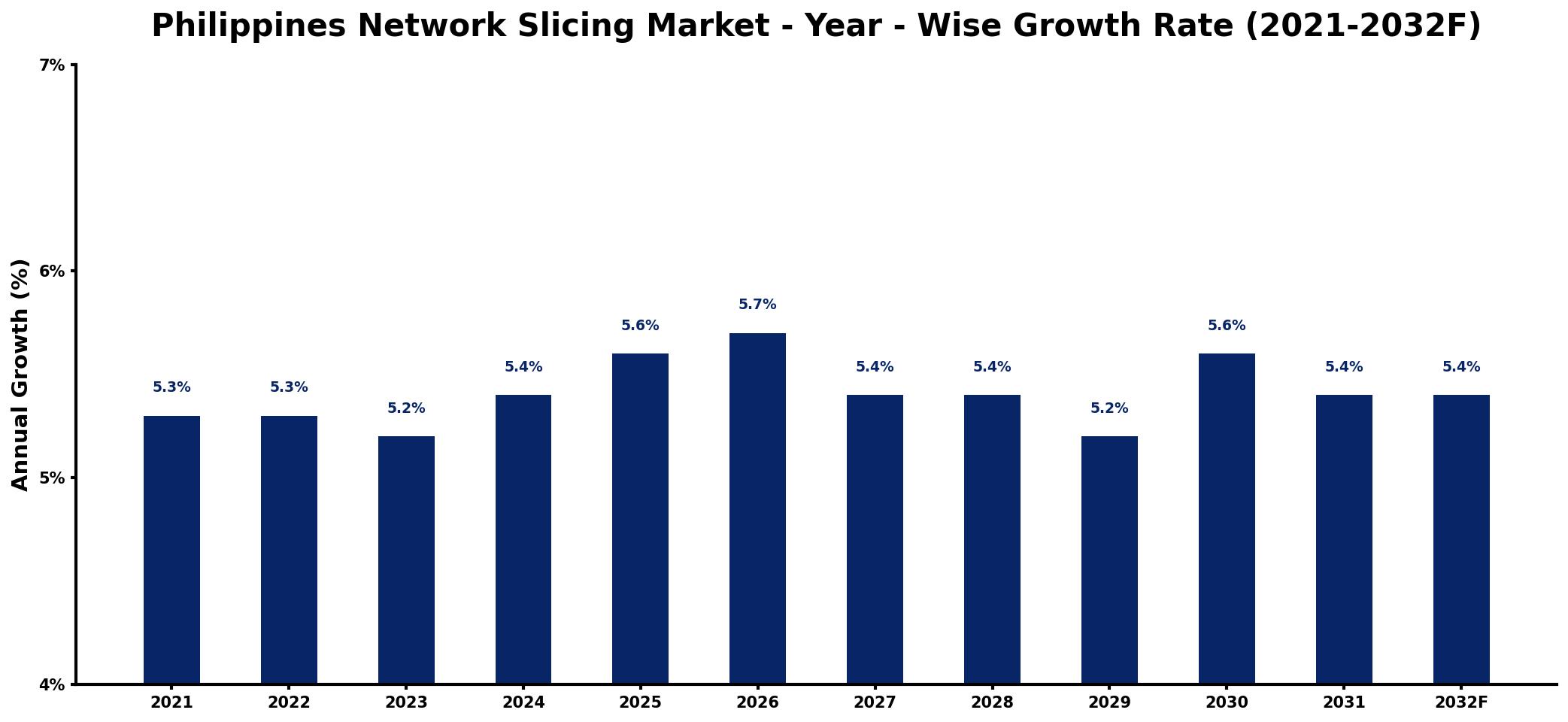
The table below presents the year‑wise growth rates along with the key drivers influencing the market
| Year | Growth Rate | Major Drivers |
| 2021 | 5.3% | rising demand from enterprises |
| 2022 | 5.3% | growth in digital transformation initiatives |
| 2023 | 5.2% | increased investment in technology |
| 2024 | 5.4% | expansion of 5G infrastructure |
| 2025 | 5.6% | greater focus on IoT applications |
| 2026 | 5.7% | surge in cloud services adoption |
| 2027 | 5.4% | enhanced customer experience requirements |
| 2028 | 5.4% | growing need for tailored solutions |
| 2029 | 5.2% | emphasis on cybersecurity enhancements |
| 2030 | 5.6% | demand for real time analytics |
| 2031 | 5.4% | investment in smart city projects |
| 2032 | 5.4% | growth of edge computing technologies |
Note: Market size estimations and growth projections presented in this report are based on 6Wresearch's proprietary forecasting methodology, utilizing the latest available industry data, government publications, and primary research inputs.
Philippines Network Slicing Market Synopsis
Currently, the strongest force shaping the Philippines Network Slicing Market is the urgent demand for advanced connectivity solutions that cater to unique user requirements. As businesses pivot towards digital transformation, the ability to allocate network resources flexibly and efficiently is becoming essential.
Furthermore, the pandemic has underscored the importance of reliable, dedicated network infrastructures. With various sectors relying more heavily on digital platforms, network slicing provides a vital solution to ensure high-quality service delivery amidst increasing demand for virtual communications and services.
Philippines Network Slicing Market Key Takeaways
- Rapid adoption of 5G technology is transforming network operations.
- Growing demand for customized network solutions drives market expansion.
- Dedicated virtual networks enhance service quality for critical applications.
- Telecom operators are focusing on resource optimization strategies.
- The pandemic has accelerated the need for reliable digital connectivity.
Evaluation of Restraints in Philippines Network Slicing Market
Despite the promising growth potential, the Philippines Network Slicing Market faces significant restraints, particularly concerning effective network resource management. The complexity of ensuring Quality of Service (QoS) guarantees across diverse applications poses a challenge for operators aiming to deliver consistent performance. Furthermore, the current infrastructure may struggle to accommodate the full capabilities of network slicing, limiting the realization of its benefits. As the market evolves, addressing these constraints will be crucial for maximizing growth opportunities.
Philippines Network Slicing Market Trends
One notable trend in the Philippines Network Slicing Market is the increasing collaboration between telecom operators and technology providers. This partnership aims to develop tailored solutions that can leverage network slicing effectively. Additionally, there is a growing emphasis on edge computing, which complements network slicing by enhancing latency and improving service delivery. As these trends mature, we can expect a more integrated approach to network management that prioritizes user experience and operational efficiency.
Philippines Network Slicing Market Opportunities
Genuine growth opportunities exist in sectors where specialized network solutions are crucial, such as healthcare, education, and smart city initiatives. The potential for leveraging network slicing to create dedicated virtual networks for telemedicine and remote learning highlights the versatility of this technology. Additionally, investments in IoT applications are expected to spur demand for customized connectivity solutions, positioning the Philippines Network Slicing Market for substantial growth.
Government Initiatives in the Philippines Network Slicing Market
The Philippine government has recognized the importance of digital infrastructure and has initiated several policies aimed at enhancing connectivity across the nation. Public spending on telecommunications infrastructure is being prioritized, and various programs are in place to support the rollout of 5G technology. These initiatives not only promote investment in network slicing but also facilitate the development of innovative services that benefit both consumers and businesses.
Future Insights of the Philippines Network Slicing Market
Looking ahead to 2026-2032, the Philippines Network Slicing Market is poised for dynamic transformation. As the adoption of 5G becomes more widespread, operators will increasingly leverage network slicing to meet the evolving demands of various industries. The integration of AI and machine learning technologies into network management practices will likely enhance resource allocation and improve service quality. Overall, the future landscape promises more agile, efficient, and user-centric network solutions.
Philippines Network Slicing Market Latest Developments (2025 - 2026)
In recent months, the Philippines Network Slicing Market has seen significant developments as telecom operators ramp up their efforts to implement 5G solutions. Increased collaboration between industry players has fostered innovation, with new pilot projects focusing on specialized applications emerging across various sectors. The emphasis on robust network performance and customer-centric solutions is becoming more pronounced, indicating a shift towards tailored services that meet the specific needs of businesses and consumers alike.
Philippines Network Slicing Market - Key Attractiveness of the Report
- 10 Years of Market Numbers
- Historical Data Starting from 2022 to 2025
- Base Year: 2025
- Forecast Data until 2032
- Key Performance Indicators Impacting the Market
- Major Upcoming Developments and Projects
Key Highlights of the Report:
- Philippines Network Slicing Market Outlook
- Market Size of Philippines Network Slicing Market, 2025
- Forecast of Philippines Network Slicing Market, 2032
- Historical Data and Forecast of Philippines Network Slicing Revenues & Volume for the Period 2022-2032F
- Philippines Network Slicing Market Trend Evolution
- Philippines Network Slicing Market Drivers and Challenges
- Philippines Network Slicing Price Trends
- Philippines Network Slicing Porter's Five Forces
- Philippines Network Slicing Industry Life Cycle
- Historical Data and Forecast of Philippines Network Slicing Market Revenues & Volume By Component for the Period 2022-2032F
- Historical Data and Forecast of Philippines Network Slicing Market Revenues & Volume By Solution for the Period 2022-2032F
- Historical Data and Forecast of Philippines Network Slicing Market Revenues & Volume By Services (Professional & Managed) for the Period 2022-2032F
- Historical Data and Forecast of Philippines Network Slicing Market Revenues & Volume By End User for the Period 2022-2032F
- Historical Data and Forecast of Philippines Network Slicing Market Revenues & Volume By Telecom Operators for the Period 2022-2032F
- Historical Data and Forecast of Philippines Network Slicing Market Revenues & Volume By Enterprises for the Period 2022-2032F
- Historical Data and Forecast of Philippines Network Slicing Market Revenues & Volume By Application for the Period 2022-2032F
- Historical Data and Forecast of Philippines Network Slicing Market Revenues & Volume By Manufacturing for the Period 2022-2032F
- Historical Data and Forecast of Philippines Network Slicing Market Revenues & Volume By Government for the Period 2022-2032F
- Historical Data and Forecast of Philippines Network Slicing Market Revenues & Volume By Automotive for the Period 2022-2032F
- Historical Data and Forecast of Philippines Network Slicing Market Revenues & Volume By Media and Entertainment for the Period 2022-2032F
- Philippines Network Slicing Import Export Trade Statistics
- Market Opportunity Assessment By Component
- Market Opportunity Assessment By End User
- Market Opportunity Assessment By Application
- Philippines Network Slicing Top Companies Market Share
- Philippines Network Slicing Competitive Benchmarking By Technical and Operational Parameters
- Philippines Network Slicing Company Profiles
- Philippines Network Slicing Key Strategic Recommendations






































